Eunidrip Irrigation Systems is an irrigation company in Kenya that designs, builds and services the water systems farms depend on. Greenhouses, drip lines, pumps, dams, boreholes and the pipework between them come from one team. As a result, one contract can carry a farm from bare land to a harvest that does not wait for rain.
We work with smallholders, agribusinesses, institutions and agricultural investors. Each group arrives with a different problem. A 1 acre vegetable grower needs a kit that pays for itself in a season. Meanwhile, a 200 acre estate needs zoning, pumping and scheduling that hold up under daily use. First, we look at your land, your crop and your budget. Then we build the system that fits them.
This page explains who we serve, what we build, how a project runs and what you receive at each stage. If you are weighing one company against another, start with the guide to irrigation in Kenya. It sets out the methods behind every service here.
Who We Work With as an Irrigation Company in Kenya
Four kinds of client come to us, and each buys a different part of the service.
- Small-scale farmers start with a drip kit sized to 1 or 2 acres. The aim is a crop that survives the dry season without a hired pump or a hose carried by hand.
- Agribusinesses contract whole-project buildouts, from the water source to the packhouse. For them, downtime costs more than equipment, so redundancy and spares count as much as output.
- Institutions such as schools, hospitals and churches need supply that is dependable and cheap to run. Their boards ask for a maintenance plan before they approve a design.
- Investors want a farm that produces on schedule. They read the yield test, the costed design and the commissioning report before they sign.
As an irrigation company in Kenya, we size the first system for the farm that exists. We do not design for the farm on a drawing. In practice, most clients start with one service and return for the next. A greenhouse grower later adds a dam. A borehole client later adds drip. That progression is how a farm becomes water-secure, one system at a time.
Greenhouse Construction
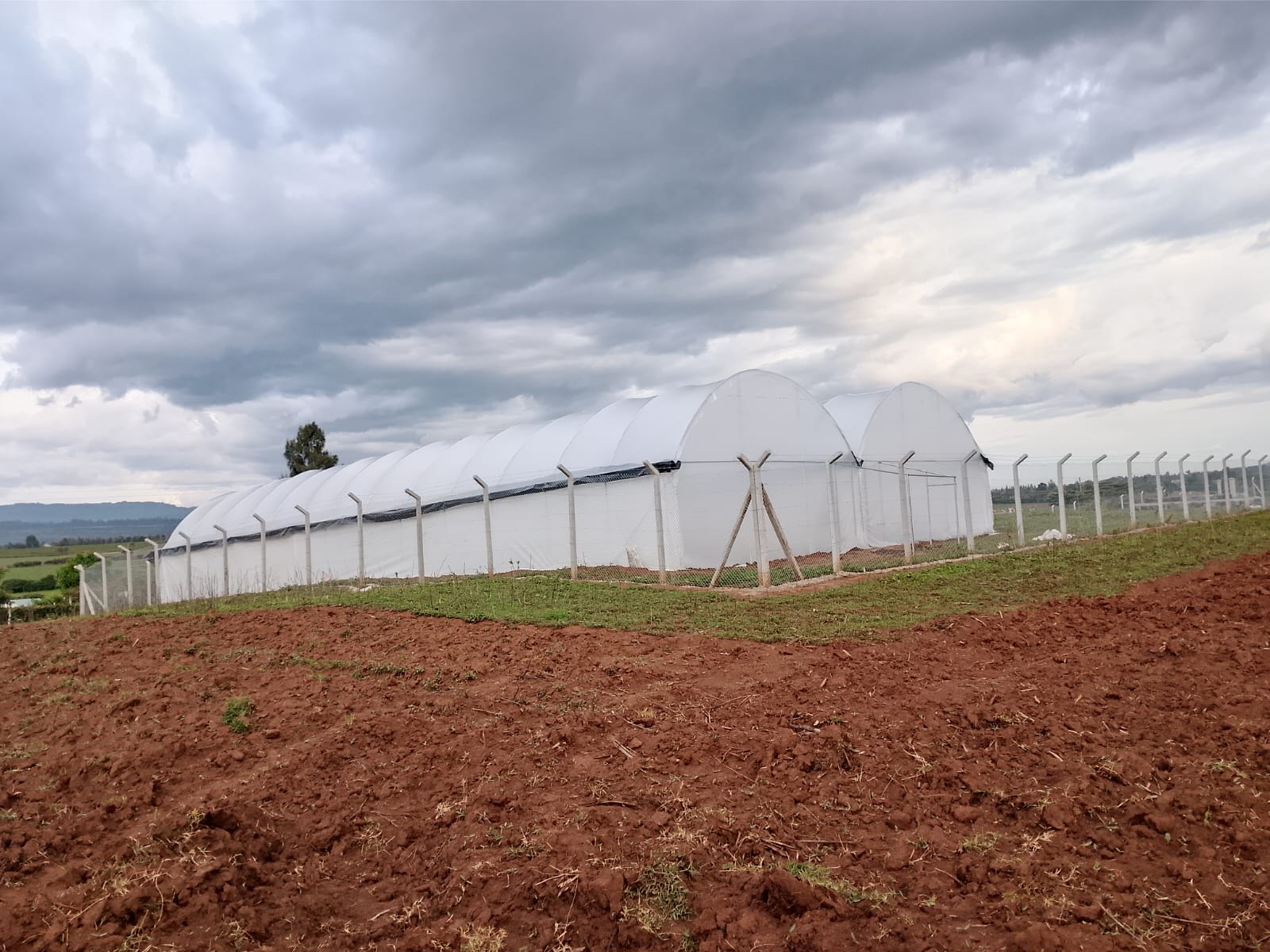
We design and build greenhouse structures that give vegetables, flowers and seedlings a controlled growing environment. The work covers timber and metallic frames, shade net houses and the insect netting that decides what reaches the crop. Start with the greenhouse construction service page and the range of greenhouse structures. Then compare the affordable greenhouse construction options and the cost of a greenhouse in Kenya. Both are worth reading before you commit to a size.
Every build begins with a site assessment. First, we check orientation, wind load, water access and soil. Then we match the covering, the insect net and the ventilation to the crop. Therefore the house protects the crop instead of fighting it.
Greenhouse work is where an irrigation company in Kenya earns its reputation. However, a structure is only as good as the water delivered inside it.
Irrigation System Installation
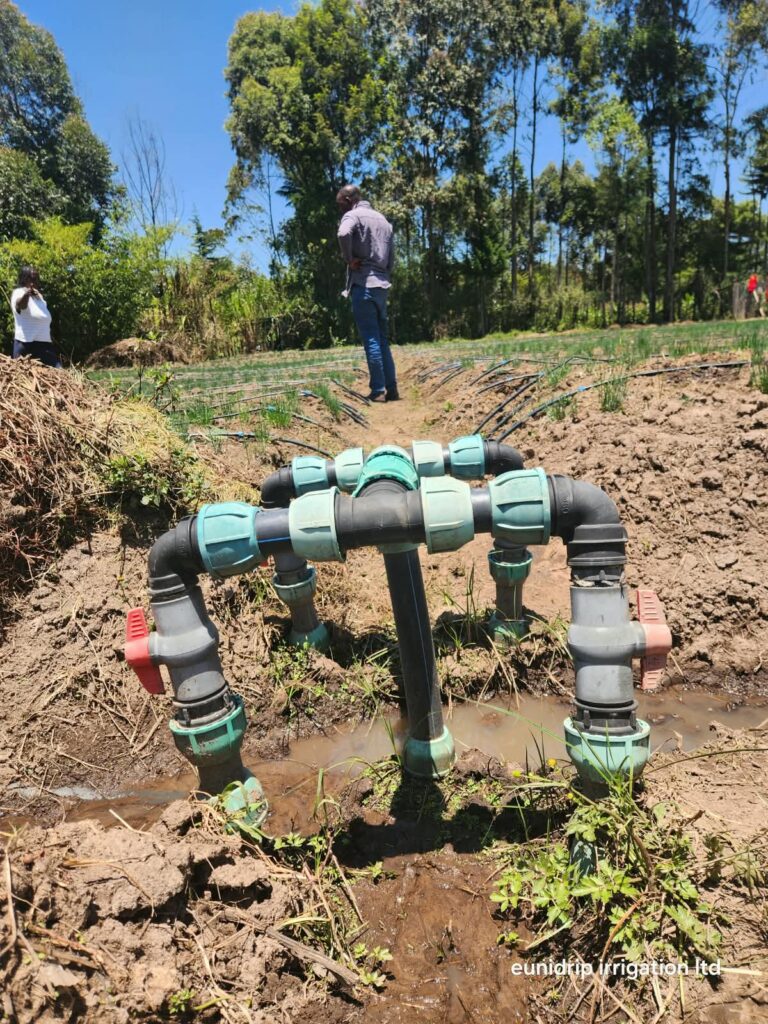
We supply and install irrigation systems sized to the farm and to the crop’s daily water demand. Consistent delivery beats maximum flow every time. A plant watered to the same depth each day roots deeper than one flooded twice a week. Specifically, a 1 ha block usually runs in 3 or 4 zones. Emitter spacing follows the soil: 20 cm on sand, 30 cm on heavier ground. Our drip irrigation installation work covers design, layout, filtration and commissioning. We also build sprinkler irrigation systems for row crops and pastures. For blocks far from the transformer, we install solar powered irrigation.
- Drip irrigation systems for vegetables, fruit and fodder
- Sprinkler irrigation systems for row crops and pasture
- Mainline and sub-main installation
- Irrigation automation and scheduling
- Pump selection for irrigation
- System upgrades and expansion
Dam Excavation and Water Harvesting
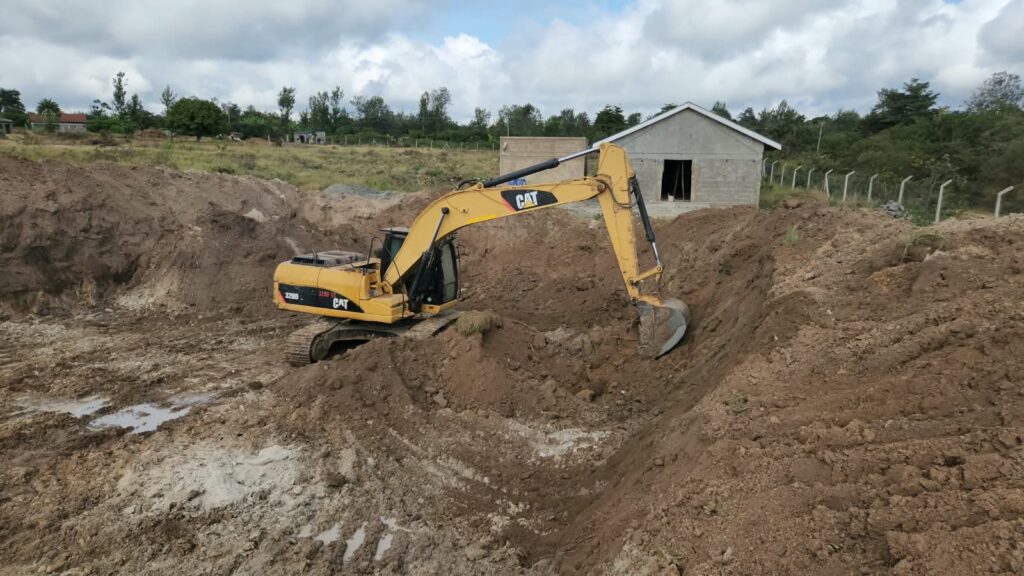
Water availability decides whether farming pays. For that reason we build storage on the farm, not only pipes. Our dam excavation service covers site assessment, sizing, earthworks and shaping. Next comes the lining, and the dam liners that keep a reservoir from draining into the subsoil.
- Farm dam and pond construction
- Irrigation reservoir development
- Water pans for livestock
- Dam expansion, rehabilitation and repair
- Rainwater harvesting setups
- Runoff and bund design
Before you dig, check the regulatory position for your river basin. Kenya’s Water Resources Authority sets the rules for reservoir construction and water abstraction. Accordingly, a short submission saves an expensive retrofit.
Borehole Drilling and Water Development
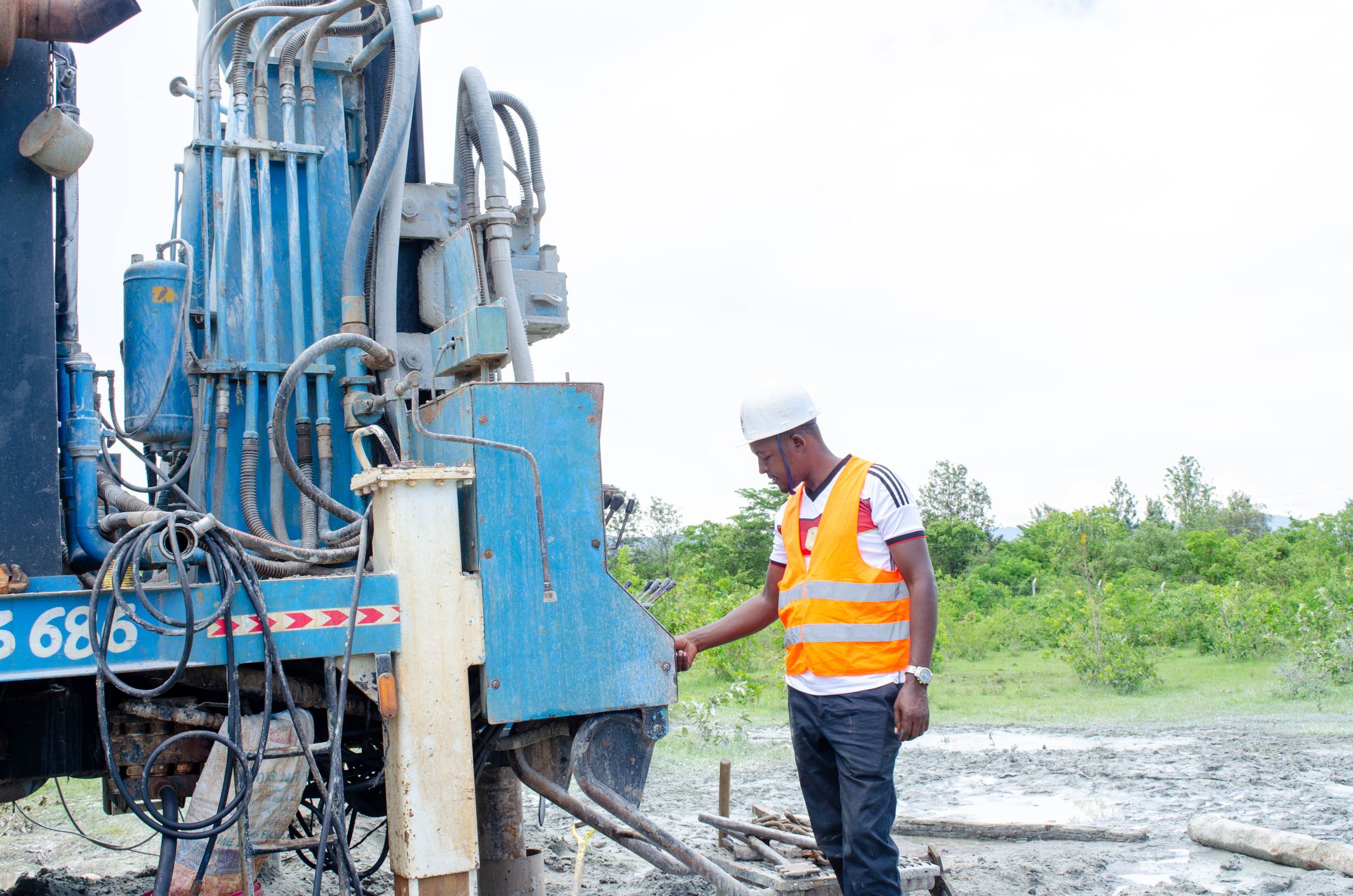
For a farm with no reliable river, a borehole is where an irrigation company in Kenya starts. Our borehole drilling in Kenya service begins with a hydrogeological survey. A badly sited hole costs twice: once for the drilling and again for the replacement. After that we case, develop, flush and test the yield. Then we hand over a pump and storage layout that matches it. The step-by-step borehole process sets realistic expectations on timing and cost.
- Hydrogeological survey and siting
- Rotor and hammer drilling
- Casing, sealing and development
- Yield testing and commissioning reports
- Solar and electric pumping
- Overhead tanks and farm water supply
Farm Water Management and Land Preparation
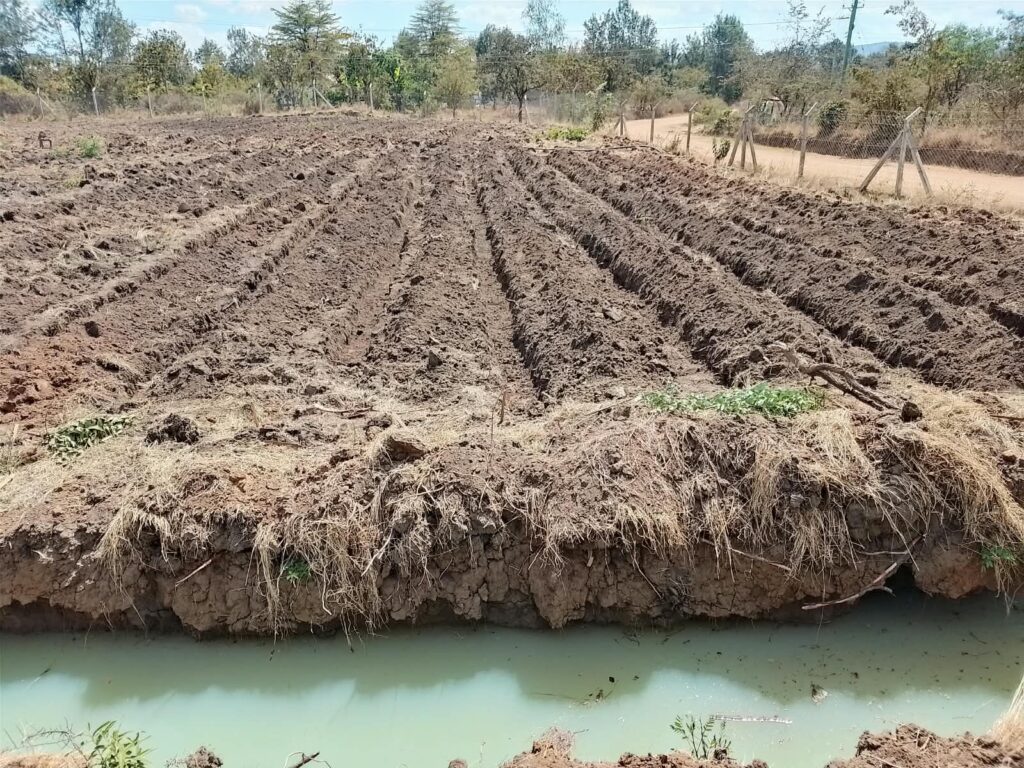
We design systems that improve how a farm collects, stores, distributes and uses water. Distribution layout matters as much as the source. Meanwhile, land preparation decides whether the installed system performs. For example, a lateral laid on an unlevelled slope feeds the top of the block more than the bottom. Our teams handle land preparation for drip irrigation, bed forming and layout marking. For wide acreage we hire out bed formers, and we advise on spacing for the crop you grow.
Farm Infrastructure and Advisory Services
A complete farm setup runs past water. It also needs a boundary that holds, tracks that carry a pickup through the wet, and a crop plan that matches the system you paid for. Three jobs, one sequence. When they are split across separate contractors, the order goes wrong and someone pays twice.
Farm Fence Installation
The purpose of the boundary decides the fence, so the job starts there and not with a rate per metre. A fence holding cattle, a fence keeping goats off a young orchard and a fence protecting a pump from theft are three different builds. Only the last one usually needs an electric charger, and a charger is only as good as its earth stake. It pushes a short pulse along the wire once a second, between 5 kV and 20 kV, and stock learn to keep off it.
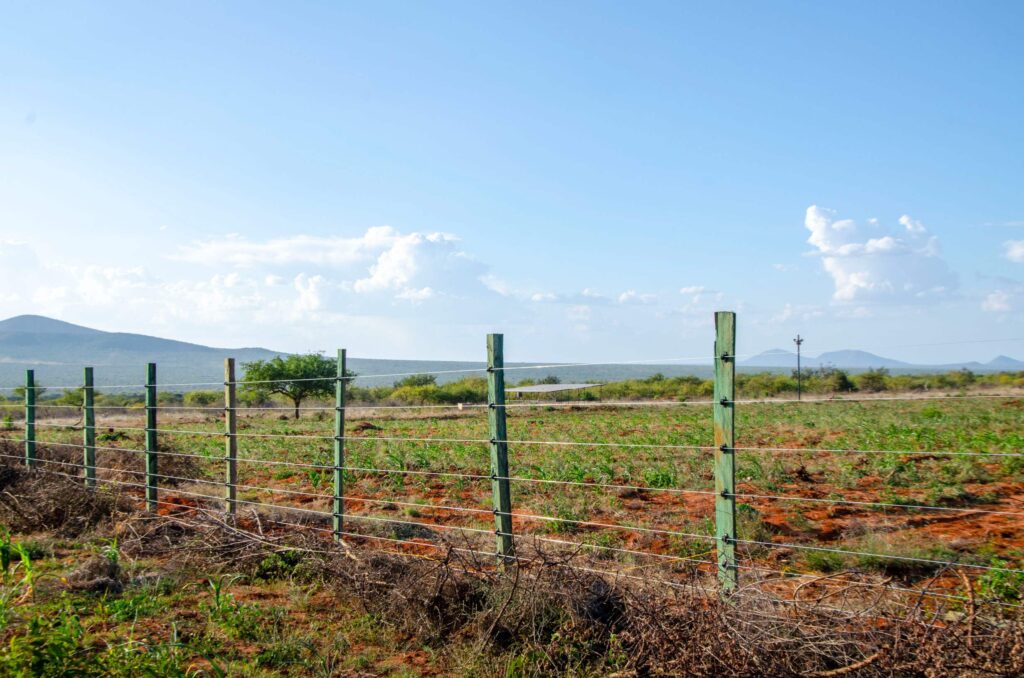
A wire fence is really a chain of bays. Each bay hangs between two posts built to carry the strain, while the posts in between only hold the strands at the right height. Corners and gates carry the load, which is where a cheap build fails first. Post depth, strand count and bay spacing then decide the material list, and that list is the honest way to compare two quotes.
For a 500 m boundary at four strands with three gate openings, the take-off lists the posts, wire, gate sets and brace timber you are actually paying for. Terrain and soil move the bill before labour does. A slope needs shorter bays, rock needs a different anchor, and soft ground needs more concrete per post.
We walk the line before quoting, because a price built from a map is a guess. The full specification, the wire types and the five failure points sit on the farm fence installation page.
Agronomy Services
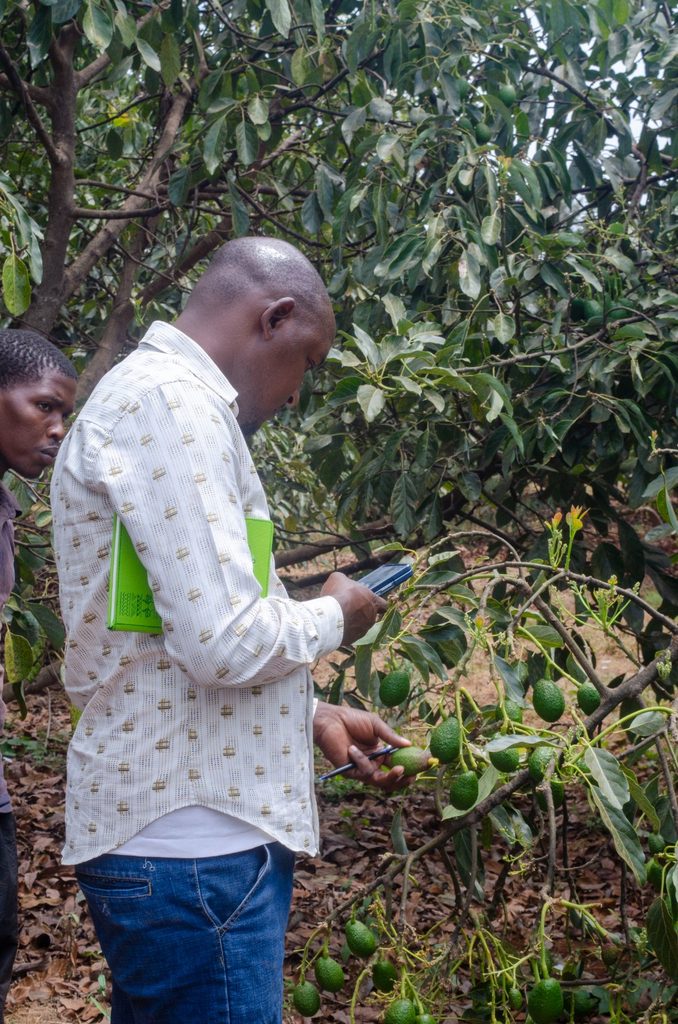
A fence protects the farm. Agronomy decides what the land earns behind it. The work starts from the ground you have, not from a crop you admired on the next farm over. A soil sample from 0 to 20 cm, a deeper one where the crop roots lower, and a water test give the first numbers. Iron, manganese and hardness matter as much as pH, because they decide whether your emitters stay open through the season.
From there the shortlist narrows twice. First the soil and water remove crops that cannot pay, then the market removes crops that will not sell. Each crop we keep gets a planting window tied to the long and short rains, a water depth per week by growth stage, and a fertigation plan. The schedule is converted into run hours per block, so an operator can follow it without doing arithmetic in the field.
That conversion needs the emitter figures, and the tape we install runs 16 mm or 12 mm at 1 to 2.5 litres an hour. Through the season we scout, adjust and record, and the review at the end starts the next calendar from evidence. The agronomy services page sets out all seven steps.
Both jobs come back to the same order of work. The crop choice fixes how much water each block needs. That figure fixes the size of the system. The boundary then goes up before the equipment arrives. One team can carry that sequence, which is cheaper than five contractors arriving in the wrong order..
What an Irrigation Company in Kenya Should Put in Writing
The table below shows the 6 stages we deliver and what you receive at each one. Not every farm needs every row, and a kit-only client may stop after the second. Consequently, you can see where a quote starts and where it ends.
| Stage | What we do | What you receive |
|---|---|---|
| Assessment | Site survey, water test, crop and budget review | Written recommendation |
| Design | Hydraulic layout, zoning, sizing, drawings | Costed design and bill of quantities |
| Water source | Borehole, dam, reservoir or abstraction setup | Tested supply with yield data |
| Installation | Pumping, filtration, mains, laterals, structure | Commissioned system |
| Training | Operation, scheduling, maintenance, spares | Handover documentation |
| Support | Upgrades, expansion, repairs, consumables | Ongoing service cover |
Ask any irrigation company in Kenya for the same breakdown before you pay a deposit. A quote that names only equipment leaves the design, commissioning and training to chance.
Choosing an irrigation company in Kenya is really a question about service after the sale. Pumps fail, emitters clog, and a season does not wait for a spare part to clear customs. Therefore the support row in that table matters more than the price list.
Our Mission, and Why We Started an Irrigation Company in Kenya
Our mission is to empower farmers through modern irrigation, water and greenhouse technologies that raise productivity and promote sustainable agriculture. Our vision is to become a leading agricultural solutions provider in Kenya through innovative, dependable and efficient farming technology.
Both statements are operational, not decorative. They decide which products we stock and which we refuse to sell. We started this irrigation company in Kenya to close one gap. A farm can have water and still lack a working system. Eunidrip Irrigation Systems does not install a system it cannot service afterwards. Any farmer who has waited weeks for an unsupported pump knows why that rule exists.
Why Farmers Choose Eunidrip Irrigation Systems
The reasons farmers give are practical. They apply to any irrigation company in Kenya they might be comparing.
- A professional, experienced installation team
- End-to-end project support, from survey to harvest
- Quality workmanship and reliable components
- Efficient execution against an agreed programme
- Sustainable approaches that conserve water and energy
- Customer-focused service and spare parts availability
The company received the Best Irrigation Technology Award. Every project reflects one commitment: helping farmers reach modern technology and dependable infrastructure that drives growth. We believe agriculture should be smarter, more efficient and built for the future.
Frequently Asked Questions About Our Irrigation Company in Kenya
What does Eunidrip Irrigation Systems do?
We design, supply and install greenhouses, drip and sprinkler irrigation, farm dams, reservoirs and boreholes. We also build farm infrastructure and advise on crop water planning.
Which regions do you cover?
Work runs across Kenya’s 47 counties and into East Africa. In addition, our teams mobilise drilling and earthmoving equipment to remote sites.
How much does a 1 acre drip irrigation system cost?
Cost depends on the water source, elevation, crop spacing and filtration. For a worked figure, see the cost of drip irrigation in Kenya and the one-acre drip kit breakdown.
Do I need a licence to dig a farm dam?
It depends on your basin, dam size and water source. We assess the requirement during site planning, before any machine arrives on your land.
Can you upgrade an existing irrigation system?
Yes. We audit the installed layout, then add pumping, filtration, automation or zoning. Upgrades usually cost less than a new installation.
How do I start a project?
Send your location, acreage and intended crop. Then we prepare a design and a costed quotation.
Talk to an Irrigation Company in Kenya That Answers the Phone
Call +254 724 775516 or +254 728 163329, or write to info@eunidripirrigationsystems.com. For equipment and kits, use the Eunidrip online shop. Alternatively, send your location, acreage and crop, and we will schedule a site assessment.
You may still be deciding whether to start with water, a structure or a reservoir. An irrigation company in Kenya that builds all three can sequence the work for you. Finally, one call sets the order of work, so you do not begin with a system that the next step will replace.