Table of Contents
Drip irrigation systems in Kenya are not one product but a family of them. The type you pick decides whether the layout suits your crop, your water source and your slope. An onion grower on flat land near a tank needs a different setup from an avocado grower on a hillside with a pump. This page sorts the five common types of drip irrigation systems in Kenya. It shows what each one is built for. Then it points you to the page that answers the next question once the type is settled.
Most confusion starts because sellers use one phrase for several different kits. Therefore it helps to separate the three choices behind every system before you compare prices. Once those choices are clear, the five types stop looking like competing products. They become combinations of the same three decisions.
What drip irrigation systems in Kenya actually are
A drip system delivers water slowly to the root zone of each plant. Specifically, emitters spaced along a pipe do the work. Because water lands only where the crop grows, the soil between rows stays dry. As a result, weeds get little help. Typically, the method suits row crops, orchards, greenhouses and kitchen gardens. However, the hardware that carries the water changes with the farm. That hardware is what separates one type from another. The basic principle is summarised in the public overview of drip irrigation.
If you want the full case for why growers switch, read our page on the advantage of drip irrigation system. It covers water saved, fertiliser efficiency and plant health. This page assumes you have already decided on drip. Now you need to choose the type.
The three choices behind every drip system
Every drip layout is built from three decisions. In practice, each decision has two common answers. First, the emitter carrier: thin-wall drip tape for seasonal rows, or thick-wall drip line for permanent plantings. Second, the pressure source: gravity from a raised tank, or a pump that pushes water through the lines. Third, the placement: surface lines on the soil, or subsurface lines buried beneath it.
Mix one answer from each column and you have a working system. For example, a gravity-fed surface tape layout is a common smallholder kit. A pump-driven surface line layout suits a commercial orchard. The five types below are the combinations farmers actually buy. They are named the way the market names them.
| Choice | Option A | Option B | What decides it |
|---|---|---|---|
| Emitter carrier | Drip tape (thin wall) | Drip line (thick wall) | Seasonal row crop vs permanent trees |
| Pressure source | Gravity (raised tank) | Pump | Plot size, head and water source |
| Placement | Surface | Subsurface (buried) | Tillage, crop type and maintenance access |
Drip tape systems for seasonal row crops
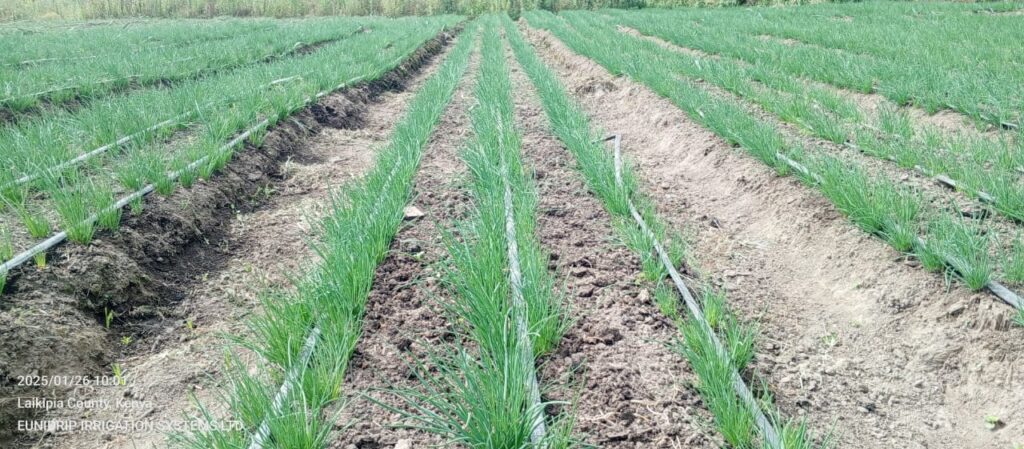
Drip tape is a thin, flat pipe. It opens into a tube under pressure, with emitters pre-cut at fixed spacing. It is light and cheap per metre, and fast to lay. Moreover, it dominates vegetables, onions and tomatoes. These are row crops replanted each season. Because the wall is thin, tape is treated as a consumable. Typically, it is rolled out at planting and often replaced after a few seasons.
Tape suits flat or gently sloping ground and short runs. However, on a long run the far end gets less water, so the layout is split into zones. Also, tape clogs easily on dirty water. Filtration is not optional. Our drip irrigation kit page lists the tape sizes and what a full acre kit contains.
Drip line and inline systems for permanent plantings
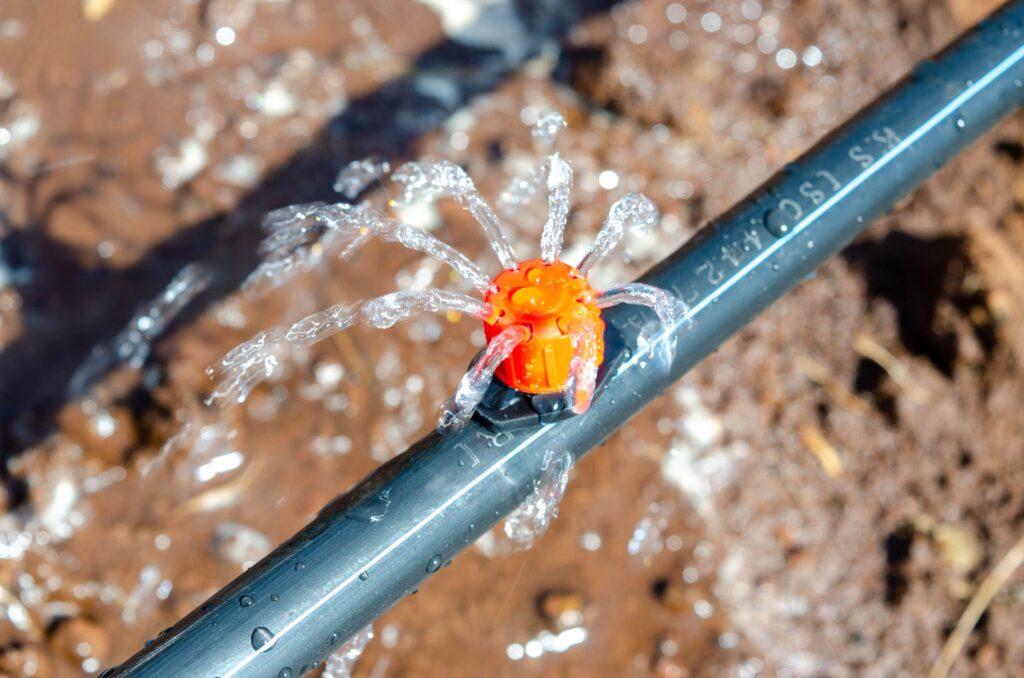
Drip line is a thick-wall pipe with emitters built into the wall. In addition, it is made to last many seasons in one place. It shrugs off handling, sun and occasional damage far better than tape. Therefore orchards, coffee and avocado use it. Inline emitters are moulded inside the pipe at set spacing. Point-source buttons can be punched in wherever a single tree sits.
Because trees are spaced widely, a line often carries one or two button drippers per plant. That keeps water on the root ball and off the bare ground between trees. However, the thicker pipe and the fittings cost more upfront than tape. The emitter options are set out on the best drip irrigation system design page.
Gravity-fed drip irrigation systems in Kenya
A gravity-fed system runs on head pressure alone. Specifically, there is no pump and no fuel. Water sits in a tank raised above the plot, and the height difference pushes it through the lines. These drip irrigation systems in Kenya suit small plots near a tank, a spring or a roof catchment. The flow is modest and the budget cannot carry a pump.
The trade-off is pressure. Gravity gives low head, so emitters must be the low-pressure type. Also, runs must stay short and level. A metre of tank height is roughly a tenth of a bar. Thus a tank two metres up delivers only about 0.2 bar. Therefore the layout is zoned tightly and the filter is sized for low pressure. For a plot that outgrows gravity, the next step is a pump.
Pump-driven drip irrigation systems in Kenya
A pump-driven system pressurises the water. As a result, it can travel longer runs, climb gentle slopes and feed more zones at once. Commercial farms use pump-driven drip irrigation systems in Kenya because the emitter flow stays uniform from the first plant to the last. The pump can be electric, diesel or solar. It depends on what power the site has.
With pressure comes responsibility. The pump must match the total flow and head of the layout. In addition, a pressure regulator protects the emitters from surges. Oversizing wastes fuel. Undersizing starves the far end. Our pump for drip irrigation page walks through sizing. The solar irrigation page covers the off-grid option.
Subsurface drip irrigation systems in Kenya
Subsurface drip irrigation (SDI) buries the laterals below the soil surface. Water reaches the roots with almost no evaporation. Meanwhile, the surface stays dry for traffic and weeding. Among drip irrigation systems in Kenya it is the most water-thrifty. It suits permanent crops, pasture and places where surface lines would be damaged by machinery or animals.
The cost is complexity. Buried emitters are hard to inspect, so the water must be filtered finely. Therefore the system is flushed on a schedule to stop roots and soil entering the lines. Installation also needs care at planting depth. For most smallholders a surface layout is easier to live with. SDI earns its place where water is scarce and the crop stays put for years.
Matching the type to your crop, soil and slope
The right type follows from the farm, not from the catalogue. Row crops on flat ground take tape. Permanent trees take line. A tank above a small plot takes gravity. A large or sloping plot takes a pump. Heavy clay soil wets slowly, so emitters there run at a lower rate to avoid runoff. Sandy soil wets narrowly and needs closer emitter spacing.
Slope changes the pressure along the line. So a hillside layout uses pressure-compensating emitters. Where possible the lines run along the contour. Windy sites favour drip over sprinklers because the water never leaves the pipe. Before any line goes down, the ground must be ready. Our land preparation for drip irrigation page covers levelling, beds and trenching.
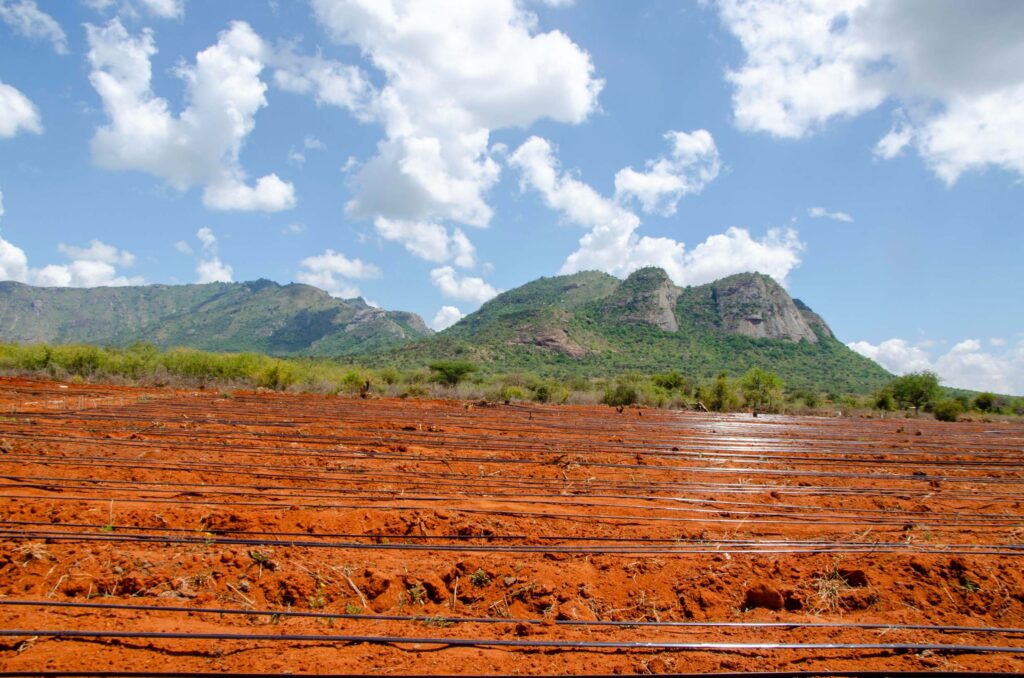
Which drip irrigation systems in Kenya fit which farm
The table below maps a typical farm to the type that suits it. Treat it as a starting point. Then confirm the emitter rate, the filtration and the pipe sizes against your own water and crop. Two farms with the same acreage can need different types. Their water source and slope differ.
| Farm situation | Suggested type | Why |
|---|---|---|
| Vegetables, flat, replanted each season | Surface drip tape | Cheap per metre, fast to lay and replace |
| Avocado or coffee orchard, permanent | Surface drip line, button drippers | Durable pipe, water on each root ball |
| Small plot below a raised tank | Gravity-fed tape or line | No pump or fuel, low-pressure emitters |
| Large or sloping plot, pump available | Pump-driven line, pressure-compensating | Uniform flow over long runs and slope |
| Scarce water, permanent crop, machinery | Subsurface drip (SDI) | Least evaporation, dry surface for traffic |
Once the type is chosen, the price follows from the components and the acreage. Our cost of drip irrigation system in Kenya page breaks down what each part costs. So you can budget the type you have picked rather than a generic figure.
Where each next question is answered
This page sits inside a cluster, and each neighbour owns one job. So you do not read the same advice twice. For the methods beyond drip, start at the irrigation in Kenya hub. It compares drip with sprinkler, surface and soilless systems. For the parts and the wetting patterns, read the shop’s drip irrigation system design page. It lists the components and how emitters wet the soil.
In short, use this page to pick the type. Use the design page to size it, the kit page to buy it, and the cost page to budget it. That order keeps each decision with the page that handles it best. It is the same order our team follows when we quote a farm.
Frequently asked questions
What is the most common drip system for a small farm in Kenya?
A gravity-fed surface tape kit is the most common starting point. It needs no pump and the tape is cheap per metre. It suits a small, level plot near a tank. As the plot grows or the slope increases, growers move to a pump-driven line layout.
Can I use drip tape on a sloping plot?
Only on gentle slopes and short runs, ideally with pressure-compensating emitters. On steeper ground the pressure varies too much along a thin tape line. So a pump-driven drip line with compensation is the safer type.
Is subsurface drip worth the extra cost?
It is worth it where water is scarce and the crop stays in the ground for years. It cuts evaporation and keeps the surface dry. For a seasonal vegetable plot the extra effort rarely pays back. So surface tape is usually the better choice.
Do all drip irrigation systems in Kenya need a filter?
Yes. Every emitter has a small passage that blocks on sand, silt or algae. So a filter sized to the flow and the emitter type is part of every system, gravity or pump. Skipping the filter is the fastest way to ruin a layout.
How do I know which type my farm needs?
Start from the crop (row or permanent), the water source (tank or pump) and the slope (level or hillside). Those three answers point to one of the five types in the table above. Then confirm the emitter rate and pipe sizes on the design page before you buy.