

Table of Contents
An irrigation reservoir turns a short rainy season into a working water supply for the rest of the year. Most Kenyan farms lose rainwater within days of a storm because there is nothing on the ground to hold it. Irrigation reservoir construction companies solve that problem with a basin. In practice it catches runoff, stores it and releases it to the pump when the crop needs it. This guide walks through the seven stages of a farm reservoir project. Each stage below lists what to check before you sign a contract.
Storage is not only an engineering job. A reservoir of the wrong size or on the wrong soil will fail in its first heavy season. So will one built without a spillway. Therefore the useful work happens before the first bucket of soil is moved.
What irrigation reservoir construction companies actually do in Kenya
A reservoir contractor should cover six things. They are siting, design, earthworks, seepage control, the inlet and outlet, and commissioning. However, some firms sell one part of that list. For example, a liner supplier installs the membrane but does not design the spillway. When you compare irrigation reservoir construction companies, confirm which scope each one owns in writing.
Two related jobs sit outside this page. The earthworks are covered in the guide to dam excavation. The membrane price is covered in the guide to dam liner prices in Kenya. Instead, this page covers the whole build and how to choose the firm that runs it.
Step 1: Survey the site and size the reservoir
Sizing starts with demand, not with the size of the hole. Work out the daily water need of the crop. Next, multiply it by the days you will run without rain. Then add an allowance for evaporation and seepage. That demand figure is the first number any irrigation reservoir construction company should ask you for.
Take a one-acre vegetable block on 25 cubic metres a day. For example, through an 80-day dry spell it needs 2,000 cubic metres of stored water. Next, convert that volume into a basin. A reservoir 40 metres long, 30 metres wide and 2 metres deep holds 2,400 cubic metres. Specifically, that figure is measured at the top of its storage range.
In practice you never draw the full depth. Therefore design the basin about 20 percent larger than the figure you calculated. The survey should record the catchment that feeds the basin. It should also log the soil profile to the proposed bed and mark the high water line. Ask the firm for that survey note. A quote without a survey is a guess.
Step 2: Design the basin, embankment and spillway
The design drawing fixes four numbers. They are top water level, embankment height, side slopes and spillway width. Earth embankments usually carry side slopes between 2:1 and 3:1 horizontal to vertical. That way heavy soil does not slump into the basin. Freeboard of at least half a metre above top water level keeps wind waves inside.
The spillway is the part most often undersized. It must pass the largest storm the catchment can deliver without overtopping the embankment. Moreover, it needs a lined or grassed channel that carries that flow away from the structure. Ask the designer for the storm figure used, in millimetres and in cubic metres per second.
Water storage at this scale also needs approval. The Water Resources Authority issues water use permits under the Water Act. A project may also need an environmental licence from NEMA. Confirm in writing who files those applications.
Step 3: Clear, strip and excavate the basin
Topsoil is stripped first and stockpiled. It goes back on the embankment face at the end. The basin is then excavated to the design profile, with the spoil placed where it cannot wash back in. On sites with a high water table, the crew needs a dewatering plan before the dig reaches the seepage line.
Excavation is usually the largest single cost line, and it is driven by the volume of material moved. Therefore ask for cut and fill volumes in cubic metres, not a lump sum. The specialist guide to dam excavation explains the equipment and haul options in detail.
Step 4: Compact the subgrade and install the liner
A liner performs only as well as the ground under it. The subgrade is compacted and trimmed smooth, and any rock or root is removed before the sheet goes down. Sharp stones under a membrane cause pinholes that leak slowly and are hard to find later.
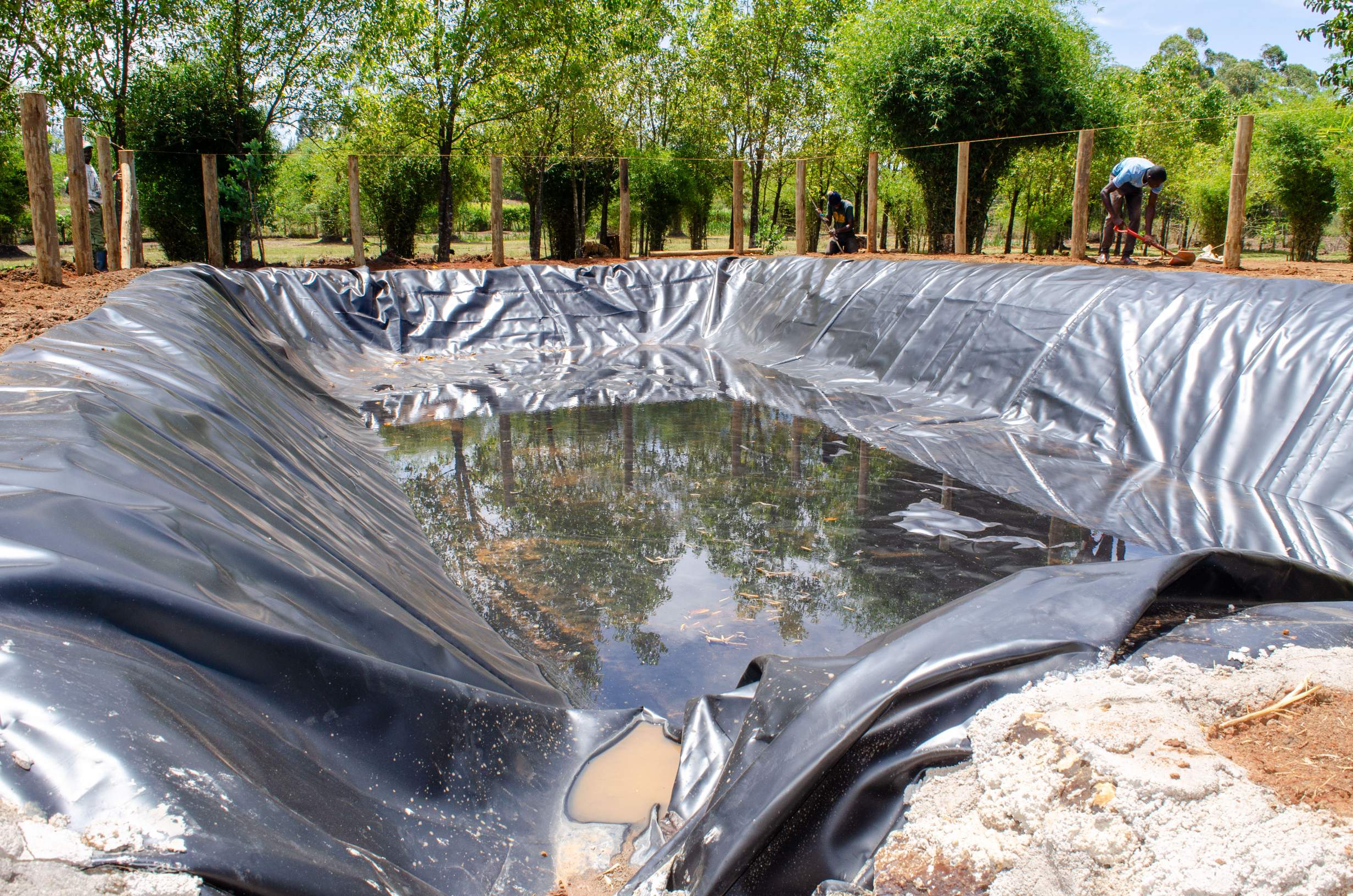
Sheet thickness, welding and testing are covered in full on the dam liner prices in Kenya page. It also lists the current rate per square metre by thickness, and most farm basins use sheet from 0.5 mm upward. What matters here is the sequence. Anchor trench first, sheet layout second, welding third, then an air test on every seam before backfilling.
Three details decide whether the membrane survives. An anchor trench around the full perimeter, 300 mm deep and backfilled over the sheet edge. Seams tested and numbered on a drawing, so a leak can be traced without stripping the whole basin. Every outlet penetration sealed with a fitted boot, never a cut slit wrapped in tape.
Step 5: Build the inlet, outlet and draw-off
Water enters the basin through a silt trap. Sand then settles before it reaches the storage. A silt trap that is easy to clean will save years of desilting.
On the outlet side, the draw-off should sit above the bed, not on it. A floating intake or a raised sump pulls cleaner water and keeps grit out of the pump. Fit a valve at the lowest point for draining. Add a level gauge so the operator can see how much water is left.
Step 6: Fill, test and commission the reservoir
Commissioning is a measurement, not a handover ceremony. Fill the basin to a marked level, leave it for a set period and measure the drop. A fall beyond the evaporation and seepage allowance means a leak. The numbered seam record then tells the crew where to look.
At the same time, run the pump through its full duty cycle. Check the flow at the far end of the line. Record the level, the running hours and the flow rate on paper. These become the baseline for every later maintenance decision.
Step 7: Maintain the reservoir between seasons
A reservoir is a structure, and it needs a routine. Fence the basin so livestock cannot break the embankment. Keep the spillway clear of brush and silt. Check the liner at the water line after each season. That is where sun and wave action do their damage.
Desilting is the other recurring job. A silt trap cleaned twice a year costs far less than removing sediment from a full basin. Finally, keep a written log of levels and repairs so the next inspection has something to compare against. A maintenance visit belongs inside irrigation reservoir construction, not outside it.
How irrigation reservoir construction is priced in Kenya
Quotes vary because four inputs vary. The four are earth volume, liner area, haul distance for spoil, and rock in the profile. A site with soft soil beside the basin is cheaper than a rocky site with a long haul. Irrigation reservoir construction in rock is a different quote from the same job in clay.
Ask for a bill of quantities that separates excavation, compaction, liner supply, liner installation, pipework and spillway. A single lump sum hides the item that is usually the real driver. The dam liner prices page gives KSh 170 to KSh 650 per square metre depending on thickness. For the membrane line, that turns the item into simple arithmetic: area times rate. A 1,000 square metre basin at KSh 170 per square metre uses KSh 170,000 of membrane at the thin end.
Payment terms matter as much as the total. A staged schedule tied to milestones keeps the project moving. Set payments for completed excavation, completed lining and a passed fill test. Hold a retention until the fill test passes.
Comparing irrigation reservoir construction companies
Price is the last thing to compare. Six checks separate a build from a problem.
| Check | What good looks like | Red flag |
|---|---|---|
| Scope | Design, earthworks, lining and commissioning under one contract | The firm supplies material only |
| Designer | A named engineer signs the drawings | No drawings, only a sketch |
| Approvals | Water use permit and environmental licence handled in writing | Approvals left to the client at the end |
| Evidence | Two finished basins you can visit, one over two seasons old | Photos with no site address |
| Costing | Bill of quantities in cubic metres and square metres | One lump sum with no breakdown |
| Handover | Fill test and pump test before final payment | Payment on the day the crew leaves |
Before you sign, ask who answers the phone after commissioning. A company that maintains what it builds will design for maintenance from the start. Conversely, a firm that disappears after the last invoice has no reason to fit a serviceable silt trap.
Why farmers choose professional irrigation reservoir construction
The case for a professional build is simple. A poorly built basin leaks, silts or overtops. The repair usually costs more than the gap between the original quotes. In addition, an undersized spillway puts people and property downstream at risk.
Good irrigation reservoir construction also unlocks the rest of the irrigation plan. A reliable reservoir lets a drip system run on schedule. It also lets a pump be sized for a steady duty instead of a variable one. As a result, a greenhouse crop can be planned across the dry months rather than stopped by them. The reservoir sits at the head of the system, and everything downstream depends on it.
Where the reservoir draws from a river or an aquifer, the source itself needs checking first. A groundwater hydrogeological survey establishes what a borehole can yield before a pump and basin are sized around it. Upstream surface work is covered by the borehole drilling process and the ponds and dam construction service.
Mistakes that shorten an irrigation reservoir
Most failures trace back to six decisions. Each one is cheap to fix at design stage.
- Sizing from average rainfall instead of from crop demand over the longest dry spell.
- A spillway narrower than the design storm the catchment can deliver.
- Lining laid on loose, uncompacted soil with rock left in the bed.
- No silt trap at the inlet, so the basin fills from the bottom up.
- Cutting the membrane for an outlet instead of sealing a fitted boot.
- Leaving the basin unfenced, so livestock break the embankment face.
Frequently asked questions about irrigation reservoir construction
How long does an irrigation reservoir take to build? A farm basin of a few thousand cubic metres usually takes a few weeks. That clock starts once the design and approvals are done. Larger community structures run into months, and ground conditions decide most of the difference.
What does irrigation reservoir construction cost in Kenya? There is no single rate per cubic metre. Earth volume, liner area, haul distance and rock content all move the figure. Ask for a bill of quantities and compare line by line. The liner line alone runs from KSh 170 to KSh 650 per square metre by thickness.
Do I need a permit to store water on my farm? Water use and storage are regulated under the Water Act. The Water Resources Authority issues the permits. Larger schemes may also require an environmental licence from NEMA. Confirm the requirement for your site before excavation starts.
How large a reservoir does one acre need? Size it from demand. Multiply the daily need by the dry-spell length, add a loss allowance, then add about 20 percent for draw-down depth. An acre needing 25 cubic metres a day for 80 days points to roughly 2,000 cubic metres before the allowance.
Can a leaking reservoir be repaired? Usually yes. A failed seam can be found and patched, and a boot that was sealed badly can be redone. If the subgrade itself has failed, the affected section is relined. That is why the ground preparation in Step 4 matters so much.
What else should I read before appointing a contractor? Read the dam liner prices page if the membrane is your main unknown. Read the dam excavation guide if earthworks are. Both carry the line-item detail this overview leaves out.
For a reservoir quote, call Eunidrip Irrigation Systems on +254 728 163329. Have the site location, the crop and the dry spell ready.