

Table of Contents
This page records one greenhouse construction in Nakuru project from the ground up. The client was the County Government of Nakuru. The site is Muguga Dispensary. The structure is a standard 8 m x 30 m house. Eunidrip Irrigation Systems designed and installed the automated drip irrigation inside it, under a separate contract. Every photograph below came off that site, and the build sequence follows what the crew actually did.
Most buyers search for a price before they have seen a finished build. So this page works in the other order. It shows what a public-sector house in Nakuru contains, and where our own scope sat inside it. For the method behind all of it, our greenhouse construction in Kenya hub carries the process pages.
What the County Government of Nakuru commissioned
The client here is a county, not a private farmer, and that single fact changes the whole brief. A private grower buys a house to sell produce. A county buys a house to teach people how to sell produce. The training aim comes first, and the crop comes second.
Muguga Dispensary was chosen because it is already a place people visit on ordinary days. Trainees arrive for clinic business and see the greenhouse on the way in. That is a quieter form of outreach than a hall meeting, and it keeps the site in use between sessions. Consequently the county’s own portal explains how its agricultural programmes are organised, and a supplier should read it before quoting.
Why the site sits inside a dispensary compound
Dispensary grounds are small, and they are never empty. The build had to fit beside a working clinic without blocking patients, an ambulance bay, or the perimeter fence. You can read that constraint straight off the photographs of this greenhouse construction in Nakuru site. A blue and white fence runs a few metres from the arches, and the crew works the 240 square metres of house on the grass strip between fence and building.
The compound also decided what the house could not be. There was no room for a wide machinery yard, so the sheet had to be unwound on the lawn. There was no room for a deep sump, so water is stored above ground in a tank. Small public sites are designed around what is already standing. For that reason greenhouse construction in Nakuru inside a working compound is paced by the clinic, not by the crew.
Greenhouse construction in Nakuru begins with the ground
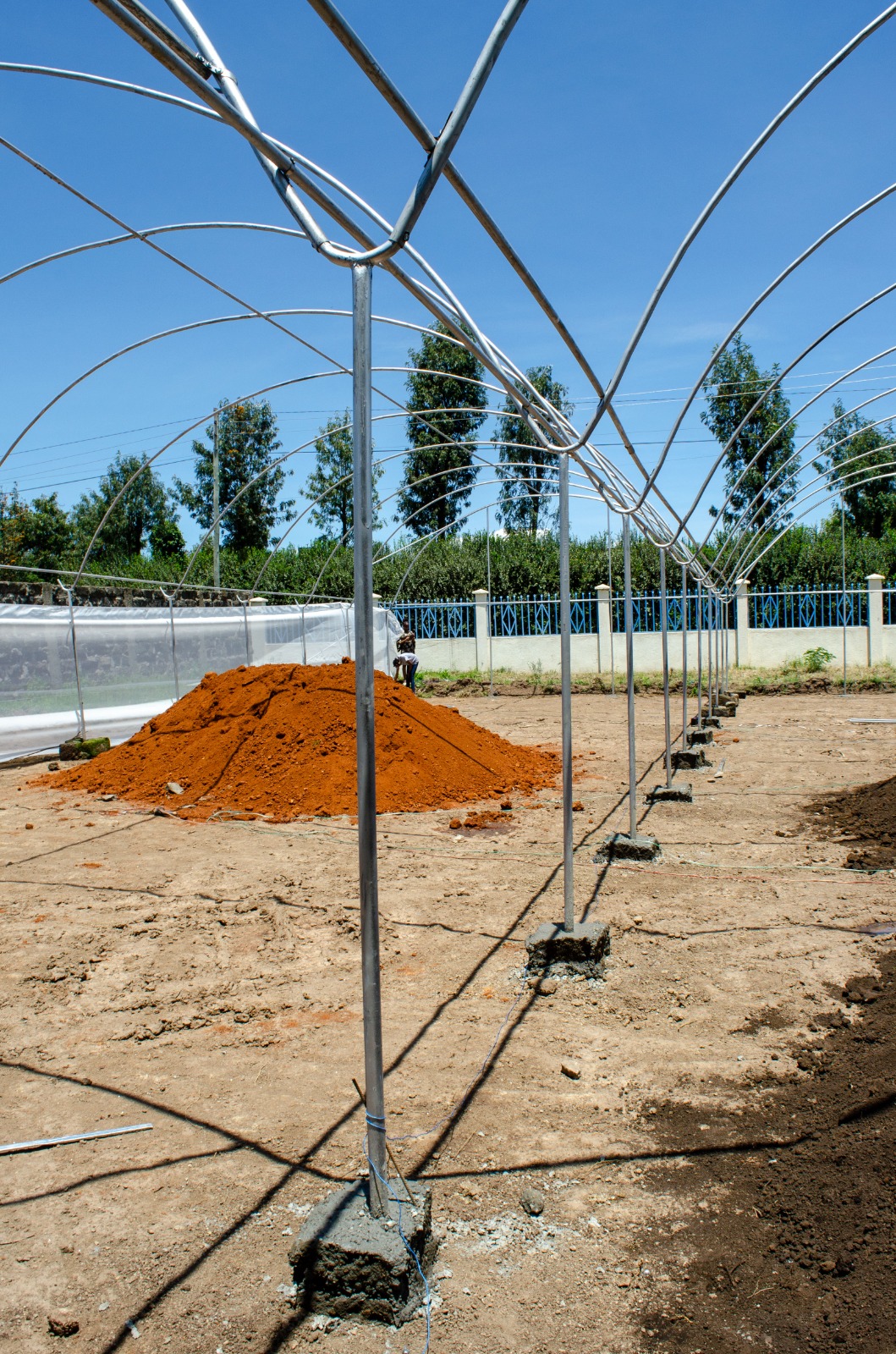
Before any steel arrives, the ground is set out and levelled. Then the footings. Each post of the frame lands on its own concrete pad, cast in place on site. The interior photograph shows this clearly: a row of square pads, one under each post, with red soil still piled where the digging happened.
Pads were chosen instead of a continuous slab for two reasons. First, a house on pads can be lifted and moved later without demolition. Second, a soft patch under one post does not twist the whole ridge. A slab would be cheaper to argue about and worse to live with on a site like this one.
The frame, the covering and the vents
The frame is galvanised steel. Arches are bent to a fixed radius, then bolted to the posts, and the whole skeleton stands before any film touches it. Covering is UV-treated polythene. Side curtains roll up along a bottom rail, with insect net behind them.
That vent arrangement does two jobs at once, and it is the part most buyers under-specify. Roll-up curtains let the operator change the house through the day instead of committing to one fixed opening. Insect net behind them stops whitefly and leaf miner entering through the gap that the heat needs.
Covering a house is a crew job, not a machine job
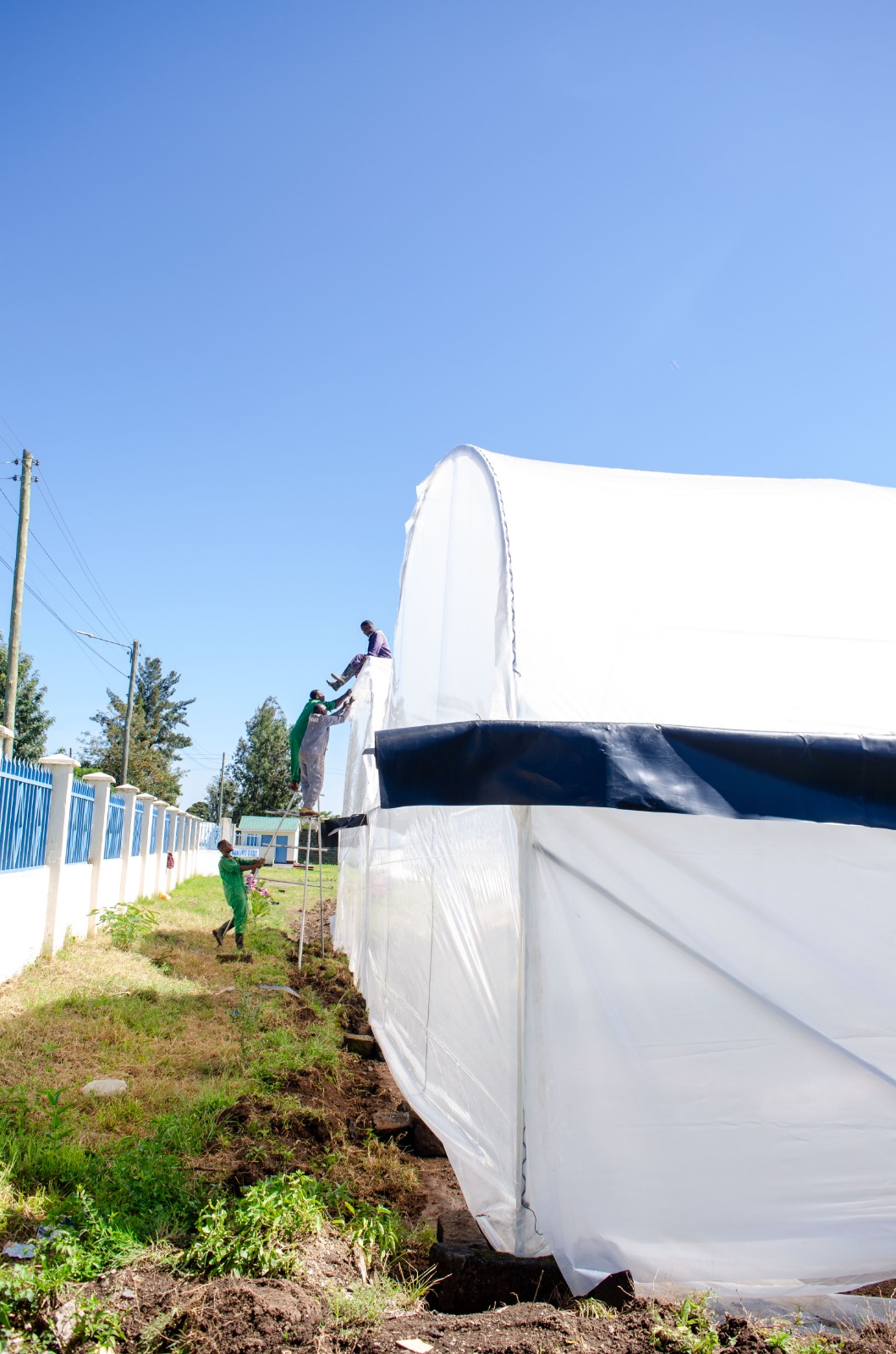
The sheet is dragged out and unwound on the grass first, so it is cut to the right length before anyone lifts it. Then the crew gets it over the arch. In one photograph a man sits on the ridge while two more pull the film up the shoulder, and an older hand holds the ladder steady at the base.
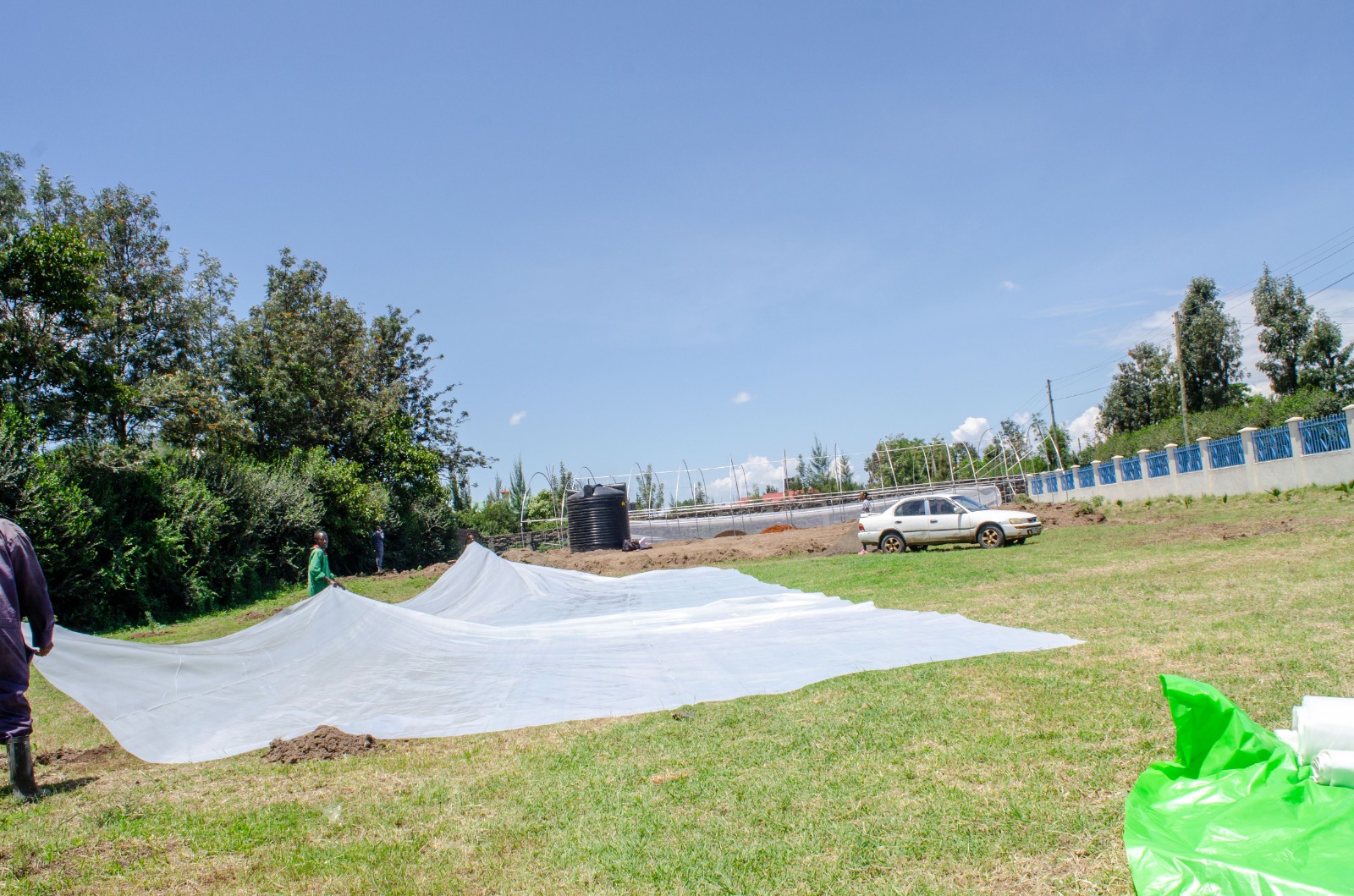
That is a four or five person lift on an 8 m span. Wind is the risk here, not the steel. A half-covered sheet behaves like a sail, and the only safe way to handle it is to work quickly with enough hands on the ground. For the full stage list, our greenhouse installation stages page sets each step out in order.
Greenhouse construction in Nakuru at 1,850 metres
Altitude changes the greenhouse, and it does not change the price list. Nakuru town sits at roughly 1,850 metres above sea level. Nights are cold enough that a covered crop still needs the film closed at the top to hold what little heat the day left behind. Days are bright and dry, so the side vents open wide by mid-morning.
A house built to a coastal specification will overheat here. A house built to a highland specification will sit shut and damp in Mombasa. This is why a Nakuru build should not be copied from a photograph of a house erected somewhere else. The vent discipline, not the frame, is where the climate actually lands.
Our contracted scope: the automated drip system
Eunidrip did not erect the steel at Muguga. We were engaged for the irrigation, and that split is common on county work. The civil contractor builds the shell. The irrigation specialist designs and installs the watering. Our deliverables were the layout, the filtration, the pressure control, and the timer programme.
That arrangement also protects the buyer. When the irrigation scope is named separately in the contract, the county can hold two parties to two different specifications. A single bundled line item hides which parts are thin. Meanwhile, on public greenhouse work the irrigation line is usually the one written most vaguely, and it is the line that decides whether the house still works in year two.
How the drip layout is controlled
Water is stored before it is applied. A poly tank stands inside the fence line, so the house does not depend on a municipal line that may be shut on the exact day a crop needs watering. From storage, the mainline runs the length of the house. Submains branch off it. Laterals carry the emitters along each bed.
Timers open and close each zone. Because the source is a tank and not a pressurised main, the design runs on a small pump sized to hold the line pressure steady. Filtration sits upstream of every emitter, since tank water is not the same as treated water.
The programme matters as much as the pipe. A training house has to be operable by someone who has never irrigated before, so the schedule is written simply: few zones, fixed run times, and one obvious place to look when a bed is dry.
Greenhouse construction in Nakuru: the as-built specification
| Item | As installed at Muguga | Why this site |
|---|---|---|
| Footprint | 8 m x 30 m house | Fits the grass strip beside the clinic |
| Frame | Galvanised steel arches and posts | Bare steel rusts out in either climate |
| Foundations | Concrete pad under each post | Lets the house be relocated later |
| Covering | UV-treated polythene | Highland light breaks untreated film |
| Vents | Roll-up curtains with insect net behind | Daytime heat, night retention, pest barrier |
| Irrigation | Automated drip by Eunidrip | A beginner must be able to run it |
| Water source | Storage tank inside the fence | Municipal supply is not guaranteed daily |
| Purpose | Demonstration and training | The county brief is knowledge transfer |
This is the as-built specification for the Muguga Dispensary house.
Emitters, and why the choice matters
Drip is only as good as the emitter at the end of the line. On a training site a clogged emitter teaches the wrong lesson, because the trainee concludes that irrigation does not work. We therefore specify pressure-compensating button drippers, which hold one flow rate as the line empties and as the tank level falls.
Where a private grower buys the same parts for a house of their own, the shop lists the pressure compensation button dripper and the adjustable button dripper as separate items. The adjustable type has its place, but not on a bed a class of beginners will water unsupervised.
Training the people who will run the house
A county training house fails if nobody learns to operate it, so the handover here was not a signature. It was a session. Our team covered bed preparation, crop selection, emitter cleaning, and how to read a clogged line before you pull it apart. Healthcare workers from the dispensary sat in, because the produce was meant for them as well.
That is the part an institutional buyer should insist on in writing. A greenhouse handed over without training becomes a maintenance problem inside two seasons, and the fault gets blamed on the technology instead of the handover. Specifically, greenhouse construction in Nakuru for a county is only finished when someone on the staff can open and close a zone alone.
What the site grows, and who eats from it
The house is small enough that it will never supply a market, and that is the point. Its value is a visible season. Tomatoes, capsicum, and cucumber are the usual first crops on greenhouse construction in Nakuru training houses because the extension service already has local data on them. Lettuce and herbs work too, and they show a trainee a fast cycle from seed to cut.
Where a grower wants one crop costed properly before choosing, our greenhouse onion farming page works a single crop out in detail. It is the more useful document than any general crop list.
Cost of greenhouse construction in Nakuru
No figure on this page is a quote, and the county contract is not a price you will be offered. Costs move with steel, with the grade of covering film, and with how much groundwork a specific site needs. This project is a record of what was built, not a rate card.
Two of our pages carry the current breakdown instead: the cost of a greenhouse in Kenya, and the four sizes priced in affordable greenhouse construction. For a much larger block, the 10 hectare greenhouse cost page works out what scale does to the unit price.
How long a build like this takes
A house of this size is normally erected in 7 to 14 days. The steel goes up quickly once the pads have cured. Covering is the weather-dependent stage, because a sheet cannot be lifted safely in a hard wind. Irrigation adds a few further days, since the lines are flushed, each zone is tested, and the timer is programmed in front of the people who will use it. Greenhouse construction in Nakuru on a live public site also waits on the site itself, because a crew cannot work beside a busy clinic entrance at will.
Our step-by-step greenhouse construction guide sets the sequence out in order, starting at the site intake. Read it before you ask for a completion date, because most delays are ground conditions that nobody walked.
Greenhouse construction in Nakuru compared with Ol Kalou
Buyers mix these two projects up often, so the difference is worth stating plainly. The Ol Kalou project is five houses on one acre, which is a production layout. This Nakuru project is one house on a dispensary compound, which is a teaching layout.
The irrigation design differs accordingly. A five-house block needs zoning across separate structures, with a mainline that can feed any combination of them. A single training house needs a layout a beginner can understand in one afternoon. Same supplier, same country, two different jobs.
What an institutional buyer should check before contracting
Ask four questions, and ask them before tender. First, who owns the groundworks and who owns the irrigation. Second, whether the water source is metered, borehole, or stored, because that decides the pump. Third, whether training is written into the contract or offered as a courtesy.
Fourth, whether the emitter specification is named in the bill of quantities. Because a county tender is scored on paper, a vague line becomes a cheap installation, and nobody discovers the difference until the second season. The County Government of Nakuru publishes its programme structure, and a supplier who cannot tell you which programme your site falls under has not read it.
Frequently Asked Questions about greenhouse construction in Nakuru
What does greenhouse construction in Nakuru cost?
There is no fixed rate. The price depends on footprint, covering grade, and how much groundwork the site needs first. Our cost pages carry the current bands, and a site visit settles the rest. A quote given without walking the ground is a guess with a number attached.
How long does a Nakuru greenhouse project take?
One to two weeks for the structure, then a few further days for irrigation, flushing, and testing. Rain delays the covering stage, not the steel. A crew that quotes the same duration for every site is quoting a habit.
Did Eunidrip erect the steel at Muguga Dispensary?
No. The county contractor built the structure. Eunidrip designed and installed the watering system inside it, which is a normal split on public work.
Which crops suit a Nakuru greenhouse?
Tomatoes, capsicum, and cucumber are the common first crops here. Lettuce, herbs, and strawberry all do well too. Altitude gives cool nights, so heat-loving fruit sets slowly but steadily across a longer window.
Do you train staff after installation?
Yes, and on this project the handover covered bed preparation, emitter cleaning, and zone control. Training is written into institutional contracts and scheduled, not left to whichever crew finishes last.
Does a county greenhouse need a borehole?
Not always. This site runs on stored water held in a tank inside the fence line. A borehole becomes worth it once the tank has to be topped up by truck. Our borehole drilling in Nakuru page covers what local drilling involves.
See the site before you size the house
The video below is a frame installation walkthrough filmed at Solai, on one of our other sites. It is here because it shows the stage the Nakuru photographs cannot: the skeleton rising before any film touches it. Static photographs show a finished frame well and the assembly sequence badly, and the sequence is where most of the work actually sits.
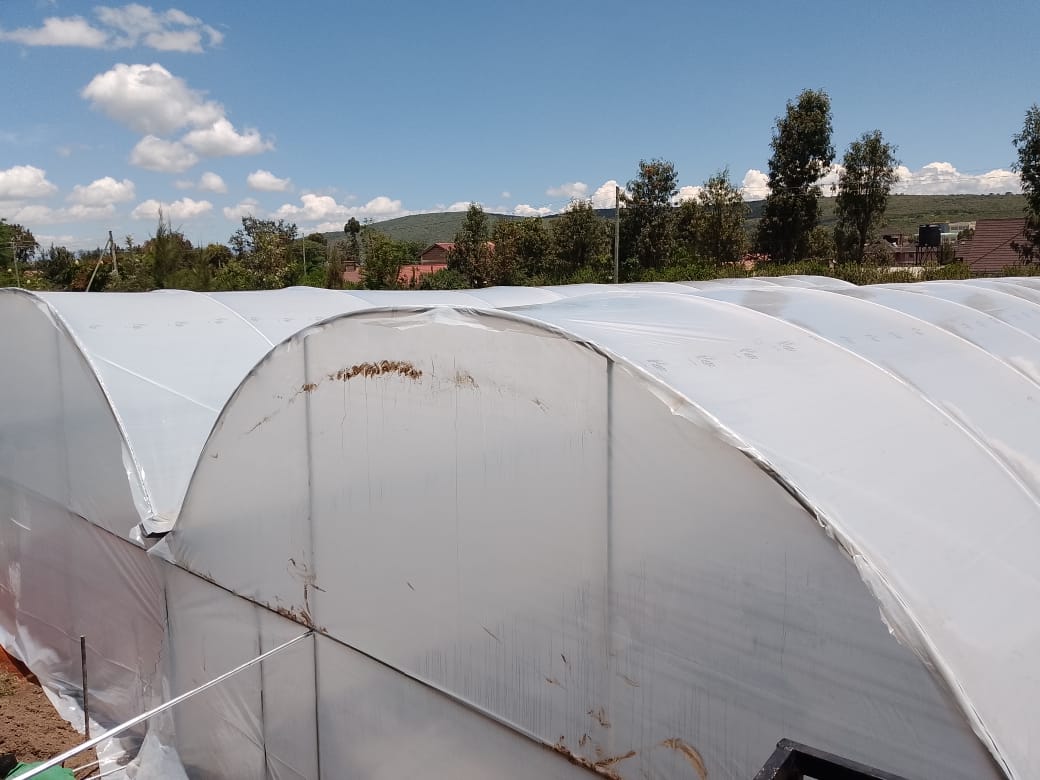
Weather staining along the film is common on covered bays, and it is the honest reason a covering is a consumable line in a greenhouse budget instead of a one-time cost. The galvanised frame underneath carries no such penalty, provided the coating was never scratched through during the lift.
Next steps for growers in Nakuru
If you are planning greenhouse construction in Nakuru, start with the site and not the structure. Walk the ground, settle the water question, then size the house to what the ground and the water can actually support. Our drip irrigation kit page lists what we supply for the irrigation stage.
For the wider picture of how irrigation fits a whole farm plan, our irrigation in Kenya guide is the place to begin. Then bring a sketch of your site, because a conversation that starts with dimensions ends with a realistic budget.