

Table of Contents
Drilling equipment mobilization in Kenya is the point where a borehole project stops being paperwork and becomes a truck. The rig, the compressor, the rods and the crew must all reach one small patch of ground. Then they must stand up on it. Typically that ground is a farm, and the track to it is not a road.
Most stalled moves are decided before the vehicle leaves the yard. Therefore this page covers the five checks we run first, what the paperwork gate actually is, and what a site has to look like when the rig arrives.
What drilling equipment mobilization in Kenya actually covers
It is a move and a setup.
The move carries the drilling rig, the compressor, the mud pump, drill rods, casing, fuel, water and the crew to the approved point. The setup makes that point able to hold all of it. Neither half is optional. The second half is the one most clients have not planned for.
On our projects this step sits between the survey and the first rotation. Our full sequence runs 18 steps from documentation to handover, and it is set out on our borehole drilling sequence page. That page gives this phase one paragraph. Drilling equipment mobilization in Kenya is what fills it.
The paperwork gate before the rig moves
Kenya’s water regulator publishes this gate as a numbered process.
An application arrives with its attachments, which include the hydrogeological assessment report. The Water Resources Authority enters it into the permit database, notifies the public and verifies the site. A technical evaluation committee reviews the file. Only then does the Authority issue an Authorization to Construct Works, under the Water Act 2016. The steps are published at WRA water use allocation.
That authorization is the mobilization document. Drilling without one is listed by the Authority as an offence. The same page states that abstracting water on an authorization, before the permit exists, is also illegal. The permit comes later, after a completion certificate and a final inspection, and it renews every 5 years.
Two consequences follow. First, the authorization names a point. A rig moved to a different point is a compliance problem before it is a drilling one. Next, the paperwork clock runs longer than the truck clock, so a crew mobilized on a verbal go-ahead is a crew that waits at a gate. The Authority processes these files through 33 offices at sub-regional, regional and national levels, which is why timelines differ by county.
What a drilling crew mobilizes to site
Seven loads, and the last three are the ones clients forget.
| What moves | What it does on site | What you lose if it is missing |
|---|---|---|
| Truck-mounted rig | Drills, and stands its own mast | The whole day |
| Compressor or mud pump | Flushes cuttings out of the hole | A stalled hole and hung rods |
| Drill rods and hammer | Builds the drilling string | A second mobilization |
| Casing and screen | Lines the hole once it is open | A caving borehole |
| Water on site | Drilling fluid, and the crew | No start at all |
| Fuel and a genset | Power away from the grid | A dawn that produces nothing |
| Timber blocks and pads | Stands the rig level and firm | An unstable platform |
Read the bottom three rows as a warning. A rig can arrive complete and still be unable to work, because nobody put water, fuel or blocking on the plot. That is the half of drilling equipment mobilization in Kenya a client controls.
Reading the site before drilling equipment mobilization in Kenya begins
The visit is short, and it is not optional.
Site-preparation guidance from the National Ground Water Association quotes one drilling firm photographing every site before it mobilizes. Another spends about 30 minutes there with the surveyor to stake the well. That is the whole budget, and it is enough if the person walking the plot knows the questions to ask.
- Can a loaded truck reach the point, with a trailer behind it?
- Can it turn there, or must it reverse the whole way in?
- Will the ground hold jacks after 2 hours of rotation?
- Is there a line overhead along the path the mast will take?
- Is there water at the point, or does it have to be brought?
- Who holds the gate, and what is their working day?
The staked point comes from the survey, and how we choose it is covered on our groundwater hydrogeological survey page. Likewise, the county office that issues local approvals decides whether that point is legal. Do both before drilling equipment mobilization in Kenya is scheduled.
Standing the rig: blocking, cribbing and grade
A rig does not drill on its tyres.
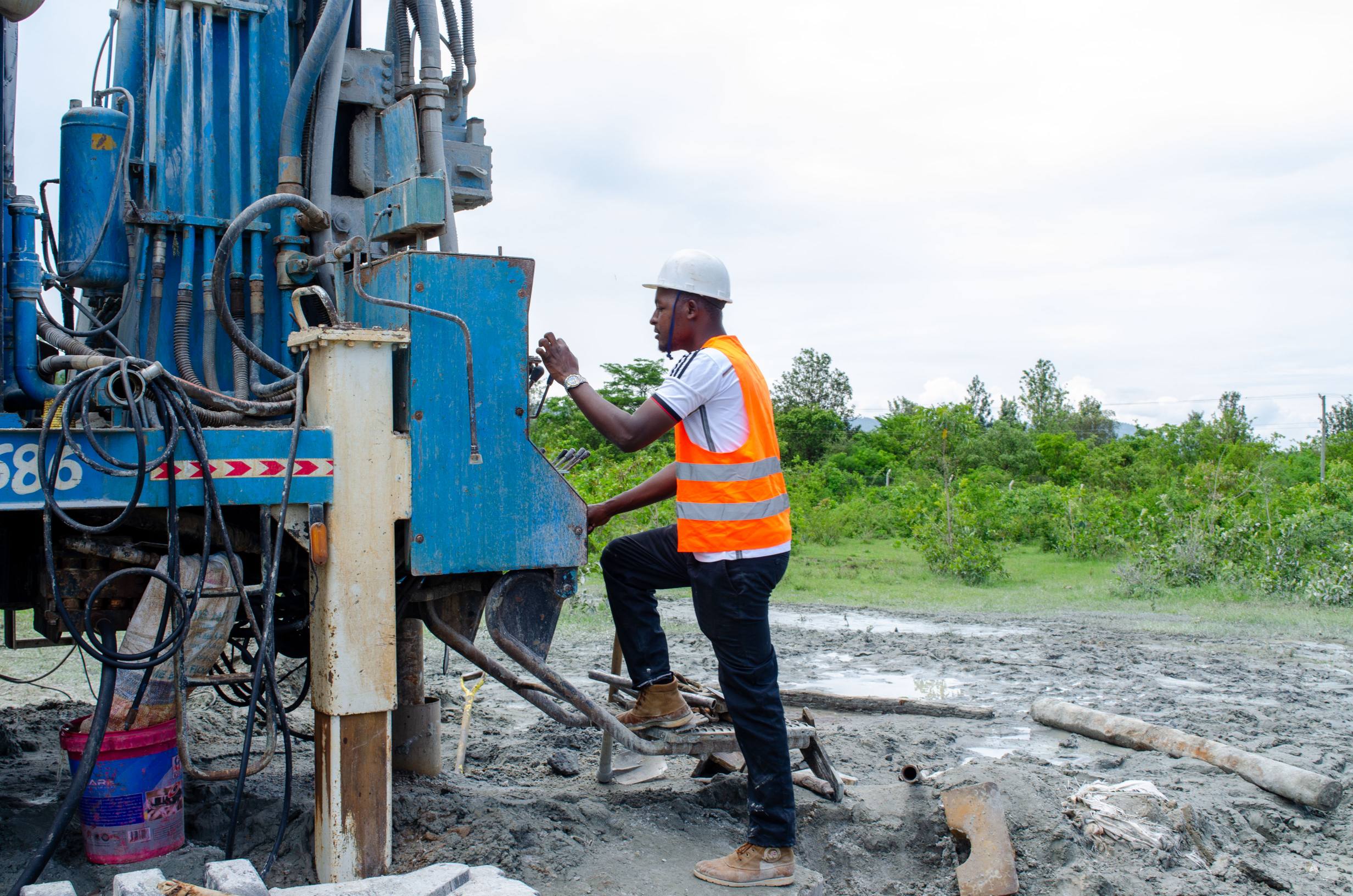
It stands on jacks, and the jacks stand on blocks. That guidance is specific about material: wood blocks, never brick or cinder block. Drillers quoted there carry about 15 blocks in the truck and use two to four under each jack. Some coat the timber with hydraulic oil to extend its life.
Grade matters as much as timber. The recommended layout puts the rig and its support truck side by side. The slope runs away from the equipment, at no more than 5% grade under it. On a Kenyan plot that means a strip of ground cut, filled and compacted the week before, not on the morning the truck arrives.
The reason is load transfer. A 50,000 pound rig with a 40,000 pound pullback becomes a 90,000 pound shock load the moment the string hangs up in the hole. The article records 6 by 6 blocking breaking exactly that way. As a result, a pad that looked sound at setup can fail mid-drill, and it fails with the mast loaded.
These are not new rules. The drillers quoted in that guidance learned them more than 30 years ago, and the failure modes have not changed.
Wet-season drilling equipment mobilization in Kenya
Rain is the most common reason a move is cancelled.
A murram track that carries a pickup in January carries nothing in April. The loaded rig sinks, the recovery truck cannot reach it, and the job becomes two jobs. Typically the fix is earthworks, not a winch. A cut, a fill and a drained crossing at the soft point will do it, done by an excavator already on the plot. Our dam excavation work covers that kind of plant. It is cheaper to schedule access in the dry season than to negotiate it in the rain.
Water also moves the other way. Rotation returns warm, dirty fluid to the surface. A pad that drains toward the rig will pool there instead of away from it. Therefore we set the level so runoff leaves the working area, and we fix the disposal point before the first truck loads. For drilling equipment mobilization in Kenya in the long rains, that ordering is the whole difference between a day and a week.
How drilling equipment mobilization in Kenya is priced
Drilling equipment mobilization in Kenya is a separate line, and it should read like one.
A per-metre drilling rate pays for rotation. It does not pay for the move, the recovery, the access works or the days a crew sits at a gate. So ask for a quote that splits five things: mobilization, demobilization, standby time, access and ground works, and the statutory fees. Each has a different cause. Only the first two sit inside our control.
Standby is the line that surprises people. A rig that cannot work still carries a crew, a truck and a slot in the schedule that another project could have used. For the cost basis of the hole itself, including what changes with depth and county, see borehole drilling in Kenya.
Access, power lines and the hazards that stop a move
Every driller who has lost a day repeats the same short list.
Utility locates come first. Underground cable and pipe are invisible, and a tracked rig on a route nobody checked is a repair bill. Overhead line is second. The mast is the tallest object on the plot, and it rises on a hinge, so clearance has to exist along the swing path and not only at the hole. Specifically, walk the path the mast takes before you call the move.
Then the ordinary ones: site access width, turning room, towing the rig on and off soft ground, live traffic where the track meets a road, equipment left unattended overnight, and housekeeping around the pads. Fuel and small tools disappear from a plot with no gate and no watchman. That loss is a second mobilization.
Five checks before drilling equipment mobilization in Kenya starts
Run these five, then load the truck.
- The Authorization to Construct Works is in hand, and the point on it is the point on the ground.
- The site is photographed and staked, with the mast swing path walked.
- A loaded truck can reach the point and turn at it, wet and dry.
- Water, fuel and timber blocking are on the plot before the rig is.
- The pad is level, drained away from the rig, and compacted rather than merely cleared.
If any one of those is a guess, the move is a guess. Also, an answer that arrives by phone, without a walk of the track, should be treated as unverified. Book the pre-move visit on +254 728 163329, and do it before the truck is scheduled.
What still goes wrong on site
Five patterns, in the order we meet them.
- The truck reaches the gate and cannot reach the point, so the day becomes a waiting day.
- The rig stands on ground that was cleared but not compacted, and one jack settles.
- There is no water for the mud plant, and drilling starts 2 hours late.
- An overhead line is located after the mast is raised instead of before.
- The crew demobilizes at dusk with no completion record, and the file stalls.
Four of those five are site-readiness failures, not drilling failures. That is the argument for the pre-move visit, and it is why we schedule it on a separate day.
Demobilization and the record you keep
The move ends with paperwork, not with the truck.
Once works are built as authorized, the Authority’s process requires a completion certificate and a borehole completion record, plus a water quality analysis, before final inspection and permit issuance. Demobilizing without that record leaves a drilled hole and unauthorized water. First file the record. Next take the rig off the plot.
The same record decides the pump. Yield, depth and casing are what size the surface equipment, so keep it and hand it to whoever installs the system. A hole planned to serve for 40 years needs that record kept, because the pump, the casing and the neighbours’ boreholes are sized against it 10 years later.
For the layout that follows a borehole, see how we design a drip system for a plot and what our crew installs in our borehole drilling service. Storage and lining for the water itself are on the shop side, in our guide to a water reservoir and its ground preparation.
Frequently asked questions about drilling equipment mobilization in Kenya
Do I need approval before the rig moves? Yes. The Authority issues an Authorization to Construct Works before abstraction works are built, and drilling without it is an offence. County approvals can sit on top of the national ones.
How long does the whole project take? Our borehole cycle usually runs from 7 days to 14 days, survey and permits included. Mobilization is one day of that when the site is ready, and it is the part a client can shorten.
Who pays for access works? Whoever needs the plot prepared, which in practice means it appears on your quote. We show ground and access work as its own line, so you can see what the track costs and what the hole costs.
Can a rig work on wet ground? Only if that ground has been cut, filled and compacted. Blocking spreads the load, but it cannot hold a jack that is sinking. A wet plot is a ground-works job first and a drilling job second.
What happens if the site is not ready when the rig arrives? The crew waits, and standby is charged. The rig then moves to the next booked project, so you usually pay for a second mobilization instead of a second day.
Do you mobilize outside Nairobi? Yes, and distance is why the move is quoted per project instead of flat. Our county pages cover work in Nakuru, Murang’a County and Rumuruti.