

A tank tower is a raised support structure that holds a water storage tank above the ground. Gravity then pushes water from the tank through pipes, drip lines and other irrigation outlets.
The right height, material and tank capacity depend on the farm’s topography, irrigation method, water demand and available space. This guide covers each decision, from the pressure calculation to the final pipe connection.
What Is a Tank Tower?
A tank tower lifts stored water so the weight of the water column creates pressure at the outlet. Farms use it where gravity-fed irrigation is preferred, or where extra elevation improves water distribution.
In addition, the structure must carry the tank completely full. Water weighs about one kilogram per litre, so the load grows quickly with capacity.

| Tank capacity | Approximate weight of water |
|---|---|
| 500 litres | 500 kg |
| 1,000 litres | 1,000 kg |
| 2,000 litres | 2,000 kg |
| 5,000 litres | 5,000 kg |
| 10,000 litres | 10,000 kg |
For example, a 5,000-litre tank holds about five tonnes of water. Therefore the tower, its foundation and every supporting member must be designed before installation, not after.
How a Tank Tower Creates Pressure
Pressure comes from the height difference between the water surface in the tank and the irrigation outlet. The approximate static pressure follows one rule: pressure in bar equals water head in metres multiplied by 0.098.
This is the hydrostatic pressure relationship, about 9.8 kPa for every metre of water head. As a planning shortcut, 1 metre gives roughly 0.1 bar, 5 metres give 0.5 bar, and 10 metres give 1 bar.
| Water head | Approximate static pressure |
|---|---|
| 2 metres | 0.20 bar |
| 5 metres | 0.49 bar |
| 8 metres | 0.78 bar |
| 10 metres | 0.98 bar |
| 12 metres | 1.18 bar |
| 15 metres | 1.47 bar |
These figures are static pressure, measured before water flows. In practice, friction in pipes, fittings, filters and elevation changes reduces the pressure at the equipment. Therefore check the available pressure at the outlet while the system is running.
Tank Tower Height and the Land Gradient
The land gradient is the primary factor in tower height. Specifically, the elevation difference between the tank site and the field sets most of the available head.
- Downhill gradient: the natural fall generates pressure on its own. A shorter tower, or even a ground-level tank on a nearby hill, is often enough.
- Flat terrain: the tower must provide 100% of the required head. Typically this means an elevated tank 15 to 30 metres high, depending on pipe friction losses.
- Uphill gradient: the tower must overcome the elevation gain plus friction losses and still leave residual pressure at the outlet. Consequently a booster pump may be more economical than an extremely tall tower.
Four inputs complete the calculation: the service elevation at the highest outlet, the tank ground elevation, the desired residual head, and pipe friction losses. One bar (14.5 psi) equals about 10.2 metres of water column, and friction typically adds 2 to 5 metres per kilometre of pipe, depending on diameter and flow.
However, steep downhill sites can over-pressurise the lowest outlets. Above about 80 psi (55 metres of head), fit pressure reducing valves on the lower distribution lines. In addition, a heavy tower on a steep slope needs stepped foundations, retaining walls and deeper soil testing.
A site assessment, covered in our guide to land preparation for drip irrigation, establishes the correct tank tower position and elevation before any concrete is poured.
Tank Tower Height by Method, Slope and Distance
Different irrigation equipment needs different operating pressure. Drip systems generally run at relatively low pressure, while some sprinklers need more. A tank tower that is too low will not operate the equipment properly, so always check the manufacturer’s requirement.
Flat farms
On flat land, height follows the equipment’s pressure requirement and the distance to the outlets. Therefore start from the operating pressure of the chosen drip irrigation systems, then add the friction losses.
Sloping farms
On sloping land, include the ground elevation difference. A tank at the top of the farm supplies lower sections by gravity, and pressure rises as the ground drops. However, supplying a higher section needs extra elevation to overcome the gain.
Hilly farms
On hilly farms, one tank tower rarely gives uniform pressure across all blocks. As a result, the system may need pressure regulators, separate irrigation zones or additional storage points.
Distance matters as well. Longer pipe runs and small diameters increase friction losses, especially at high flow rates. Therefore choose the tower height together with pipe size, length, fittings and required flow. For example, the Colorado State University extension drip guide adds 5 psi to the operating pressure for every 10-foot rise above the source connection.
Choosing Tank Capacity for a Tank Tower
Capacity follows the farm’s daily water demand, irrigated area, crop type, irrigation method and supply reliability. A tank that is too small runs dry before the cycle finishes. However, an oversized tank raises the tower and foundation cost without adding value.
- Small tanks (500 to 2,000 litres): suit gardens, nurseries and limited sections, or serve as temporary storage where another source refills them regularly.
- Medium tanks (5,000 to 10,000 litres): suit small and medium farms, depending on crop water requirements and the irrigation schedule.
- Large tanks (15,000 to 20,000 litres and above): suit farms with higher demand, and need careful structural planning because the water weight grows with capacity.
| Tank capacity | Possible application |
|---|---|
| 500 to 1,000 litres | Small gardens and nursery sections |
| 2,000 litres | Small irrigation areas and temporary storage |
| 5,000 litres | Small farms and selected irrigation blocks |
| 10,000 litres | Medium-sized irrigation installations |
| 15,000 to 20,000 litres | Larger farm water storage requirements |
In addition, match the capacity to the supply. Where a solar irrigation pump refills the tank, size the storage around the pump’s daily output so the tower never runs dry mid-cycle.
Galvanised Steel Tank Towers
Galvanised steel tank towers use steel columns, beams and bracing to carry the tank. The zinc coating protects the steel against corrosion, which matters in outdoor installations exposed to rain and changing weather.
- Size the steel columns for the intended load.
- Provide cross-bracing to improve structural stability.
- Design welded and bolted connections properly.
- Match base plates and anchor bolts to the foundation.
- Support the tank platform across the whole tank base.
- Repair damaged galvanised coatings to limit corrosion.
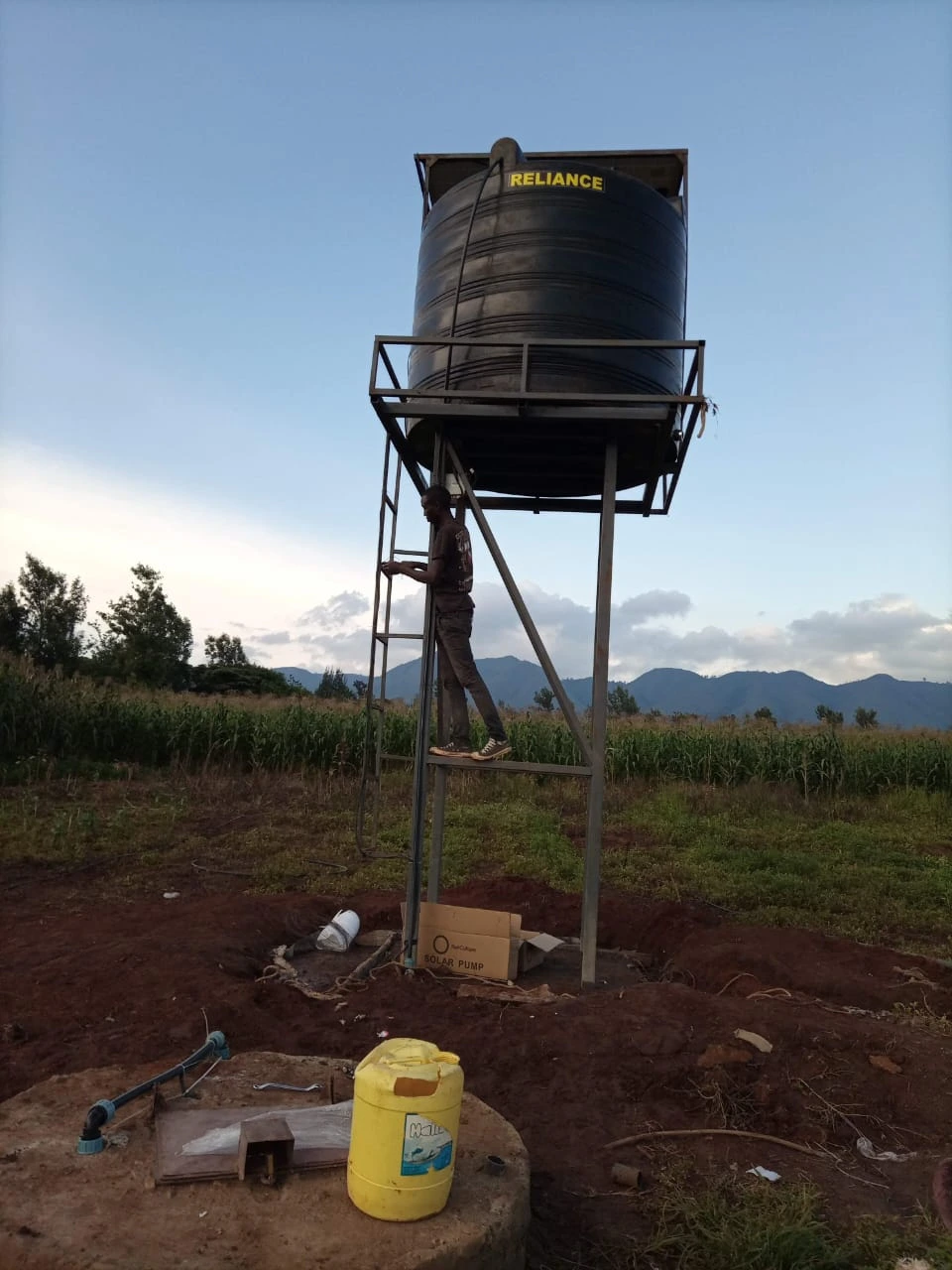
However, strength depends on the steel sections, connections, bracing, foundation and workmanship. Therefore larger tanks and taller structures need professional structural design, not a copied frame.
Reinforced Concrete Tank Towers
Typically, reinforced concrete tank towers use concrete columns, beams and a supporting slab or platform. Steel reinforcement inside the concrete provides the required structural strength.
They suit permanent installations where the capacity and height justify a substantial structure. However, mistakes in foundation or reinforcement design are costly and difficult to correct after construction.
- Design the foundation for the soil conditions and total load.
- Follow the structural drawings for reinforcement.
- Control concrete strength and workmanship.
- Design columns and beams for vertical and lateral loads.
- Provide appropriate bearing support on the tank platform.
- Allow proper curing and construction supervision.
Steel vs Concrete Tank Tower Comparison
| Feature | Galvanised steel stand | Concrete stand |
|---|---|---|
| Main material | Zinc-coated steel | Reinforced concrete |
| Construction | Steel columns, beams and bracing | Reinforced columns, beams and platform |
| Maintenance | Inspection for corrosion and coating damage | Inspection for cracks and deterioration |
| Suitable application | Various capacities and heights, subject to design | Permanent installations, subject to design |
| Foundation | Designed footings and anchors | Designed reinforced foundations |
The best option depends on capacity, height, site conditions, expected service life and budget. Specifically, steel offers flexibility across sizes, while concrete suits permanent heavy installations.
Tank Tower Structural Checks Before Building
Foundation design
The foundation transfers the tank and tower loads into the ground. Specifically, its design depends on soil type, bearing capacity, groundwater conditions and the total structural load. Loose, waterlogged or unstable ground may need additional foundation work.
Structural bracing
Bracing resists sideways forces from wind, movement and other external loads. A tower that is strong vertically but poorly braced may become unstable. Therefore check the bracing layout, not only the column sizes.
Tank platform
The platform must support the tank according to the manufacturer’s requirements. Many plastic water tanks rest on a continuous, flat surface. They should not sit on a frame that leaves sections of the base unsupported.
Plumbing and outlet position
Plan the outlet position before construction. Allow space for connecting pipes, valves and other irrigation components. In addition, provide pipe supports and flexible connections so the tank outlet carries no unnecessary strain.
Professional structural assessment
A qualified structural professional should assess the design, especially for tall towers and larger tanks. The structure must account for the full water load, tank weight, wind forces, stability and foundation conditions.
Finally, avoid copying another farmer’s tower dimensions. Two farms may differ in soil, capacity and height, so the site assessment sets the design.
Connecting a Tank Tower to Irrigation
Once the tank tower stands, connect it to the distribution network in order. A typical gravity-fed installation runs as follows:
- Water storage tank.
- Tank outlet and isolation valve.
- Main delivery pipe.
- Water filter, where required.
- Pressure regulator, where required.
- Main irrigation line.
- Submain pipes.
- Drip lines, button drippers or other irrigation outlets.
Select each component for the system’s flow and pressure. For example, gravity-fed drip needs enough head to operate the chosen emitters. If the tank tower cannot provide it, a suitable pump or another pressure solution is necessary.
In addition, match the filter to the water source and the equipment’s filtration requirement. A pressure regulator is essential wherever the available pressure exceeds the emitter or sprinkler rating.
Tank Tower Checklist Before You Build
- Tank capacity: the volume your irrigation schedule requires.
- Required height: the pressure needed at the irrigation outlets.
- Farm topography: slopes and elevation differences between tank and field.
- Construction material: treated timber, galvanised steel or reinforced concrete, based on the design.
- Soil conditions: whether the ground can safely support the foundation.
- Pipe distance: friction losses along the irrigation network.
- Future expansion: additional storage or irrigation blocks later.
Therefore a proper site assessment avoids a tower that is too low for pressure, or unnecessarily high and expensive.
Tank Tower Solutions from Eunidrip
Eunidrip Irrigation Systems Ltd supplies irrigation equipment and water distribution solutions. We plan installations around water storage, tank elevation, pipe connections and the pressure requirements of the irrigation system.
Whether the project is a small gravity-fed drip kit or a larger farm network, start from the water requirement and the site. For the wider system design, see our hub on irrigation in Kenya; for prices, our cost of drip irrigation system in Kenya page breaks down the budget.
Our team also advises on tank tower position and height during site visits, so the structure matches the irrigation design rather than the other way round.
Frequently Asked Questions
What is the purpose of a tank tower in irrigation?
A tank tower raises a water storage tank above ground level to create gravity pressure. This pressure helps distribute water through irrigation pipes and outlets.
How high should an irrigation tank tower be?
The height depends on the irrigation equipment, farm topography, pipe distance, friction losses and required operating pressure. Therefore no single height suits every farm.
Which tank tower is better: wooden, steel or concrete?
In practice, each has different construction and maintenance requirements. Treated timber may suit smaller installations, galvanised steel can be designed for various capacities and heights, and reinforced concrete may suit permanent installations. The final choice follows the structural design and site conditions.
What tank capacity is suitable for irrigation?
Capacity depends on the irrigated area, crop water requirements, irrigation schedule and water supply. Smaller tanks suit gardens and small plots, while larger farms may need several thousand litres or more.
Does a higher tank tower provide more pressure?
Yes. Increasing the height difference between the water surface and the outlet increases gravity pressure. However, pipe friction and changes in land elevation also affect the pressure available at the outlets.
Can I use a tank tower for drip irrigation?
Yes. An appropriately designed tank tower can supply a gravity-fed drip system, provided the available pressure meets the requirements of the drip lines and emitters.
Can I install a 10,000-litre tank on a wooden stand?
Not without a proper structural assessment. A full 10,000-litre tank holds about 10 tonnes of water, excluding the tank and tower weight. Therefore the stand and foundation must be specifically engineered for the load.
Does the slope of my farm affect tank tower height?
Yes. The elevation difference between the tank and the irrigation field affects the available water pressure. A site assessment helps determine the correct tower position and height.