

Table of Contents
You can follow the Pixie Oranges Irrigation Project in Nakuru by its photographs. They show ploughed ground, staked planting positions, power lines crossing the block, and an engineer writing measurements into a notebook. Those are the first outputs of the job, and they matter because every later decision is priced against them.

This page sets out what the brief asks for and the water arithmetic behind the pump and the reservoir. It also gives the cost band the scope falls into, the questions the survey has not answered yet, and the five stages in the order they run.
What the Pixie Oranges Irrigation Project in Nakuru covers
The brief covers 25 acres of citrus land at Pixie Oranges Farm in Nakuru County. That is 10.1 hectares. A perfect square of that area would measure about 318 metres on each side. In practice the boundary follows the farm roads, so the pipe runs are longer than the square suggests.
Five things are fixed at this stage, and the rest waits on the survey:
- Area: 25 acres (10.1 hectares) under a single irrigation system.
- Crop: pixie oranges, the mandarin type the farm is named for, planted as an orchard, not as beds.
- Method: drip, with two emitters at each tree and the laterals buried or pegged along the tree line.
- Water source: a borehole or a surface source, chosen after the yield test. Nothing in the photographs confirms which.
- Service: site visit, design, quotation, installation, training and after-sales support under one contract.
Because the crop is an orchard, the design stops being a matter of bed widths. Instead it turns on tree spacing and on the emitters each tree carries. Distance from the source to the far corner of the block decides the rest.
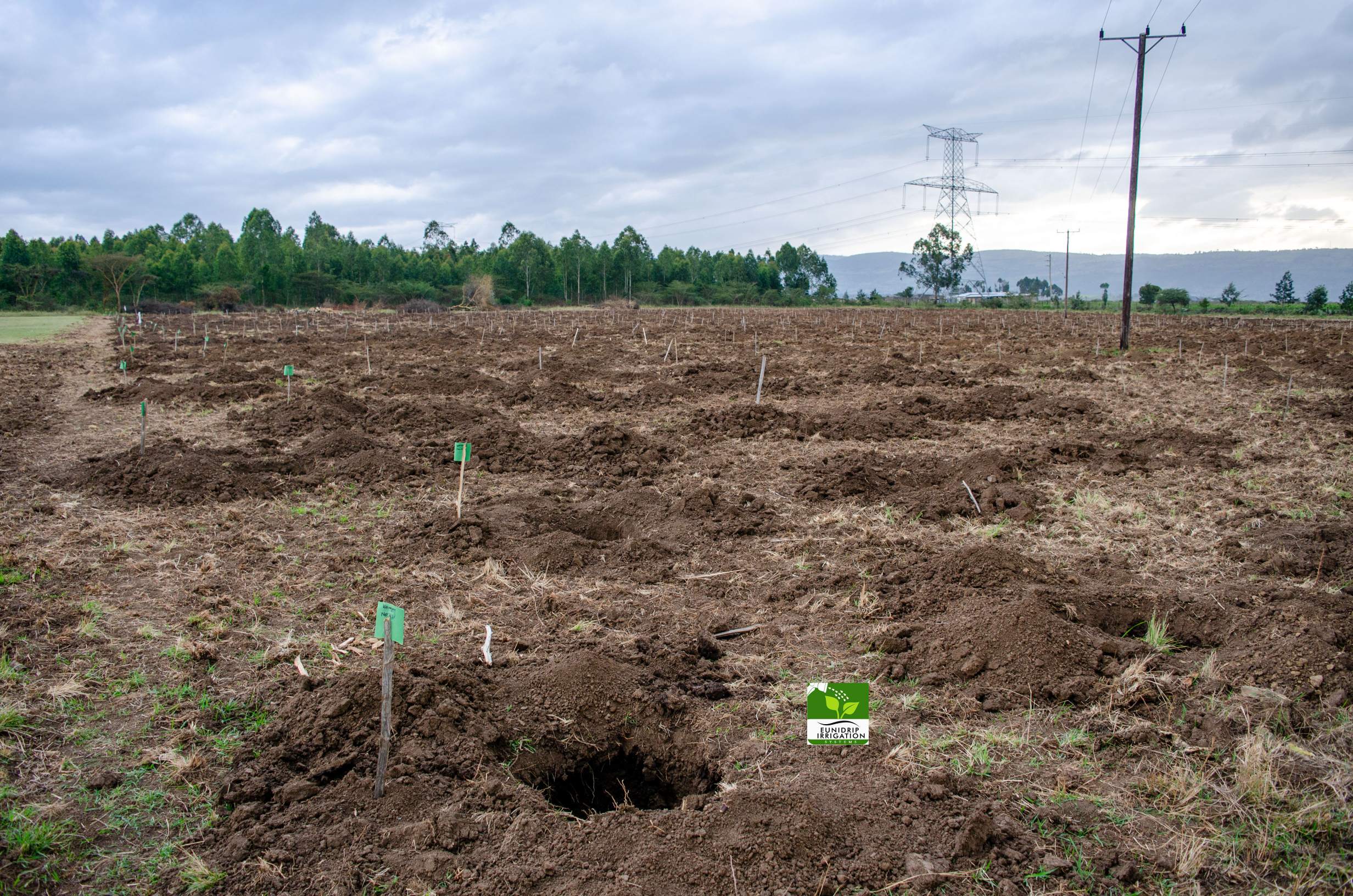
The site visit: what gets measured
The site visit is the only stage of the Pixie Oranges Irrigation Project in Nakuru where a mistake is still cheap to fix. Consequently, the survey team records four things before anyone quotes.
First, the client’s own requirements. The team asks what the orchard will look like at maturity and whether the farm plans to expand past 25 acres. It also asks whether the trees go in at once or in phases. For instance, a phased planting halves the water demand in year one. That changes the pump size, and the client should see it before signing.
Second, the water source. A borehole is tested for yield over a full pumping cycle, not for the first ten minutes. If the source is a river or a dam, the team records the dry-season level. A reading taken on the day of the visit proves little. Two pages sit behind this decision: our groundwater survey page and the Nakuru borehole page.
Third, elevation and slope. A 25-acre block rarely sits flat, and a slope above about 2 percent changes the emitter choice. A line that runs downhill gains pressure at the bottom and loses flow at the top. Pressure-compensating drippers hold the same flow across that drop, which is why they appear in most orchard quotes.
Fourth, water quality. Iron, silt and hardness decide the filter, and the filter decides the maintenance burden for the next ten years. A sample taken on the day of the visit is cheaper than a season of blocked emitters.
Water: the number that decides the design
Every other line in the quotation follows from one figure. In practice, that figure is the volume the block needs on a peak day. Two inputs produce it: the reference evapotranspiration for the site, and the crop coefficient for citrus.
The Food and Agriculture Organization lists a basal crop coefficient of 0.60 for citrus. Its evapotranspiration guidelines give that figure for 70 percent canopy with no ground cover. In practice the site’s own weather figures replace the generic assumption, and the table below is a working estimate, not a design number.
| Reference ET (mm/day) | Crop ET at 0.60 (mm/day) | Per hectare (m³/day) | Across 10.1 ha (m³/day) |
|---|---|---|---|
| 3.0 | 1.8 | 18 | 182 |
| 4.0 | 2.4 | 24 | 242 |
| 5.0 | 3.0 | 30 | 303 |
| 5.5 | 3.3 | 33 | 334 |
Peak-day water demand for the 25-acre block at a crop coefficient of 0.60, across four reference evaporation rates.
The middle row is the one to remember. At 4 mm of reference evaporation a day, the block needs about 242 cubic metres daily at peak. Therefore the pump, the mainline and the storage all get sized against roughly 240 cubic metres, not against the average.
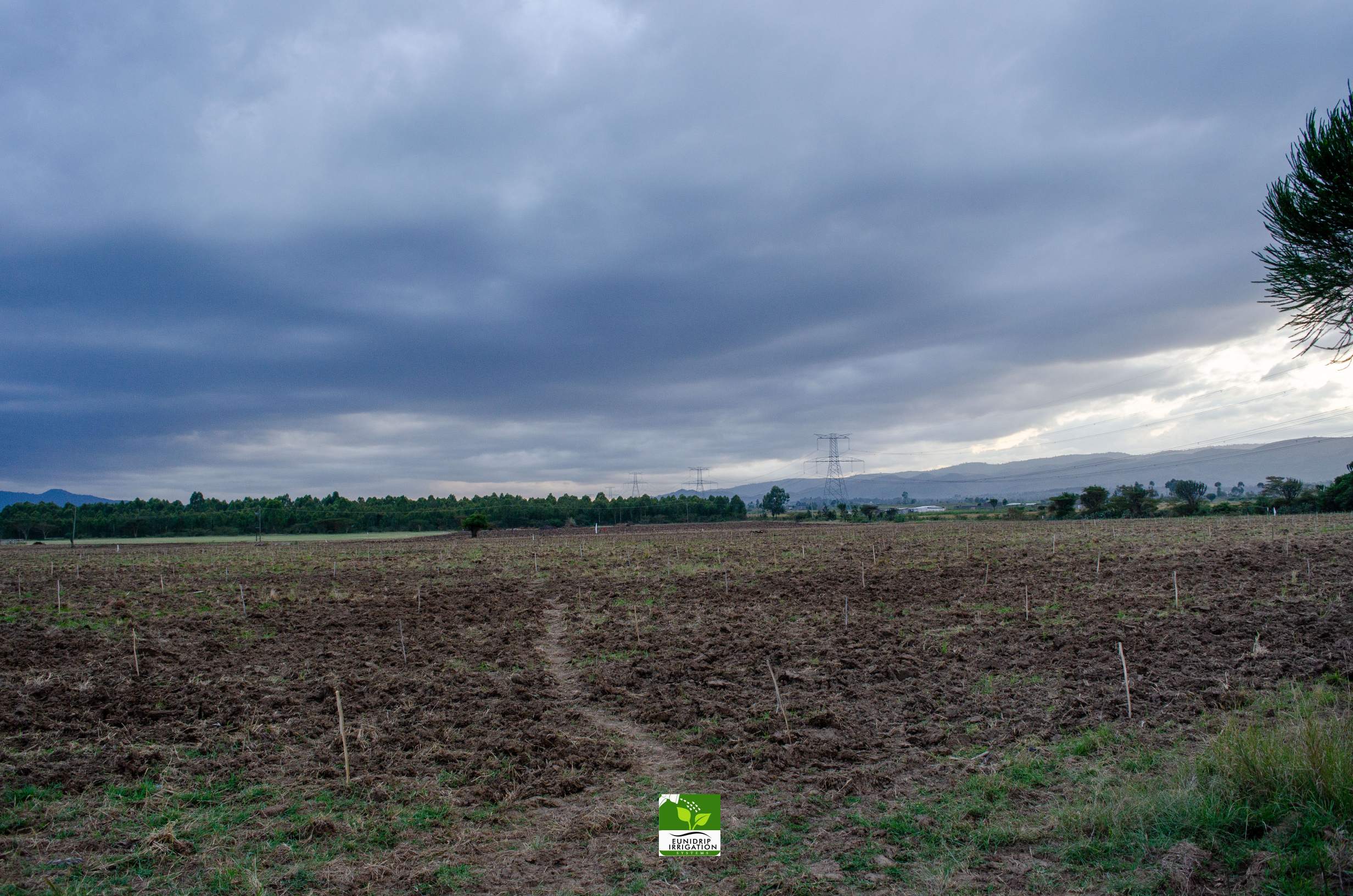
Storage follows the same figure. A lined reservoir holding one and a half peak days needs about 365 cubic metres. That is a 20 metre by 20 metre tank, one metre deep. The construction side of that work sits on our reservoir page.
Designing the Pixie Oranges Irrigation Project in Nakuru block
With the volume known, the design of the Pixie Oranges Irrigation Project in Nakuru turns into arithmetic that the client can check. Specifically, the tree count comes first. At 5 metres between rows and 4 metres within the row, each tree occupies 20 square metres. On that layout, 25 acres carries about 5,000 trees. The planting layout is the client’s decision, so treat 5,000 as a placeholder until the survey stakes the rows.
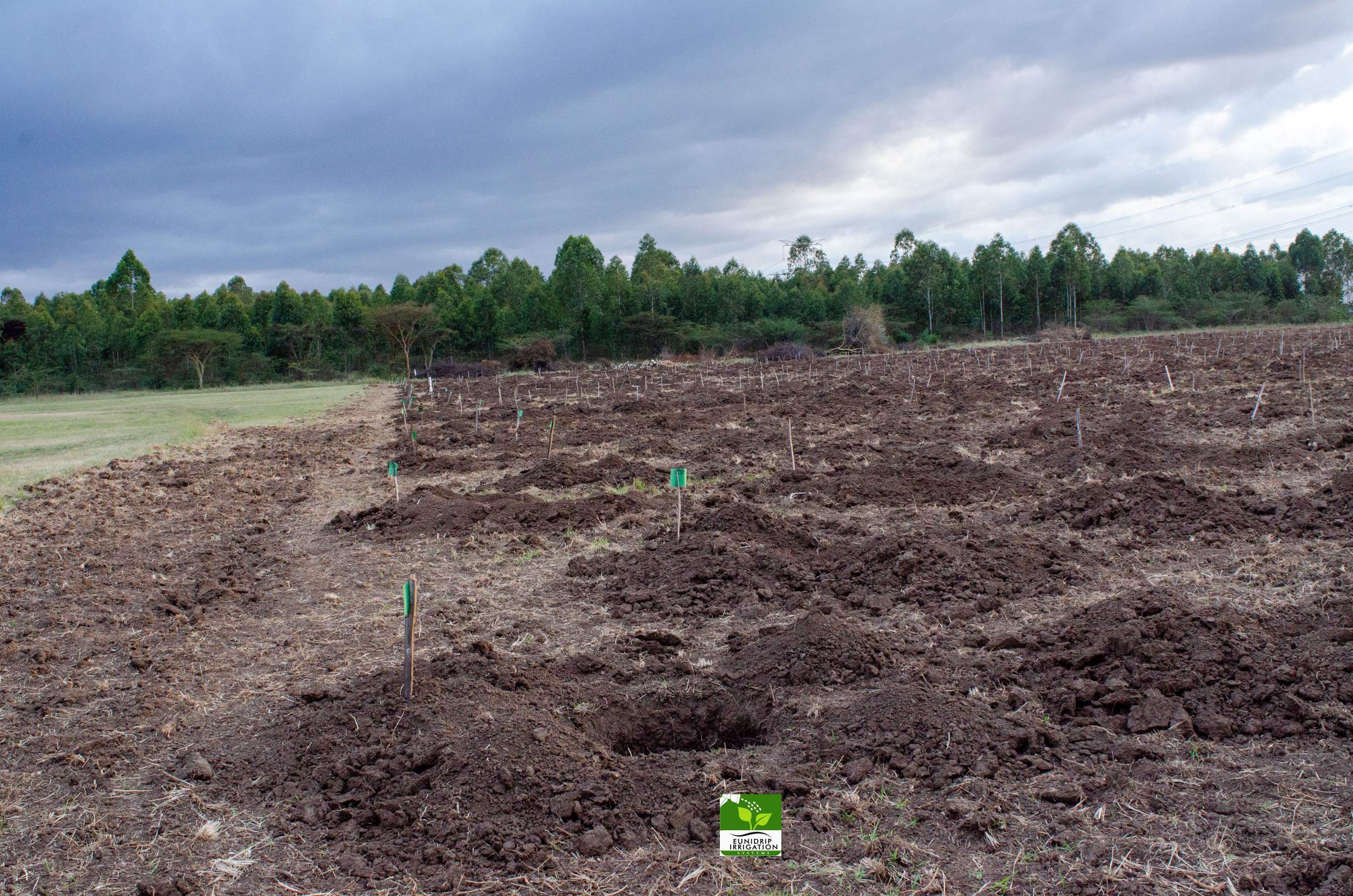
Then the emitters. Two drippers at 4 litres an hour give 8 litres an hour per tree. Consequently, 5,000 trees at full flow draw 40 cubic metres an hour. That is a large single shift for a farm pump. Split into two valves of 2,500 trees, each valve runs at 20 cubic metres an hour for three hours. The whole block then finishes in six hours at 240 cubic metres.
That is close enough to the peak-day figure from the table, which is the point. A design that cannot deliver the peak day in six or eight hours needs a bigger pump or a bigger reservoir. Therefore, both are cheaper to discover on paper.
Three parts of the layout follow from the site:
- Emitters: pressure-compensating drippers where the fall across the block exceeds about 2 percent, standard tape where the rows are short. Our guide to drip systems compares the two.
- Mainline: a loop, not a dead-end run, so the far end of the block keeps its pressure. On a 318 metre side, pipe diameter is the variable that decides this.
- Headworks: pump, sand filter, screen filter, valve manifold and a meter. Pump selection starts from the 40 cubic metres an hour figure and the total head, not from the acreage.
Energy comes next. Power lines cross the property, so a grid connection is the obvious option. However, a solar array with a variable-frequency drive removes the monthly bill and keeps pumping through an outage. Solar irrigation covers the sizing trade-off.
Cost of the Pixie Oranges Irrigation Project in Nakuru
The Pixie Oranges Irrigation Project in Nakuru lands inside a published band, not behind a single figure. Our drip cost page puts one acre at KSh 85,000 at the low end and KSh 160,000 at the top, depending on crop density. At 25 acres, that band becomes KSh 2.125 million to KSh 4 million for the irrigation kit.
That range is wide on purpose, because an orchard does not look like a bedded vegetable crop. A tree block carries fewer emitters per hectare than an onion bed, yet it carries more pipe per tree. The two effects pull in opposite directions. Therefore the quote has to be built from the planting layout instead of from the acreage band.
Four items sit outside the cost band for the Pixie Oranges Irrigation Project in Nakuru, and each belongs in its own column:
- Pump and headworks: sized from 40 cubic metres an hour and the total head.
- Storage: roughly 365 cubic metres of lined reservoir at the peak-day figure.
- Trenching and rock: priced per metre once the survey knows what the ground is like.
- Energy connection: a transformer, a solar array or both.
Ask for a take-off as well as a total. A bill of quantities lets a second supplier price the same materials. It also shows which line moved when two quotes differ by a million shillings.
Installation in the order it runs
Installation follows the survey, and the sequence matters more than the speed. In practice the crew works in six passes.
First, the rows are staked and the mainline route is marked. The trench then follows the design, not the driver’s convenience. Second, the trench is cut to depth and the main and sub-mains are laid. Third, the headworks go in: pump, filters, manifold and meter, all pressure-tested before the laterals connect.
Then the laterals and emitters follow, block by block. Each block is flushed before the emitters go on. That flush removes the soil and cuttings that would otherwise block the first drippers. Finally, the whole system runs for a full cycle while flows are logged at both ends of each block.
For a smaller example of the same sequence, see the one-acre install in Molo. The programme behind larger jobs appears in our East Africa installation overview. The ground work before trenching is covered under land preparation.
Handover and the maintenance calendar
Handover on the Pixie Oranges Irrigation Project in Nakuru is a training session, not a signature. The farm team learns to flush the laterals, clean the filters and read the pressure gauges. Those three habits prevent most of the failures that show up in year two.
The calendar that keeps the system honest is short. Flush the laterals monthly. Clean the screen filter every week and the sand filter when the pressure differential passes the maker’s limit. Take a flow reading at both ends of each block every 30 days. A slow drop at the tail is the first sign of a blocked line. Our guide to clearing blocked emitters explains what to do when the flow falls.
Finally, spares belong in the budget from day one. Two percent of the emitters, one spare filter element and a set of fittings cover almost every repair. They cost a fraction of a lost season.
What the Pixie Oranges Irrigation Project in Nakuru has not settled yet
Nevertheless, five questions are still open, and each one changes a number above. They are listed here so the client and the contractor can close them in order.
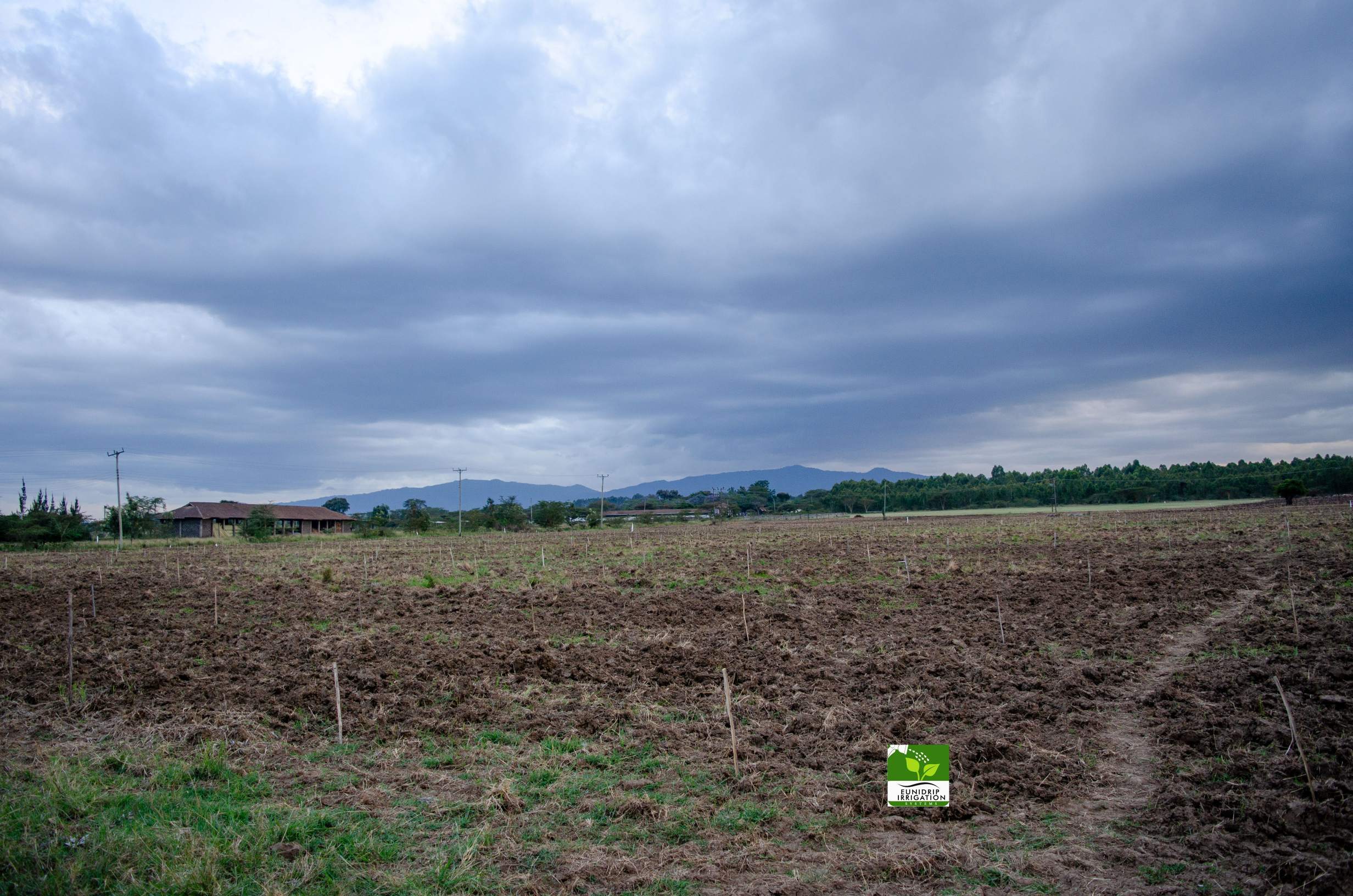
- Tree spacing and the final count: 5 metres by 4 metres gives about 5,000 trees. A tighter layout raises both the emitter count and the flow.
- Proof of water: the 24-hour pump test result has not been published, so the source is still unproven at peak demand.
- The final quote: the band puts the kit between KSh 2.125 million and KSh 4 million. The signed figure waits on the take-off.
- The calendar: no start and finish dates are published for this block, because the dates follow the quote and the permits.
- Expansion: if the farm plants beyond 25 acres, the pump and the reservoir are sized for the end state, not for today.
In practice, one habit keeps this honest. Whenever a figure above changes, the quotation changes with it, and the client sees which line moved.
Frequently asked questions on the Pixie Oranges Irrigation Project in Nakuru
These are the questions we are asked most frequently about the job.
The Pixie Oranges Irrigation Project in Nakuru covers 25 acres, which is 10.1 hectares, at Pixie Oranges Farm in Nakuru County. The system is designed for that area as a single unit with two irrigation valves.
Drip, with two emitters at each tree. It puts water at the root zone and keeps the inter-row dry for machinery. It also holds a steady flow on the slopes a 25-acre block usually has.
About 242 cubic metres a day at 4 mm of reference evaporation, rising to roughly 303 cubic metres at 5 mm. The pump and the reservoir are sized against that peak, not against the annual average.
The kit falls between KSh 2.125 million and KSh 4 million on the published per-acre band. The pump, the reservoir, trenching and the energy connection are quoted separately, so the total is higher than the band.
No completion date is published for the Pixie Oranges Irrigation Project in Nakuru. The order is fixed, though: survey, design, approved quotation, installation and handover. Each stage starts when the one before it closes.
Call Eunidrip Irrigation Systems on +254 728 163329 or +254 724 775516. Bring three figures when you call: the acreage, the source, and the run from the pump to the furthest corner.