

Table of Contents
Eunidrip Irrigation Systems is the irrigation company in Rumuruti that builds the field side of a water project. Drilling the hole is one job. Moving that water across a Laikipia plot is another. Getting it to the root zone at the right pressure is the hard part. This page covers that second job. It sets out what we measure before quoting, which emitter suits which crop, and what to hold in writing when the crew leaves. For the source itself, see our page on the Borehole Drilling Company in Rumuruti.
What an irrigation company in Rumuruti changes on your farm
Rumuruti is the headquarters town of Laikipia County. Farm trade around it runs on two short rainy seasons and two long dry ones. Mean annual rainfall for the county sits between roughly 400 and 750 millimetres. That is enough for ranching. It is not enough for a reliable vegetable crop without water you control yourself.
So the first thing an irrigation company in Rumuruti changes is the calendar. A plot that crops once in the long rains can crop three times. A tank, a pump and a line of emitters carry the dry months. Additionally, the same hardware delivers fertiliser, which is where most of the labour saving sits.
The second change is water use. Sprinkling shallow plateau soil at midday loses a large share of the water to evaporation before it reaches the roots. Drip lines put the water where the plant can take it. Consequently, a smaller source can serve a bigger bed.
Rumuruti farming decides the system, not the catalogue
In practice, five kinds of farm come up most often around town. Each one breaks the design in a different place.
- Small plots near town. The constraint is labour and cash, not water. A simple tape layout with one valve per bed works, and the owner can run it.
- Ranch and fodder land. The constraint is area. Lucerne and maize for cut fodder respond well to sprinklers and guns. The crop is dense, and its value per square metre is low.
- Orchard blocks. Avocado and mango sit on slopes. Here the emitter must hold its output from the top of the row to the bottom. Otherwise the trees at the far end starve.
- Greenhouse and shade net houses. Specifics matter more than size. Our write-up on shade net farming in Kenya covers the cooling side.
- Schools, health facilities and institutional farms. Reliability outranks yield. A system that needs daily attention from a groundskeeper will fail during the holidays.
Picking the system is therefore a local judgement, not a product choice. For this reason the honest test is simple. An irrigation company in Rumuruti should look at your farm before it sizes a kit.
What an irrigation company in Rumuruti measures before it quotes
Seven measurements decide the design. Because a quote that skips them is a guess, you end up paying for that guess in parts.
| What we measure | Why it changes the design | What it decides |
|---|---|---|
| Daily water demand | A herd drinks at dawn and dusk. A crop drinks through the day. | Storage size and how long the pump must run |
| Source yield and how steady it is | A source that tires by midday cannot feed four guns at once. | Number of zones and the order you open them |
| Silt and algae load | Drip emitters clog long before sprinkler heads do. | Filter type, flush routine and spare parts |
| Field shape and slope | Water runs downhill faster than it runs level. | Lateral length and where regulators go |
| Crop and plant spacing | A tree block and a tomato bed need different outlets. | Emitter type, spacing and line size |
| Power available on site | Grid, solar and generator each change the running cost. | Pump size and the starting method |
| Who will run it after handover | A system nobody flushes dies within two seasons. | Controls, simplicity and training time |
The seven site measurements behind every design we draw.
Two of those rows carry more weight in Laikipia North than they do elsewhere. Source yield, because a dry-season borehole is not the same borehole as a wet-season one. And silt, because the plateau’s water is often fine sand in suspension. Working through that list is the difference between a design and a parts order. It is also the standard an irrigation company in Rumuruti should be judged against.
Drip lines on Laikipia plots: where they pay
Drip is therefore the default for vegetables, and the default for a small water budget. It is the wrong answer for a dense fodder crop. There, the line cost buys coverage a sprinkler gives more cheaply.
Tape or hard line?
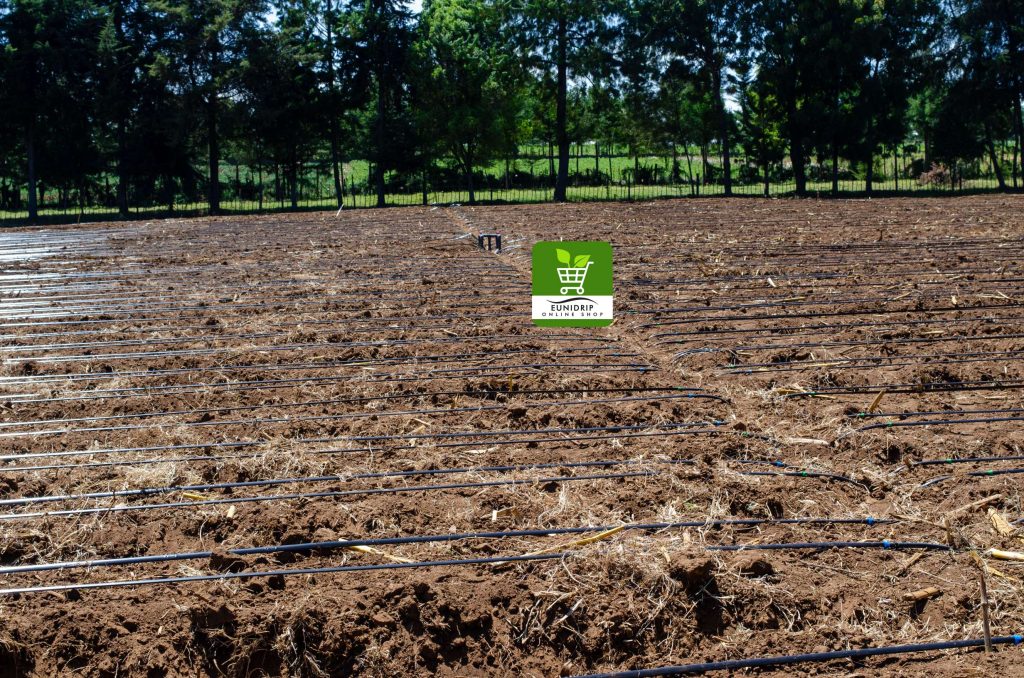
Tape is light, cheap per metre, and it is designed to be replaced. It suits a season-long tomato or onion crop on flat, prepared beds. Hard polyethylene line lasts for years. It suits a permanent planting or a crop under a net house that will not be dug up each season. Typically, an irrigation company in Rumuruti quotes tape for the season crop and hard line for the permanent one.
Specifically, tape rewards careful land preparation. A ridged bed with stones in it will cut the tape from below. Our guide to land preparation for drip irrigation covers that stage before the pipe ever arrives.
Fertiliser through the line
Fertigation is where a drip system earns back its price. Nutrient goes to the root zone in small doses, not broadcast on the surface. Less of it is lost, and none of it burns the foliage. Also, the labour is the same labour that opens the valve.
Emitters, lines and guns: the specs that decide the layout
Specifically, four products cover most of the field work around Rumuruti. The output and pressure figures below are the ones to check a quote against.
| Line or emitter | Output | Working pressure | Where it fits on a Rumuruti farm |
|---|---|---|---|
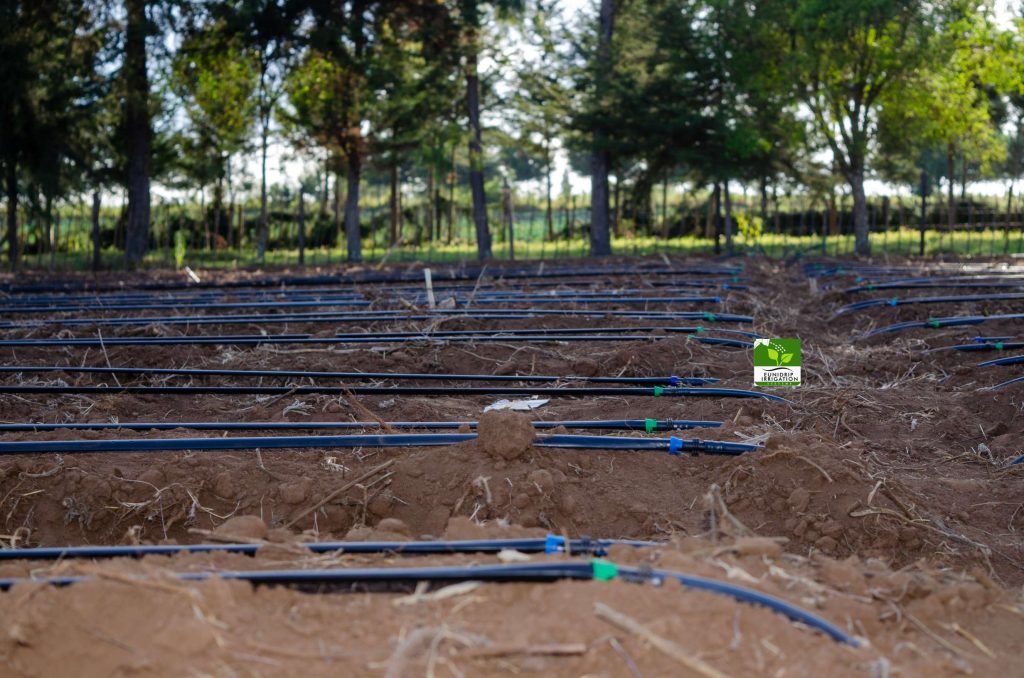
| Drip tape | 1 to 2.5 litres per hour per outlet | 1 to 2.5 bar | Seasonal vegetable beds on flat ground |
| Adjustable button dripper | 0.5, 1 or 2 litres per hour, by colour | 15 to 25 PSI | Trees, spaced crops and pots |
| Pressure compensation button dripper | Holds its output as pressure changes | Within the rated range | Sloping blocks and long laterals |
| Impact rain gun, 35 metre radius | 10,000 to 25,000 litres per hour | 58 to 80 PSI, or 4 to 5 bar | Fodder, maize and large open fields |
Four emitters cover most of the field work on the plateau.
First, read the pressure column. A rain gun that needs 4 bar will not run off a gravity tank. Also, a pump big enough to make that pressure costs more to run than a small plot can carry. Meanwhile, the drip rows work at the head an ordinary elevated tank gives you.
Sprinklers and rain guns for fodder and maize
Instead, sprinklers cover the crops drip cannot reach. Lucerne, fodder maize, wheat and pasture form a continuous canopy, so a line per plant makes no sense. Overhead coverage is the only practical answer. On a big block, a gun is the cheapest way to get it. Above a few hundred acres the answer changes again. Our shop page on center pivot irrigation covers those machines.
The trade-off is water and power. An overhead spray loses more to evaporation and wind. It also needs far more pressure than a drip line does. For this reason we size the source first and the gun second. This is also the part an irrigation company in Rumuruti gets wrong most often. A crew sells a gun by radius alone and never checks the source behind it. Our page on the sprinkler irrigation system sets out the head, mainline and nozzle maths.
Micro sprinklers, shade nets and the midday heat
Meanwhile, micro sprinklers sit between the two. They throw a small circle. Some give a full 360 degrees, others an adjustable arc from 30 to 330 degrees. They run on a half-inch or three-quarter-inch line. Nurseries, seedbeds and cut-flower houses use them because the droplet is gentle on young growth.
Likewise, under a shade net they do a second job. The same spray that waters the tray also pulls the air temperature down. That matters on the plateau when the sun is high and the wind is dry. The layout rules differ from open field work, so we draw them separately.
Stock water and the feed side of the farm
Around Rumuruti, a great many water projects have no crop in them at all. They are watering points. Troughs, dipping races and a dairy shed that washes down twice daily all draw on one source. Here the design is closer to plumbing than to agronomy.
Then there is the feed. Irrigation changes what you grow, but it also changes what you can process. A lucerne block on a sprinkler circle is worth more chopped than baled. Additionally, a chaff cutter turns a dry-season shortage into stored feed. Our write-up on chaff cutter operations in Kenya covers that side of the farm. So does the page on the animal feed mixer.
Silt is why a Rumuruti drip line dies early
In practice, most failed systems we are called to here did not fail from a burst pipe. They failed from an emitter nobody flushed. Plateau water carries fine sand from boreholes and algae from surface tanks, and both settle into the same tiny passage.
Because of that, filtration is not an accessory on this page. It is part of the design. Put a screen or disc filter at the head, a flush valve at the end of each lateral, and a routine that opens both. Then the emitter choice follows the water. A wider passage tolerates more silt, so a sandy source argues for button drippers over tape.
When a line is already blocked, the fix is usually a procedure and not a replacement. Our guide to unblocking a clogged drip tape walks through it step by step.
Power, head and pressure on the plateau
Grid supply reaches part of the town and much of the surrounding trading centres, but not every plot. Where there is no line, the choice is solar or generator. That choice is decided by the pump, not by taste.
A solar pumping set is sized against the day’s demand and the sun hours that follow it. Storage takes over where the panel stops. A generator set is cheaper to buy and dearer to run, and it tempts people into watering at midnight. First, we work out the daily volume. Next, we pick the pump. Then the power source falls out of that. Therefore, an irrigation company in Rumuruti should quote a daily volume before it quotes a pump. Our notes on buying a pump for drip irrigation and on solar irrigation carry the detail.
The installation stages we run on site
The sequence below is what a crew actually does, from the first visit to the day the owner takes over.
- Site walk and measurement. We survey the source, the tank position, the slope and the beds.
- Design and drawing. Zone layout, line sizes, emitter count and the filter set go on paper before anything is bought.
- Quotation against the drawing. Every item on the invoice appears on the drawing. Nothing on the drawing is missing from the invoice.
- Land preparation. Ridges levelled, stones cleared, and the mainline trench dug.
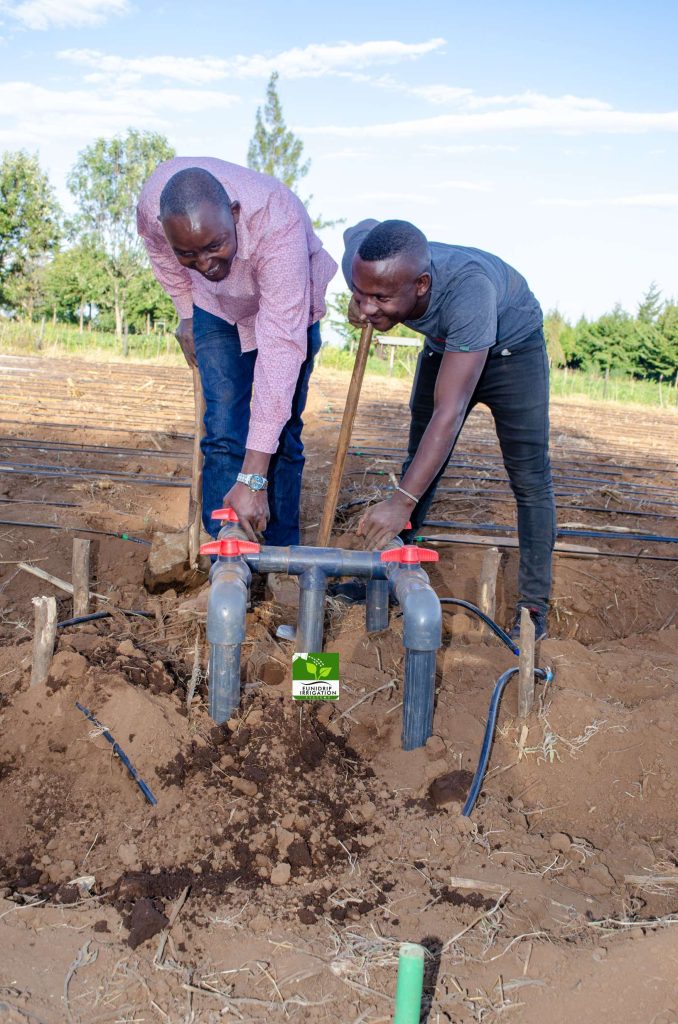
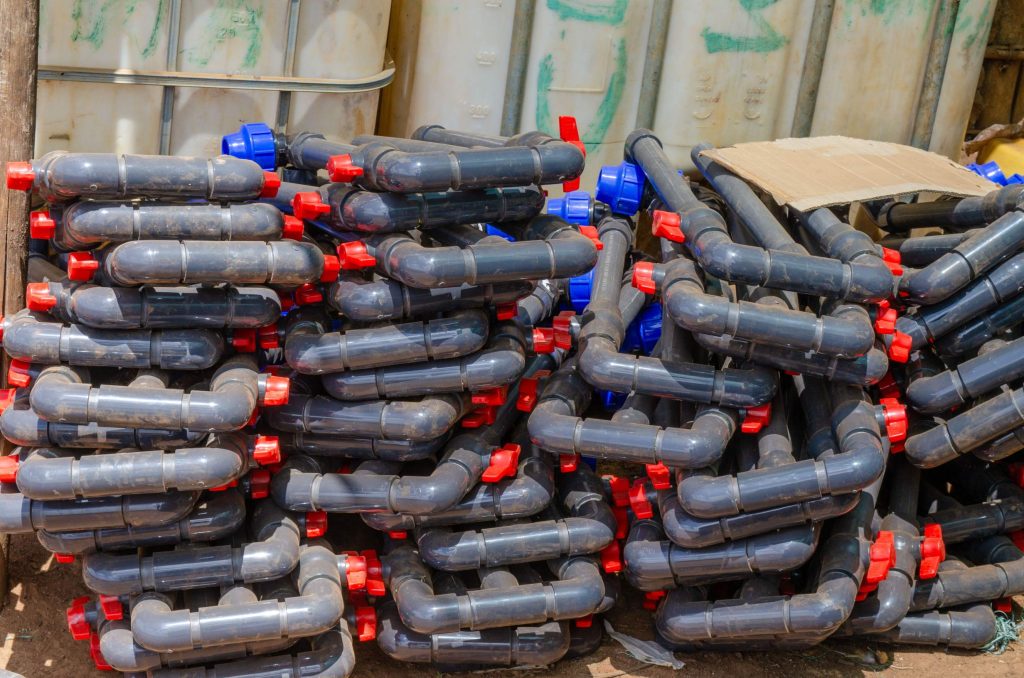
- Head assembly. Pump, filter, valves and manifold installed and tested under pressure before a single lateral is opened.
- Line and emitter layout. Laterals run out, emitters set to the spacing on the drawing, ends capped.
- Flush, pressure test and handover. The lines are flushed and the pressure checked zone by zone. Then the owner is trained on the flush routine.
What an irrigation company in Rumuruti hands over in writing
Stage seven is where most contractors get vague. A handover is not a handshake. It is a set of documents, and you should ask for them before you pay the balance. This list is also a test. It tells you which irrigation company in Rumuruti intends to be reachable.
- The drawing as built, not the drawing as proposed.
- A parts list with the emitter, filter and valve models actually installed.
- The flush and maintenance routine, written down, on a page you can hand to a worker.
- Warranty terms in writing, with what they exclude.
- Who to call, and how fast. Additionally, what happens if a fitting is no longer stocked.
How an irrigation company in Rumuruti services a dry-climate system
First, dust is the local problem. It settles on exposed tape, in valve stems and on sprinkler nozzles. The dry season here is long enough for that to matter. Next, sun is the other one. Ultraviolet light embrittles cheap fittings. A fitting that cracks in a hot month is a leak you find too late.
So servicing here is a calendar, not a call-out. Typically that means a flush each week in high use and a filter clean whenever the pressure drop is visible. Then an emitter count check at the start of each season, and a full drain between crops. Consequently, a system that is serviced costs less than one that is repaired.
Where your own labour stops paying
Also, a farmer can lay laterals, clip emitters and even assemble a simple head. That work is honest, and it saves money. What it should not include is the sizing.
Line size, pump duty and filter grade are decided by arithmetic. Get them wrong and the cost is a whole season. In practice, the cheapest path on a serious plot is a paid design and your own installation labour. For a smaller bed, a standard kit is enough. Our page on the drip irrigation kit for sale in Kenya says what a kit includes. The cost of a drip irrigation system in Kenya explains what moves the price.
Questions to put to any irrigation company in Rumuruti before you pay
Specifically, six questions separate a designer from a parts seller.
- Will the quote come from a drawing, or from a field size?
- Which filter is on it, and what does it remove?
- How many zones, and can my source supply them one at a time?
- What pressure do the emitters need, and what pressure will my pump actually give?
- Who flushes the lines after handover, and how often?
- Are the spares for these fittings available in Kenya next season?
A competent supplier answers all six without hesitation. Also, a supplier who has worked in Laikipia will name a specific filter. A general promise about clean water is not an answer.
Where this page stops and the borehole page begins
The split is simple. Anything below the tank is the drilling job: siting, permits, the rig, casing, development, test pumping and the water report. Anything from the tank outward is this page: filtration, mains, sub-mains, laterals, emitters, zoning, fertigation and controls.
One team can carry both, and that is how we usually work here. Still, know which half of your problem you are buying, because the two halves are priced and warrantied differently. Conversely, an irrigation company in Rumuruti that only does one half leaves you to join the two together. The county’s own agriculture, irrigation, livestock and fisheries directorate runs the public-side programmes. Additionally, the national State Department for Irrigation sets the wider water policy behind them.
Frequently asked questions about an irrigation company in Rumuruti
How large a farm do you take on?
There is no minimum. A bed of fifty metres gets the same design logic as a hundred-acre fodder block, only with fewer parts. What changes is the equipment, not the thinking.
Can a solar set run a drip system here?
Yes. Furthermore, it usually runs one better than a sprinkler set. Drip needs low pressure, so the pump duty is modest. A gun needs four or five bar, which is a much larger panel and a much longer sun window.
Do you drill the borehole as well?
We handle the whole job. However, the drilling work has its own page. Read it for depth, casing, permits and test pumping before you budget for the field side.
Which system is best for tomatoes on two acres?
Drip tape on prepared beds, zipped to a screen or disc filter, with a fertigation injection point. However, the real answer depends on your source. Two acres of tomato will empty a weak borehole in a single afternoon.
How long does installation take?
Once the design is agreed and the material is on site, most plots are finished within a few days. The long part, therefore, is the design. A supplier who quotes you the same afternoon has not measured your slope.
Who maintains the system after handover?
The owner, on the routine we leave behind. We are the call for the faults that routine does not cover, and for parts that have failed early. Because of that, keep the as-built drawing somewhere you can find it. An irrigation company in Rumuruti that answers in year four beats the cheapest quote in year one.