

Table of Contents
A chaff cutter is a simple machine, and a slow one is usually the result of how it is run and not how it is built. In practice, this page covers the working side of that chaff cutter in Kenya: the feed path, the blade setting, the published output of each drive type, the daily checks, the lubrication routine and the faults you can hear before the machine stops. Prices are not here, because a separate page carries them.
What This Page Covers
Four questions come up on every call about a chaff cutter in Kenya. What does the machine actually do to the fodder? Which drive suits my shed? How long will it take to cut today’s batch? What breaks first, and what does it cost me when it does?
Specifically, this page answers those four. It does not list models, and it does not quote a rate. For the published price of each machine, our chaff cutter machine price in Kenya page holds the current bands by model. For the commercial side, the shop listing carries the stock position and the sale price.
For this reason, keep the two pages apart in your head. A price tells you what a machine costs once. The operating facts tell you what it costs every week you own it.
How a Chaff Cutter Works
First, every machine on the Kenyan market does the same three jobs in the same order. It grabs the standing stalk, it pulls the stalk past a blade edge, and it drops the cut pieces out of a chute.
The grabbing is done by feed rollers or a spiked conveyor. The cutting is done by blades bolted to a disc or a drum, working against a fixed bed knife. The flywheel is what keeps the cut clean. It stores rotational energy between bites, so the blade does not stall when a thick stalk arrives.
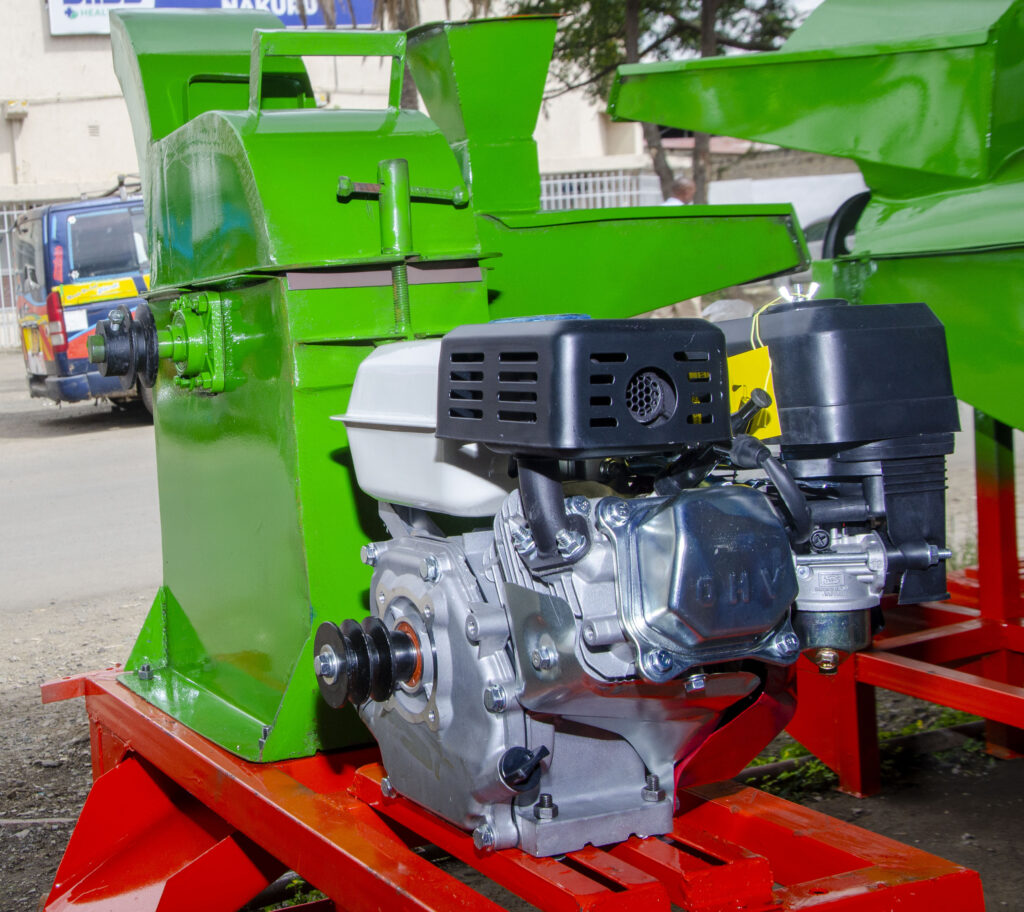
In practice, that one fact explains most slow running. A machine with a light flywheel and a worn belt slips exactly when the fodder is heaviest, which is when you least want it to slip.
The Chaff Cutter Feed Path, Step by Step
Then walk the fodder through the chaff cutter and you can find the fault without opening a panel. The path has six stages.
- Intake. The stalk goes into the chute, butt end first, and rests against the stop.
- Grip. The rollers close on the stalk and pull it in at a fixed rate.
- Cut. The rotating blade passes the bed knife and severs the stalk.
- Second cut. The same stalk is cut again as the roller feeds the next length.
- Discharge. The pieces leave through the chute or a blower.
- Collection. A bag, a cart or a bale catcher takes the cut material.
Stage two and stage three are where output is won or lost. Grip depends on roller clearance and on how dry the stalk is. Cut depends on blade edge, blade count and the gap at the bed knife.
| Stage | What you control | What it costs you when it is wrong |
|---|---|---|
| Intake | How the stalk is laid in | Uneven length, more re-passing |
| Grip | Roller clearance, spring tension | Rolling instead of cutting |
| Cut | Blade edge, bed knife gap | Shredded dust, higher load |
| Discharge | Chute angle, blower speed | Blockage, a stop on a full throat |
Each stage is adjustable, and each one you leave alone adds running time.
Consequently, a blocked discharge is the most common stop on a small farm. It is also the easiest to prevent, because it starts with a chute pointed at an empty cart and not a wall.
Cut Length and the Blade Setting
In practice, cut length comes from two settings working together: how far the roller advances the stalk between cuts, and how sharp the blade is at the moment it passes.
Typically, the machines sold here carry two or three blades on one disc, with a fixed bed knife opposite. More blades on the same shaft speed means a shorter piece at the same feed rate. Fewer blades means a longer piece, or the same length at a slower roller.
For this reason the number you want on the paperwork is the maker’s own cut-length range, in millimetres, at a stated roller setting. Ask for it in writing. If a supplier cannot give you a figure, judge the machine on the demonstration instead, and cut a handful of your own fodder, not the sample they prepared.
Why does this matter at the trough? Because piece length changes how animals sort the ration. Long, stringy pieces get selected and left. Fine, dusty pieces get blown out of the feeder. The setting that suits your herd is the one you find by watching the refusals, and it is a setting you can change.
Matching a Chaff Cutter to Your Fodder
Maize stover, Napier grass, wheat straw and hay are four different jobs. The machine does not care what the plant is called. It cares about stalk diameter, moisture and how much fibre is in the way.
For instance, green Napier is soft, wet and stringy. It wraps around a shaft that is not fully enclosed, and it plugs a discharge sized for dry straw. Dry wheat straw is light, dusty and abrasive. In contrast, it cuts easily, but it sends grit into every bearing and grease point on the machine.
Old maize stover sits between the two. The stalk is hollow and hard, and a dull blade crushes it instead of severing it. That is the fault most often blamed on an underpowered engine.
| Fodder | Main behaviour | What to set first |
|---|---|---|
| Green Napier | Wraps, plugs, stains | Shorter intake, clean discharge path |
| Dry wheat straw | Light, dusty, abrasive | More frequent greasing |
| Hard maize stover | Crushes on a dull edge | Blade condition before anything else |
| Cut and dried hay | Bulky, low mass | Longer cut, larger collection volume |
Set the machine to the fodder you actually cut, not the fodder used in the demonstration.
Therefore, if you cut more than one of these in a season, the deciding feature is how fast you can change the setting. A machine that needs a spanner and twenty minutes gets left on one setting all year.
Chaff Cutter Capacity in Kenya: The Arithmetic
Published output is stated in kilograms per hour. Your day is stated in bags, in animals and in hours of light. The bridge between them is one division.
| Drive | Power as published | Published output |
|---|---|---|
| Manual, flywheel and hand crank | No engine | 0.8 T/hour |
| Electric | 2 hp | 1,000 to 1,250 kg/hour |
| Electric | 3 hp | 1,250 to 1,500 kg/hour |
| Electric | 5 hp | 1,300 to 1,750 kg/hour |
| Petrol | 7.5 hp | 2,000 to 2,500 kg/hour |
| Diesel | 7.5 hp | 2,500 to 4,500 kg/hour |
| Diesel | 18 hp | 5,000 to 7,500 kg/hour |
| PTO, tractor-driven | Tractor shaft | Up to 2,000 kg/hour |
These are the maker’s published bands for the machines sold here, not measured field rates.
For example, suppose you cut 1,200 kg of stover in a morning. A petrol machine rated at 2,000 kg/hour finishes the cutting in 36 minutes at the published rate. A manual machine rated at 800 kg/hour needs 90 minutes of steady cranking for the same pile.
Then add the parts the rating leaves out. Unloading the stack, laying stalk into the chute, emptying full bags and clearing the discharge are real minutes, and they are usually more than the cutting minutes. A machine that cuts in 36 minutes and waits 50 is not a 36-minute machine.
Therefore, compare two quotes on total time, not on the printed rate. Ask the operator who runs one all day how many hours the whole job takes, and use that number.
Power Source: What Changes on the Ground
Specifically, four drives are sold here: manual, electric, petrol and diesel, plus a PTO machine that borrows its power from a tractor. The choice is rarely about horsepower. It is about what you already have.
An electric chaff cutter is typically the cheapest to run and the most restricted. It needs a three-phase or a suitably wired single-phase supply, and it stops the moment the grid does. Where the supply is reliable and the shed is fixed, it is the sensible pick, because it also needs the least upkeep.
In contrast, a petrol machine moves. It runs at a friend’s shed, in a store yard, or on a plot with no line. It carries fuel cost and engine service, and the units sold here are rated at 5 hp and 7.5 hp. Similarly, a diesel machine is the same freedom with more torque and a heavier service bill, and the larger 18 hp unit is rated for silage work and not a daily dairy ration.
Finally, a PTO machine needs a tractor before it needs anything else. If you already own one, it is often the strongest cut per shilling spent on power. If you do not, the tractor is the real price of the machine. Our PTO driven feed chopper page covers shaft speed, gearbox and the tractor checks.
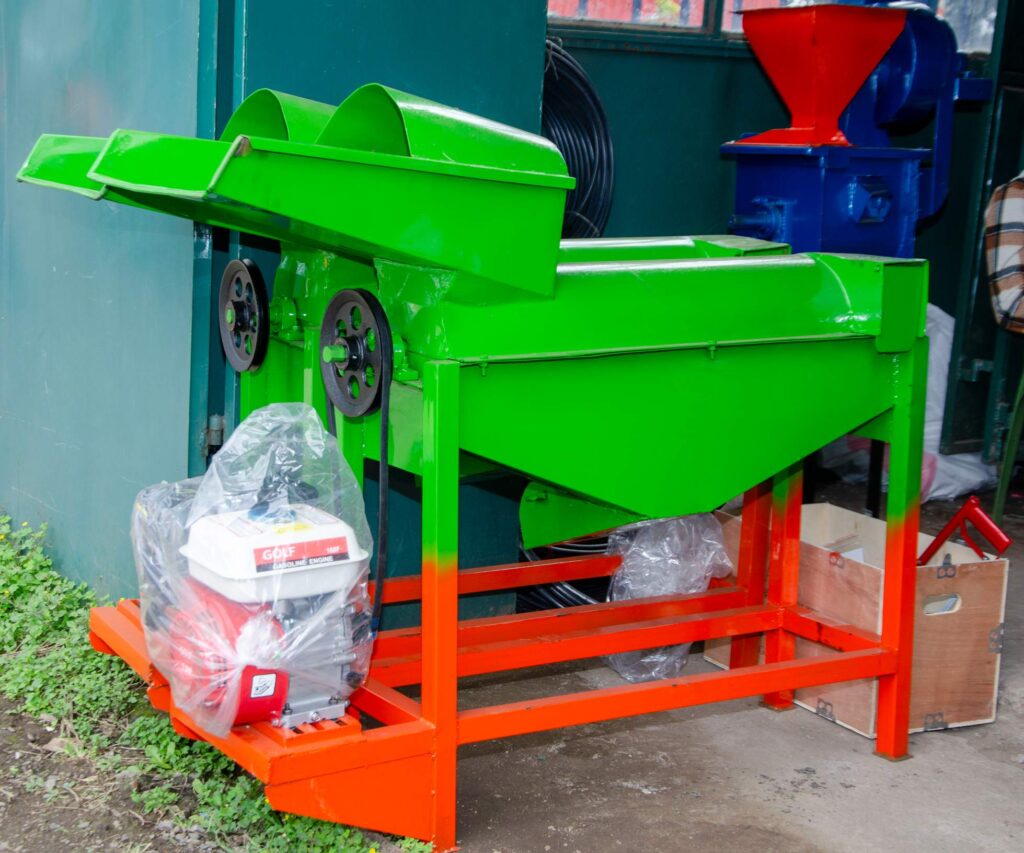
However, that photo is worth one warning. The engine arrives in plastic, and the belts are not yet tensioned. Set the belt tension and check the rotation direction before the first cut, because a reversed impeller blows nothing and a slack belt slips on the first wet stalk.
Daily Checks Before You Start a Chaff Cutter
Typically, five minutes of checks before the chaff cutter turns saves an afternoon of downtime. Run these checks in the same order every day, so a missing one is obvious.
- Welds on the frame and the chute bracket. A cracked weld changes alignment before it changes shape.
- Bolts and nuts on the blade carrier, the pulleys and the motor mounts.
- Belt tension and belt condition. Glazing on the underside means the belt is slipping.
- Throat and discharge clear of the last batch, and of any stone inside it.
- Guards in place, especially the flywheel cover.
- Blade edge, by sight and by the cut test on a stalk, not by touch.
A stone in the throat is the one check that saves the machine and not the schedule. It passes into a cutting gap, and the gap is made of steel edge against steel edge.
Lubrication, the Gearbox and the Season
Output and efficiency depend on how well the chaff cutter is serviced, and lubrication is most of that service. The routine sold with these machines has three parts.
Clean first. Lithium is used when cleaning the machine down, and grease is used when lubricating. Cleaning before greasing matters, because grease pushed over dust makes an abrasive paste that wears a bearing seat.
Then grease the moving points: roller shafts, bearings and the pulley bosses. Every grease point you skip becomes a bearing you replace. Finally, the gearbox. The gear oil in the box should be changed every season, not every year, because a season of dusty straw work is harder on oil than calendar time suggests.
Therefore keep a small log. Three lines a week, dated, is enough. When a part fails early, the log tells you whether it was skipped.
Blade Care: What a Dull Edge Costs
A dull blade does not slow the machine down. Instead it changes the cut from a sever to a crush, and a crushed stalk passes through the animals less cleanly. That is a feed problem disguised as a machine problem.
Blades on these machines are high-carbon steel, usually two or three per carrier. They are bolted, not welded, so a replacement is a bolt job with the right spare. Two practical rules follow.
First, buy spares with the machine, not after it. Ask the seller for the blade part number and the bolt size, and put two sets in the store. Second, check the bed knife with the blades. A sharp blade against a worn bed knife still shreds, and it is the bed knife nobody inspects.
Likewise, if a chaff cutter is left outdoors, rust pitting on the blade face will cost you an edge before the edge wears. Store the carrier dry, and coat it lightly when the season ends.
Safety Around the Flywheel and the Chute
Specifically, the injuries on these machines come from two places: the flywheel and the intake. Both are obvious, and both are covered by a guard that gets removed for a stubborn stalk and never put back.
Never reach into the throat while the flywheel turns. A flywheel keeps spinning after the power is off, and on a manual machine it keeps spinning after you stop cranking. Wait for it, or block it. Likewise the same rule applies to clearing a plugged chute, which is the single most common reason a hand ends up inside a running machine.
Keep the discharge pointed away from people, because a machine throws more than cut grass. Loose stalk, a broken blade fragment and a stone all leave at the same speed. The International Labour Organization keeps the general guidance on machine guarding and operator safety for agricultural work.
Finally, two more habits are worth the trouble. Tie back anything that can be drawn in, and run the machine at the shaft speed the maker states, not faster to finish sooner.
Faults You Can Hear Before You Stop
Typically, most failures announce themselves in sound and in the shape of the cut. Match the symptom, then work the feed path in order, starting at the intake.
| Symptom | Likely cause | First action |
|---|---|---|
| Rolling roar, long strands | Worn blade or wide bed knife gap | Blade and bed knife check |
| Belt squeal under load | Slack or glazed belt | Tension or replace the belt |
| Machine stalls on wet stalk | Feed too fast for the drive | Shorter bites, slower intake |
| Vibration at no load | Bent blade carrier or loose bolt | Stop, then inspect the carrier |
| Discharge slows and backs up | Plugged chute or blower wear | Clear with power off and blocked |
| Grease weeping at a bearing | Over-packed or worn seal | Clean, then check shaft play |
Six faults cover most of a season, and five of the six need no parts.
However, vibration is the one symptom to treat as an emergency. A cracked blade carrier at shaft speed is a thrown piece of steel, and no batch of stover is worth that risk.
Watch a Diesel Machine With a Blower Run
The blower is typically the feature that changes how a chaff cutter fits a shed. Without it, cut material drops at the mouth of the chute and someone bags it. With it, the material is blown across the yard into a cart or a clamp, and one person does the work of two.
For instance, watch the discharge in this clip before you decide. Note how the operator feeds, how the pile builds, and how much time goes to handling and not cutting.
Buying a Used Machine: Six Checks
A used chaff cutter is a reasonable purchase when the wear parts are cheap and the frame is sound. Both of those are checkable in twenty minutes, and both decide the real price.
- Frame. Sight along the skid. A bent frame misaligns the shaft and no blade change fixes it.
- Welds. Look for tack welds and paint-filled cracks at the chute bracket.
- Shaft play. Grip the carrier and rock it. Any play is a bearing or a bushing.
- Blades and bed knife. Ask the price and lead time for a spare set before you agree yours.
- Guards. A missing flywheel cover is a discount, not an extra.
- Run it on your fodder. Bring a armful of your own stalk, wet or dry as you normally cut.
In practice, local fabrication is common in this category, and it is not a problem by itself. What matters is whether the parts are still being made. Our guide to a locally made feed chopper sets out the frame, weld and blade checks to run on a workshop-built machine, and the imported feed chopper page covers landed cost and spares.
Chaff Cutter Operations: Frequently Asked Questions
How do you feed a chaff cutter correctly?
Lay the stalk butt end first against the stop, and let the rollers take it. Do not push. Pushing a stalk faster than the rollers grip it is how a machine jams and how hands get close to a cutting gap.
Why does my chaff cutter jam on wet grass?
Wet fodder wraps instead of breaking. It builds on the roller shaft and closes the discharge. The fix is a shorter bite and a clear chute, not more power. Stop, block the flywheel, and clear it.
How often should the blades be sharpened?
By condition, not by calendar. Test with a stalk at the start of each working day. If the cut crushes or the strands are ragged, the edge is done. A season of dry straw shortens the interval.
Does the gearbox oil really need changing every season?
Yes, if the machine works a season of dusty material. Straw dust reaches the box through the shaft seal, and oil loaded with silica polishes gears. A season is the interval the maintenance guidance for these machines gives.
Is a manual machine worth it for a small herd?
It is worth it when the volume is small and the labour is there. At about 0.8 T/hour, a manual unit suits a few animals and a short daily batch. It also has no engine to service, which is its real advantage.
What cutting length should I set?
Watch the refusals. Animals sort long pieces out and leave them, and they blow fine pieces out. Adjust one step, feed for a week, then judge the trough. Ask the maker for the cut-length range in millimetres before you guess.
Which is cheaper to run, PTO or a petrol engine?
A PTO machine is cheaper per hour only if the tractor is already paid for and already fuelled for other work. Otherwise the tractor is the cost. See the PTO driven feed chopper page for the shaft-speed and gearbox checks.
Where to Go Next
Three pages finish the job this one starts. For the published bands by model, our chaff cutter machine price in Kenya article carries them. For the full model list and the drive comparison, the feed chopper for sale page covers the seven machines we list.
Similarly, grain handling is a separate machine. The hammer mill page covers what a screen size does to meal, and the animal feed mixer page covers blending a ration after the cutting is done.
For the wider range, including the sizes in stock, the shop category for chaff cutters in Kenya is where to start. Fodder conservation research from the International Livestock Research Institute gives the wider context on storing what you cut, and the definition of chaff explains the older term the machine is named for.
Finally, run the daily five before the next batch, and write the log. The machine will tell you the rest.