Borehole Drilling in Kenya: 7 Steps, Top Costs
Borehole drilling in Kenya is the most dependable way to secure water when the municipal line runs dry. First, a survey locates the water. Then we drill, case, develop, equip and test the hole. One team stays with the job from the survey to the tap.
Demand for borehole drilling in Kenya keeps rising with erratic rainfall and expanding small-scale farming. Typically a household, a school or a one-acre greenhouse needs the same thing: a yield that holds through the dry months. Eunidrip Irrigation Systems has drilled over 200 boreholes across the country, in urban plots and in remote counties.
We work for domestic, commercial, industrial and agricultural clients. Additionally, we install submersible electric pumps, solar pumps and hand pumps. We also erect steel tanks and towers so the water reaches the use point under pressure.
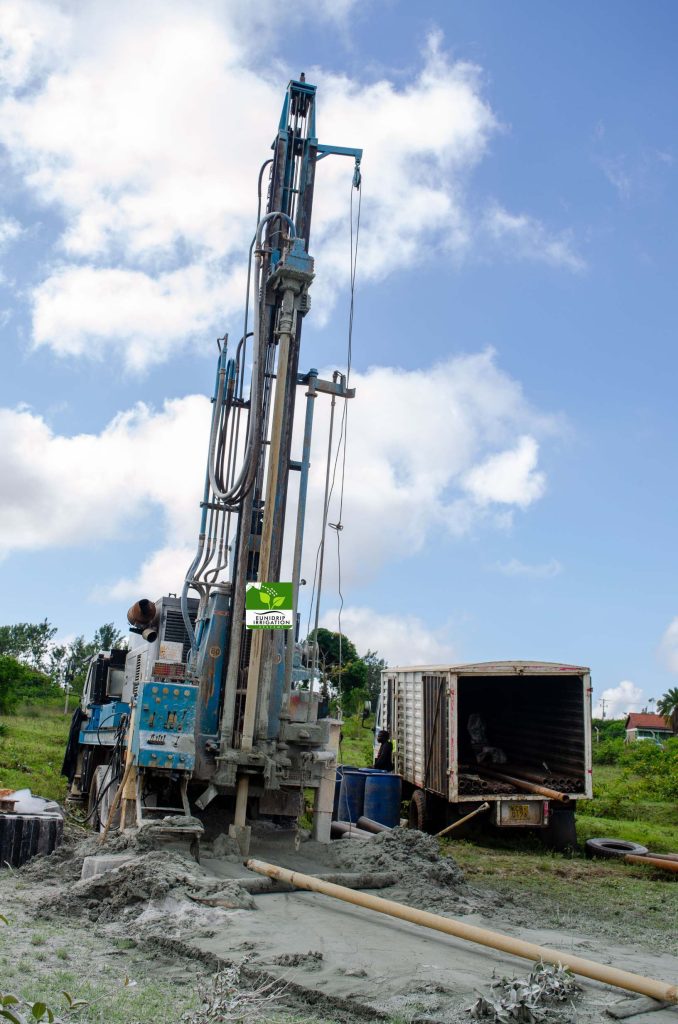
The 7-Step Process of Borehole Drilling in Kenya
Drilling a borehole is a sequence, and each stage constrains the next. Below is the order our crews follow on site.
1. Hydrogeological survey
A survey comes before any rig moves. Experts read the rock formations and the water-bearing zones to estimate potential yield. They also test soil and rock composition, because that choice drives the drilling method and the casing. Next, the team estimates the water table depth so the hole reaches a sustainable supply. Finally, the survey checks regulatory compliance. Our Groundwater Hydrogeological Survey in Kenya guide covers this stage in detail.
2. Drilling
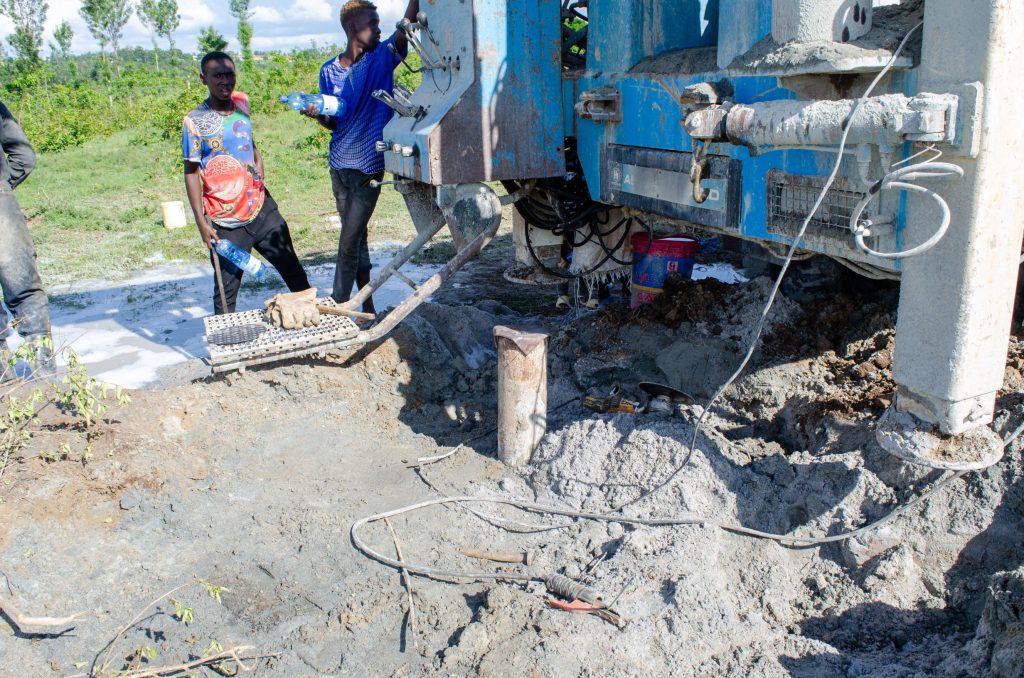
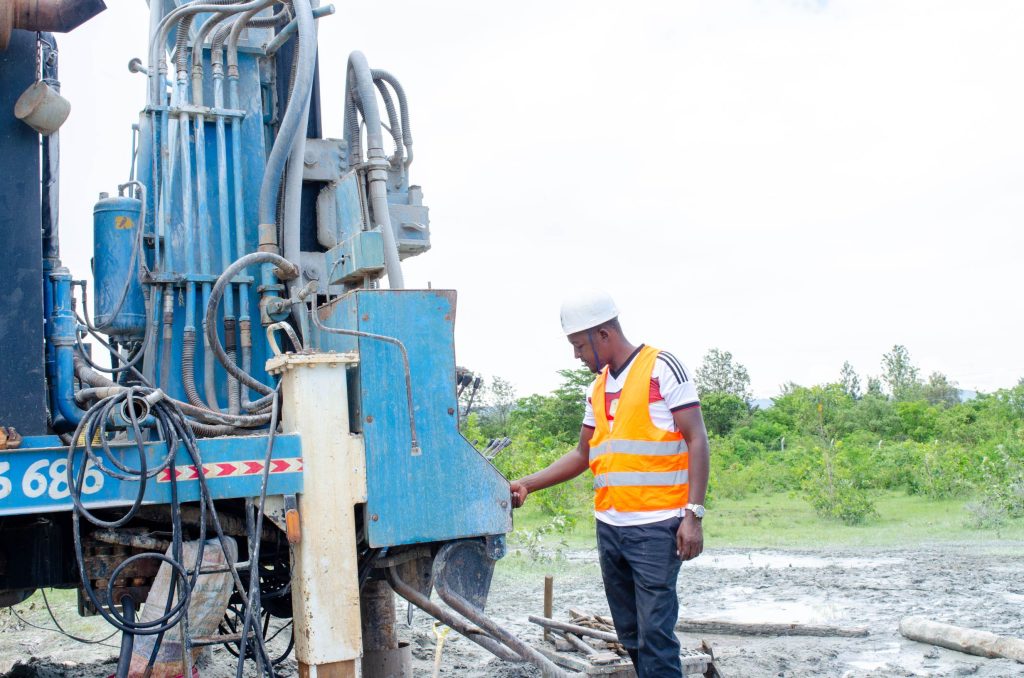
With the site fixed, drilling begins. Rigs, compressors and consumables arrive on the day. The crew drills with an 8¼-inch bit to reach the water-bearing zone, using rotary or percussion methods depending on the ground. Hard rock calls for specialised bits. Meanwhile the team watches borehole stability to prevent collapse.
3. Casing and gravel packing
Reaching depth is only half the job. The hole must hold its shape and keep surface water out. First, the crew lowers 6-inch casing screens, usually PVC or stainless steel. Then filter-packed gravel surrounds the casing, which supports the wall and strains out fine sand. Finally a sanitary seal closes the top of the hole.
4. Borehole development and testing
A fresh borehole runs muddy. Development flushes out cuttings, drilling fluid and fine particles. Then a test pump runs the hole to measure yield in litres per second and the recovery rate. Therefore the engineer can size a pump the aquifer can actually feed. The casing and gravel pack are checked at the same time.
5. Water pump installation
Pump choice follows the test data. Depth, required yield and the available power decide it. Three types do most of the work. Submersible electric pumps suit deep boreholes with grid power. Solar pumps suit off-grid sites. Hand pumps suit rural points with modest demand. Then the crew sets the pump at its working depth and makes the electrical and piping connections.
6. Water storage and distribution
Water needs somewhere to sit before it is used. Steel or plastic tanks go on towers, which hold pressure without a second pump. Pipes then run to the house, the tank stand or the field. In addition, pressure pumps and control valves regulate flow where the network is long.
7. Water quality testing and treatment
Before handover, a laboratory reads the water for bacteria, heavy metals and chemical contamination. pH gets checked so the supply is neither too acidic nor too alkaline. Treatment follows the result: chlorination for pathogens, filtration for sediment, reverse osmosis for dissolved salts. As a result the water is matched to its use, whether for drinking, irrigation or industry.
Commissioning closes the job. The owner is trained on the system, and we hand over well logs, water test results and an operations guide. After that, servicing stays with the same team.
Borehole Drilling Equipment and Rig Mobilization
Mobilization is a cost line of its own. Rigs, compressors, casing, gravel and fuel must all reach the site, sometimes along an unmapped access track. Because of that, a remote site costs more to drill than a plot twenty kilometres out of town. Our Drilling Equipment Mobilization in Kenya post sets out what moves and what it takes.
Borehole Drilling in Kenya: The Five Services
Eunidrip delivers five services on one contract, so no second supplier is needed. Each one is listed below with what it covers.
- Hydrogeological surveys – Mapping and geophysical equipment locate the water-rich zones before drilling.
- Drilling – Residential, agricultural and commercial holes, from soft soils to hard rock, including casing and well development.
- Pump installation – We supply and fit pumps matched to the measured flow, and we train the operator.
- Borehole maintenance and rehabilitation – Yield falls with age as silt and scale build up inside the casing. We clean, repair and upgrade an existing borehole to restore its output and extend its life.
- Water testing and treatment – Laboratory checks for bacteria, heavy metals and salinity, then filtration, chlorination or reverse osmosis on the result.
Applications of Borehole Water in Kenya
A borehole serves more than a kitchen tap. Here is where our completed holes go to work.
- Domestic supply – Homes gain a reliable source instead of waiting on an unpredictable municipal line.
- Irrigation – A steady supply carries crops through the dry season. Most of our agricultural clients pair the borehole with a drip irrigation system in Kenya, which turns the yield into a scheduled watering plan.
- Commercial supply – Businesses keep toilets, kitchens and cooling systems running without a tanker schedule.
- Industrial supply – Factories and processing plants meet a large, consistent demand.
- Hospitality – Hotels, lodges and resorts sustain guest demand year round.
- Schools and colleges – Boarding facilities meet water requirements that a borehole can cover on its own.
- Hospitals – Healthcare operations depend on a supply that cannot be interrupted.
Borehole Drilling in Kenya: Costs by County
The cost of borehole drilling in Kenya moves with geology, depth and access. The figures below are per metre drilled, so a deep hole costs more than a shallow one in the same county.
| County | Cost per metre (Min) | Cost per metre (Max) |
| Nairobi | KES 6,100 | KES 9,500 |
| Mombasa | KES 7,000 | KES 9,500 |
| Turkana | KES 8,000 | KES 9,500 |
| Busia | KES 7,700 | KES 11,000 |
| Kilifi | KES 7,500 | KES 9,500 |
| Machakos | KES 6,500 | KES 9,500 |
Loose soils raise the bill. Busia and Kilifi need more casing work, so the crew spends longer on site. Rocky ground, as in Turkana, calls for specialised bits and slows the drill rate.
Four factors set the final quote. Location decides the depth and the method. Depth drives equipment, labour and time. Permits add their own fees. Then the pump, tank and filtration you specify close the figure. Therefore a site visit beats any published rate.
Permits and Compliance for Borehole Drilling in Kenya
You need a permit even when the borehole sits on your own land. First, apply to the Water Resources Authority, which regulates the abstraction. Second, file an Environmental Impact Assessment report. Third, obtain approval from the National Environment Management Authority. In some areas a letter of no objection from the local service provider is also required.
Our team guides the paperwork with you, so drilling does not stall on an unanswered application. The Water Resources Authority sets the rules we build to.
Why Choose Eunidrip for Borehole Drilling in Kenya
Five things separate our crews from a rig-for-hire operator.
- Experience – Over 200 completed boreholes, in urban plots and in remote counties.
- Method range – Symmetric drilling, core drilling and geo-technical drilling, matched to the ground.
- End-to-end delivery – Survey, permits, drilling, casing, test pumping, water analysis and handover on one contract.
- Tailored design – A household hole and a 10-acre irrigation hole are not the same job, and we size for each.
- Nationwide coverage – Operations across all 47 counties, so the crew is not learning your geology on your bill.
For the fuller case, read Why Choose Eunidrip Irrigation Systems for Borehole Drilling in Kenya? If your site needs the full process explained first, the Step-by-Step Process of Borehole Drilling post sets it out stage by stage.
Where We Work Across the Country
Eunidrip drills across Kenya, including Nairobi, Nakuru, Kisumu and Mombasa, and in the rural counties between them. Three of our project areas have their own pages, which record what the ground there demanded.
- Borehole Drilling in Nakuru
- Borehole Drilling in Ithaga Murang’a County
- Borehole Drilling Company in Rumuruti
Frequently Asked Questions about Borehole Drilling in Kenya
What are the key requirements for drilling a borehole in Kenya?
You need a hydrogeological survey, a permit from the Water Resources Authority, an Environmental Impact Assessment report, and approval from the National Environment Management Authority. In some areas a letter of no objection from the local water service provider is required too.
How much does borehole drilling cost in Kenya?
Costs vary with location, depth and soil type. Rates run from KES 6,000 to KES 11,000 per metre drilled, so the total follows the depth your site needs. Eunidrip gives a tailored quote after the survey.
How long does it take to drill a borehole?
The schedule depends on depth and ground conditions. Typically the job takes between 7 and 14 days, including the survey, permits, drilling and installation.
Do I need permits if the borehole is on private property?
Yes, permits are mandatory on private land. Water Resources Authority and National Environment Management Authority approvals keep the abstraction legal and the water table protected.
What does borehole maintenance involve?
Silt and scale build up inside the casing with age, so yield falls year by year. Maintenance means flushing, repairing and upgrading the hole to bring the output back. Rehabilitation extends the life of a borehole that has already been drilled.
Talk to Us About Your Borehole
Speak to Eunidrip Irrigation Systems on +254 728 163329 or +254 724 775516. We will walk you through the survey, the permit and the drill plan, then size the pump to the yield your land can hold.