

Table of Contents
Rumuruti sits on the dry side of the Laikipia escarpment. Rain arrives in two short seasons, and piped supply reaches only part of the town. A borehole drilling company in Rumuruti has to solve two problems at once. It must find water that holds through the long dry months, and it must hand over a system that still works after the rig has gone back down the A6.
Most calls here are not for a house tap. They are for stock water, for a small irrigation plot, or for a school that has been buying water by the tanker. Each of those needs a different borehole. This page covers the county decisions: siting, permits, what the rig does on the plateau, and what you should hold in writing before you pay.
What a borehole drilling company in Rumuruti does
Scope is where local quotes differ.
Some crews only drill. They arrive once siting is settled, put a hole down and leave. A full-service borehole drilling company in Rumuruti carries the whole job. Additionally, one team answers for the depth, the casing, the pump and the water quality.
- Groundwater survey and siting, with a report on depth and expected yield.
- Drilling, casing and gravel packing.
- Borehole development and test pumping.
- Pump selection, installation and electrical or solar wiring.
- Water testing and treatment advice.
- Permit support, then maintenance after handover.
For the full technical sequence, our eighteen-phase drilling guide covers every stage we run nationally. This page stays on the parts that change in Laikipia North.
Sizing the borehole before the rig arrives
Depth is not a badge.
A borehole is sized against demand, and demand here is usually livestock-led. This is the first question a borehole drilling company in Rumuruti should ask. It is also the one most quotes skip. Write your daily figure down before anyone quotes. Then pick the storage that matches it.
| Use | Typical daily draw | What it changes on site |
|---|---|---|
| Household plot | 300 to 800 litres | A modest yield and one poly tank are enough. |
| Dairy or ranch watering | 3,000 to 10,000 litres | Yield and storage matter more than depth. |
| Small irrigation plot | 20,000 litres upward | Pump duty and a reservoir set the design. |
| School or health facility | 5,000 to 15,000 litres | Reliability and a backup tank carry the risk. |
Consider a herd that drinks 6,000 litres on a hot day. It needs that volume in the trough, not in the ground. If the aquifer yields 700 litres an hour, a 5,000 litre tank filled overnight does the job. Skip the tank and the same borehole looks like a failure by mid-afternoon.
For the crop side, our guide to choosing a pump for drip irrigation covers the duty curve a borehole has to feed.
Site conditions we look for around Rumuruti
We do not guess at geology from a map.
What we read on the ground is narrower and more useful. Six items decide most of the budget before the bit turns.
- Elevation and slope, because a tank needs gravity or a bigger pump.
- Surface and access, since a truck-mounted rig cannot climb a wet garden.
- Existing shallow wells and where their water sits in the dry season.
- Neighbouring boreholes, their depth and their static water level.
- Distance to a power line, which decides electric or solar.
- Upstream contamination within the catchment, pit latrines first.
Two of those matter most. First, if the rig has to winch in or the access road fails in rain, mobilisation moves before drilling does. Second, if the nearest grid connection is far, a solar pump stops being an option you are weighing and becomes the design. Likewise, a site with no dry-season access is a winter job, whatever the survey says.
Permits a borehole drilling company in Rumuruti files for you
Abstraction in Kenya is permit work, not a handshake.
Under the Water Act, a user needs permission from the national water regulator before taking water for most purposes. Larger projects also need an environmental licence. The environmental side runs through the National Environment Management Authority, whose site sets out which projects require a licence and how to apply. County land and works approvals sit with the County Government of Laikipia.
Our role is the technical file those applications demand: survey report, driller’s log, casing design and pump test results. What no contractor can do is sign the permit for you. Because of that, treat any company that promises a permit without your identification document, your title deed or lease, and a water user association letter where one applies, as a crew cutting a corner you will pay for later.
Survey and siting, before any rig moves
First, a geophysicist walks the site and reads the ground.
The instrument matters less than the interpretation. A survey that reports only a dot on a map, with no expected depth, no expected yield and no reasoning behind either, is not a survey you can act on.
Specifically, ask for the method used, the apparent resistivity readings, the depth the team expects to reach and the yield range they expect. Our page on the groundwater hydrogeological survey in Kenya explains what a usable report contains.
Drilling, casing and gravel pack on the plateau
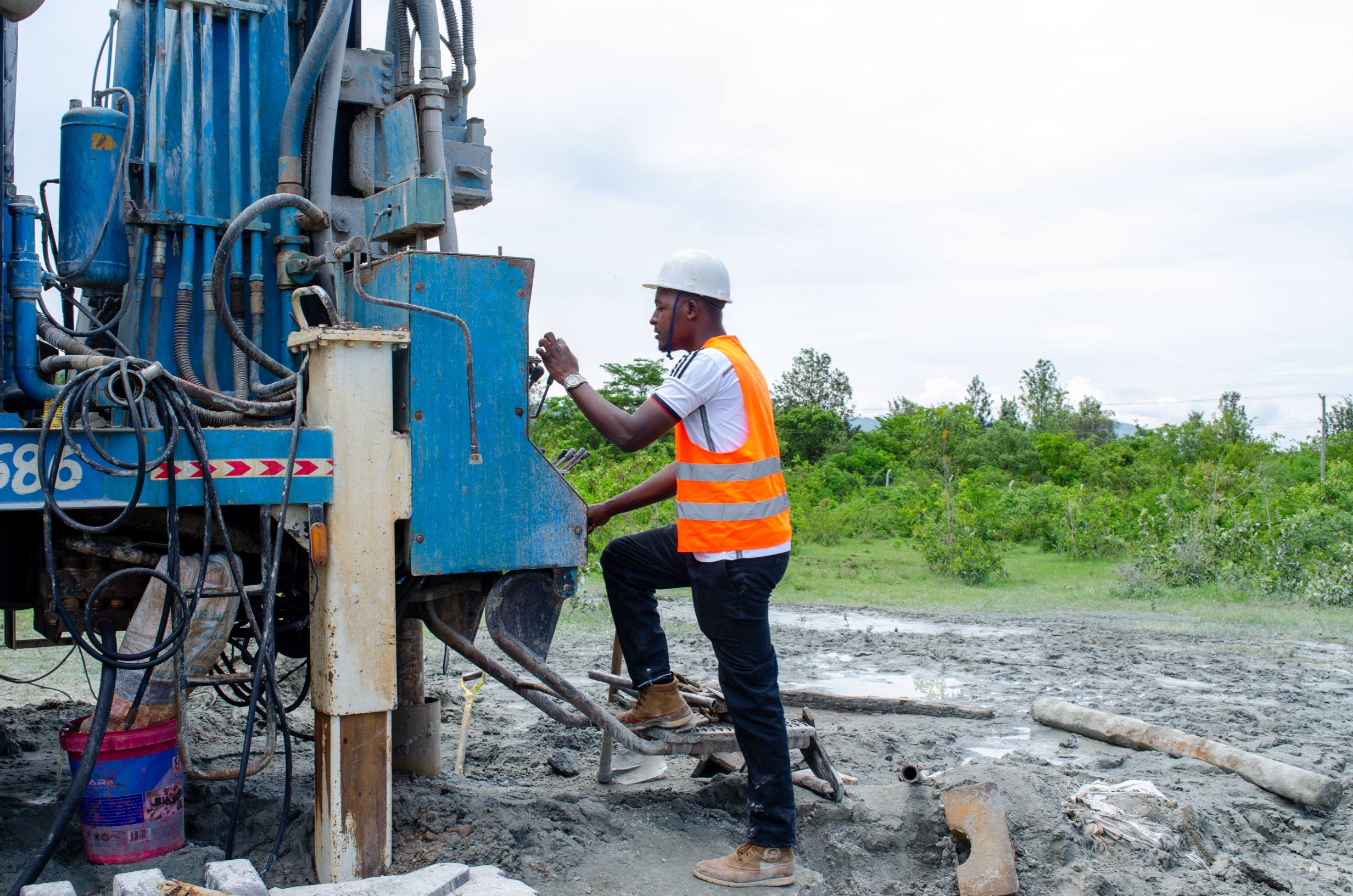
In practice, rotary drilling is the normal method here.
The crew advances the hole, logs the cuttings as they come up, and records the depth at which water is first met. Then casing goes in. This is where a cheap quote shows itself.
A domestic borehole needs uPVC casing of a diameter that carries the planned pump with room to spare. The casing must be centralised in the hole, surrounded by a gravel pack, and sealed at the top against surface water.
That seal is the part most often skipped. Without it, runoff travels down the outside of the casing, and a clean borehole becomes a contaminated one inside one rainy season.
Development and test pumping
Also, a freshly drilled hole pumps mud.
Development clears the formation around the casing, and it takes hours rather than minutes. Typically it runs half a day. Only once the water runs reasonably clean does the test pump start, and that test answers the question the whole job turns on.
The crew pumps at a set rate, watches the water level fall, then stops and records how fast it recovers. Recovery, not the flow you see on the first afternoon, is what the pump must be sized against. For example, a borehole that yields 1,200 litres an hour but needs six hours to refill cannot run a 1,200 litre an hour pump through a day. For a borehole drilling company in Rumuruti, this is the test that separates an honest report from an optimistic one.
Pump, tank and distribution
With test data in hand, the pump is sized to duty.
A submersible sits below the water column, and the choice between electric and solar follows the grid question from the site visit. Where there is no line nearby, the shop lists the solar pumps for sale in Kenya we fit, together with panel and controller sizing.
Storage comes next. A tank decouples the borehole from the demand curve, and it lets a solar pump run only in the strongest hours. Meanwhile a poly tank caps out around 10,000 litres.
Where the plot is large, or one borehole feeds several households, a lined reservoir holds far more. Our page on irrigation reservoir construction covers how those are sized and who supervises the build.
Water testing and handover
Borehole water is not automatically drinking water.
Two checks matter here, and a borehole drilling company in Rumuruti should name both. The first is bacterial contamination from nearby pits and dump sites. The second is fluoride, which is common in parts of rift valley groundwater and matters wherever the borehole serves people. Consequently, send a sample to an accredited laboratory before the water reaches a tap used for drinking.
Therefore the test is cheap next to a filtration system you did not need, or one you badly did. Then keep the paperwork.
What a borehole drilling company in Rumuruti hands over
Thus, judge the job on the file, not the first splash.
- A driller’s log showing depths and the water strike.
- The as-built casing design and the gravel pack record.
- Test pumping data: rate, drawdown and recovery time.
- The laboratory result for the intended use.
- Pump specifications plus the wiring or solar array diagram.
- A maintenance schedule and a written warranty on workmanship.
Keep that folder somewhere dry. It is what a future buyer, a plumber replacing a pump, or a permit officer will ask for. As a result, a borehole drilling company in Rumuruti that cannot produce these six documents has not finished the job.
Why location decides your choice of a borehole drilling company in Rumuruti
A crew that works the plateau returns to sites it knows.
It carries neighbours’ depths, it knows which feeder roads fail in the long rains, and it brings the right rig the first time. Distance is likewise a real line item. A rig mobilised from the capital burns fuel and driver hours before it cuts a metre, whereas a crew already in the county does not.
We drill and equip across the sub-county. If the plan is to run drip once water is in place, our irrigation company in Rumuruti page covers the field side of the same project. For the national picture, including the methods we use in other counties, read our main page on borehole drilling in Kenya.
Mistakes that shorten a borehole in Laikipia North
Six patterns account for most of the call-outs.
- Drilling before surveying, then accepting whatever depth the rig reaches.
- Sizing the pump on initial flow instead of recovery rate.
- Skipping the sanitary seal at the top of the casing.
- Building no storage, so the borehole is asked to act as a reservoir.
- Paying cash without a lab test when the water is for drinking.
- Leaving permits until the water is already flowing.
Each of those is a cost that lands in year two, when the pump burns out or the taste changes. However, every one is avoidable at the design stage for a fraction of the repair.
Frequently asked questions for a borehole drilling company in Rumuruti
How long does a borehole take in Rumuruti? The rig is usually on site for a few days. From survey to handover, the whole job runs three to seven days, subject to weather and access. Insist that a borehole drilling company in Rumuruti puts that range in writing.
Do I need a permit to drill? Yes. Abstraction needs the regulator’s permission, and larger projects need an environmental licence. We prepare the technical file; the application stays in your name.
How much does drilling cost here? Not a figure we will print without your site. Depth, casing diameter, pump duty and mobilisation move the number, so ask for a written estimate priced against a survey.
What yield counts as good? Good depends on the demand you wrote down first. A household plot lives comfortably on a few hundred litres an hour, whereas a dairy cannot.
Solar or electric pump? Whatever the site supports. Where there is no line, solar is the design, not the upgrade. Where there is one, electric costs less to buy and more to run.
Will it still work in the dry season? That is exactly what the recovery test tells you. Insist on the test before the pump is bought, and ask to see the numbers in writing.