Table of Contents
A precision irrigation system delivers water and nutrients to the root zone of each plant and to nowhere else. On a Kenyan farm that usually means drip lines, arrow drippers, hydroponics or aeroponics, depending on whether the crop grows in soil, in a growing medium or in air.
This page explains how each method works, where it fits, what drives the cost and what to check before ordering. In practice, the company installs all four, so the job is to match the method to the crop and the water source instead of selling one system to every farm.
What Is a Precision Irrigation System?
A precision irrigation system applies water at a controlled rate, at a controlled point, at a controlled time. Flood irrigation wets a whole field. Overhead sprinklers wet the leaves and the rows between plants. Precision systems put the water at the root and leave the rest of the ground dry.
As a result, that difference has three consequences. First, less water is lost to evaporation and runoff. Second, weeds only grow where water lands, so the strip between rows stays dry. Third, soluble fertilizer can travel with the water, which is what makes fertigation possible.
- Placement. The emitter sits at the plant, not in the middle of the field.
- Rate. Flow is measured in litres per hour, so the dose can be planned.
- Timing. A timer or a valve decides when the block runs.
- Nutrition. Fertilizer can be injected into the same line, at the same moment.
How Precision Irrigation Reaches the Roots
In practice, every precision system follows the same path. Water leaves the source, passes a pump, passes a filter, runs down a mainline and turns into a lateral at the block. The emitter at the end of that chain is what decides the rate and the pattern.
However, the wetting pattern matters as much as the volume. A dripper forms a bulb of wet soil under the outlet. Roots grow toward that bulb, which is why the emitter has to sit where the root zone will be in two or three years, not only where it is at planting.
A Penn State Extension guide to drip irrigation describes the effect in plain terms: water is applied directly to the plant root zone, nothing is applied between rows, and the result is better weed control and significant water savings. Therefore, the same mechanics apply in Kenya, whether the block grows vegetables, fodder or fruit trees.
Therefore the design question is not “which emitter is best” but “where will this plant feed from”. A tree in a planter, a row of kales and a tray of fodder each answer that question differently.
The Four Methods We Install
| Method | Where the roots grow | Typical use | Water delivery |
|---|---|---|---|
| Drip lines and button drippers | Soil | Vegetables, orchards, fodder fields | Emitters spaced along a 16 mm lateral |
| Arrow drippers | Soil in a single container | Pots, planters, tree nurseries | Spike pushed into the root zone |
| Hydroponics | Water or a growing medium | Fodder, leafy vegetables, seed propagation | Nutrient solution circulated past the roots |
| Aeroponics | Air, with misted roots | Seed potatoes, cuttings, nurseries | Mist nozzles inside a closed chamber |
In practice, most farms use one method for the field and a second for the nursery. The greenhouse block and the open field have different water needs, and nothing is gained by forcing one system across both.
Drip Lines and Button Drippers
Typically, drip is the workhorse. A 16 mm lateral runs down the row, and emitters clip into it at the spacing the crop needs. A button dripper takes a 12 mm or 16 mm adapter, depending on the pipe, and delivers a fixed or adjustable flow. Emitters are rated by flow, from 2 to 16 litres per hour on the pressure compensating model the shop carries.
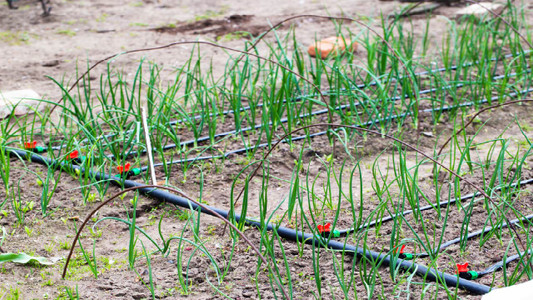
This is the cheapest form of precision irrigation system for an acre of vegetables or a young orchard. The pipe is light, the emitters are cheap, and a farmer can replace a single blocked dripper without touching the line. An orchard planted at 6 m by 6 m carries about 112 trees to the acre, so the emitter count is easy to work out. Read the full drip irrigation system in Kenya guide for the components and the layout rules.
Drip also suits slopes better than most methods, because the pipe can follow the contour and the pressure compensation emitters hold their flow when the ground falls away. On a steep block, that single detail prevents the lower rows from drowning while the upper rows starve.
Arrow Drippers for Individual Plants
An arrow dripper is a blue plastic spike on a short length of micro tube. The tube ends in a barbed connector that punches into the supply pipe, and the spike is pushed into the soil beside the plant. Water travels down the tube and drips at the arrow, below the surface.
Therefore, that design makes it the right emitter for a plant that lives in its own container. A row of potted avocado seedlings, a planter box on a veranda and a tree nursery all need one outlet per plant, and an arrow dripper gives exactly that. The shop lists arrow drippers at KSh 60 each.
- One emitter per pot. No waste on the ground between containers.
- Water below the surface. The soil surface stays drier, which slows evaporation and weeds.
- Easy to move. Change the layout when the pots move.
- Simple to inspect. Pull the spike, check the flow, push it back.
Installation is a short job. Punch the connector into the lateral, run the tube to the pot, push the spike into the root zone, then open the line and check each arrow. A farmer can fit a hundred pots in an afternoon with a punch, a knife and a bucket for the flushed water.
Hydroponic Systems for Fodder and Vegetables
Hydroponics grows plants without soil. The roots sit in a nutrient solution or in an inert medium that is flooded on a schedule. A hydroponic precision irrigation system measures, mixes and delivers water and nutrients together, which is precision irrigation taken to its logical end.
In Kenya, however, the strongest use case is fodder. Barley or maize seed is spread in trays, kept in a shaded structure, and watered on a cycle. The trays produce a green feed mat in about a week, with far less land and water than a fodder field. Dairy farmers around Kiambu and Nakuru use this to bridge the dry season.
Also, the second use case is leafy vegetables. Lettuce, spinach and herbs grow in channels or buckets, under shade net or in a greenhouse. A small pump, a timer, a tank and a set of trays are the core of the system. The nutrient solution is reused, so the water bill stays low.
However, hydroponics is not a shortcut past management. The solution has to be mixed correctly, the pump has to run on schedule, and a power cut in the middle of a hot day can cost a crop. A farmer who cannot check the system twice a day should choose drip instead.
Aeroponic Systems for Seed Potatoes and Nurseries
Aeroponics suspends the roots in air and mists them with a nutrient solution. The canopy is held above a closed chamber, and nozzles inside the chamber spray the hanging roots at intervals. There is no soil and no medium, only mist.
The method is used for seed potato production, where clean minitubers are grown from disease-free plantlets, and for cuttings that need a controlled root environment. An aeroponic precision irrigation system gives the grower complete control over water and nutrition, and it makes inspection of the root zone possible without digging.
In practice, aeroponics is the most technical of the four. It needs reliable power, clean water, a filter that will not clog the nozzles, and a person who understands the timing. The payoff is high, but only for a crop that justifies the cost, such as certified seed.
Precision Irrigation System Costs in Kenya
In practice, there is no single price for a precision irrigation system, because the same acre can be fitted for the price of a few emitters or for the price of a greenhouse. Five items drive the bill: the area covered, the method chosen, the water source, the power source and the level of automation.
- Area. Pipe, emitters and labour scale with the block, not with the crop.
- Method. Drip is the lowest entry point. Hydroponics and aeroponics add tanks, trays, pumps and a structure.
- Water source. A borehole with clean water needs a smaller filter than a dam or a river.
- Power. Grid electricity is cheap to run where it is reliable. A solar pump removes the fuel bill.
- Automation. A timer and valves add cost at the start and save labour every week after.
However, one number is public: an arrow dripper costs KSh 60 at the shop, so a nursery of 500 pots needs KSh 30,000 in emitters before any pipe, tank or filter. For a field block, the emitter bill is small compared with the pump, the mainline and the installation. A precision irrigation system quotation follows a site visit, because a figure quoted from a photograph is a guess.
Water Quality, Filtration and Fertigation
Typically, precision emitters have narrow passages. A 120 mesh screen or disc filter at the head of the system is the minimum for drip, and it has to be cleaned every week in the dry season. Water from a dam, a river or a shallow well carries more sediment than water from a lined tank, so it needs more attention.
Also, fertigation is the reason many farmers choose a precision irrigation system at all. A venturi injector or a dosing pump puts soluble fertilizer into the line, and the crop receives a small dose with every irrigation instead of one large dose by hand. The rule is to inject slowly, flush the line afterwards, and never mix chemicals that form a precipitate.
In addition, water quality decides which method is safe. Aeroponic nozzles block faster than drippers, and hydroponic solution has to be kept within a narrow range. Test the water before the design, not after the first blockage.
Pumping, Power and Automation
First, a precision system needs pressure at the emitter, and pressure comes from a pump or from gravity. Where the water source sits above the block, a gravity line can work with no pump at all. Where it sits below, the pump becomes the heart of the system and its reliability decides the crop.
However, solar pumping has changed the arithmetic on this. A solar array runs the pump through the middle of the day without fuel, and a tank carries the water into the evening. For a borehole or a river lift, the solar irrigation page covers the sizing and the panel layout.
Finally, automation is the last layer. A timer opens a valve, a pressure regulator protects the emitters, and a filter protects the regulator. None of it is complicated, but all of it has to be installed in the right order.
Choosing the Right Precision Irrigation System
First, start with the growing environment, then work outward. Soil means drip, a container means an arrow dripper, water means hydroponics, and air means aeroponics. The crop then narrows the choice: fodder and leafy greens suit hydroponics, seed potatoes suit aeroponics, and field vegetables and orchards suit drip.
- Field vegetables and orchards. Drip lines with button drippers.
- Pots, planters and nurseries. Arrow drippers, one per container.
- Fodder and leafy greens. Hydroponic trays or channels.
- Certified seed and cuttings. Aeroponic chambers.
Then check the boring constraints. Is there power at the site, and is it reliable? Is the water clean enough for the emitter chosen? Who will check the system on a Sunday? A design that ignores those three questions fails in the first dry season, however good the components are.
Installation, Support and Contact
First, the team surveys the site, measures the water source, checks the pressure and designs the block. Installation covers the pump, the filter, the mainline, the laterals and the emitters. Handover includes a walk through the system and a short training session for the person who will run it.
For a field block, the drip irrigation installation page sets out the sequence. For a quotation or a site visit, use the contact page or call 0728 163329. Bring the plot size, the water source and the crop, and the first conversation will be about the right method, not the price of pipe.
Precision Irrigation System: Frequently Asked Questions
What is a precision irrigation system in simple terms?
It is an irrigation system that puts a measured amount of water at the root of each plant instead of spreading water across the field. Drip, hydroponics and aeroponics all count.
Which precision irrigation system is cheapest in Kenya?
Drip is the lowest entry point for an open field, because the pipe and emitters are cheap and the pump can be small. Hydroponics and aeroponics cost more because they add tanks, trays and structures.
Can a precision irrigation system run without electricity?
Yes, if the water source sits above the block and gravity provides the pressure. Otherwise a solar pump is the usual answer for a site with no reliable grid supply.
Do arrow drippers suit avocado seedlings?
They work well in a nursery where each seedling sits in its own bag or pot. Once the tree is planted in the field, a drip line with button drippers is the better fit.
How much water does hydroponic fodder need?
Far less than a fodder field, because the water is circulated and reused instead of soaked away. The exact figure depends on the tray count, the stage of growth and the temperature inside the structure.
Do you install outside Nairobi?
Yes. The team works across Kenya and the wider East African region, and the design is done from a site survey, not from a standard plan.