

Kitchen garden designs are drawings before they are beds: a pattern of beds, paths and water points that fits the yard you actually have. Two gardens with the same crops can look completely different because one was drawn to its plot and the other copied from a neighbour. This page gives seven dimensioned layout patterns and a worked plan, so you can pick a shape and set it out with a tape.
Kitchen Garden Designs Start With the Yard
Measure the plot before choosing a pattern. Write down its length and width, the hours of direct sun, the direction of any slope, and where water arrives. Most vegetables want 6 hours of sun, so the beds face the open side, not the wall. Therefore a narrow shaded strip suits leafy crops, while the sunny centre takes fruiting ones.
Slope decides whether beds run level or stepped. Under 2 percent fall, straight beds work; above it, terrace or use raised rings so water does not run off the top. Moreover keep every bed within reach of a water point, because a design that needs a hose carried 20 m will not be watered daily. The yard, not the catalogue, sets the pattern.
The Bed-Grid Kitchen Garden Designs
The bed-grid is the default for a rectangular yard: parallel beds separated by straight paths. Make each bed 1 m wide so you reach the middle from either path, and 3 m long to keep walking short. Leave 40 cm paths between beds and a 60 cm path at the head for a barrow. Consequently a 5 m by 5 m yard holds four 1 m by 3 m beds with room to turn.
Run one drip lateral down each bed, fed from a single mainline along the head path. This keeps the grid tidy and the watering even. In practice the grid suits rows of onions, sukuma wiki and carrots, where a whole row is harvested together. It is the easiest pattern to set out with string and pegs.
Raised and Tiered Kitchen Garden Designs
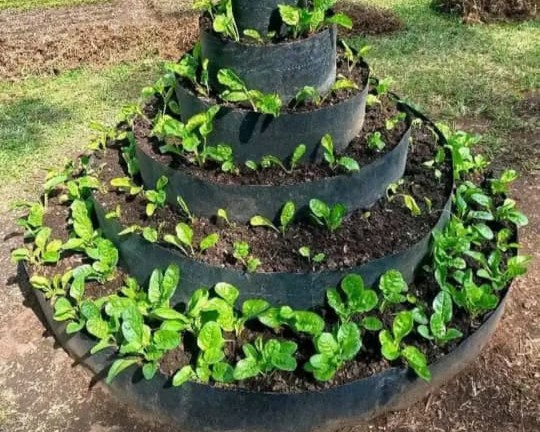
Where soil is poor or space is tight, build up instead of out. A raised bed lifts the root zone 20 to 30 cm above the path, improving drainage and letting you fill it with good soil. The tiered cone goes further: five stacked rings, each about 20 cm high, tapering from a 1.5 m base to a 0.5 m top. One cone therefore plants five circles on a single square metre.
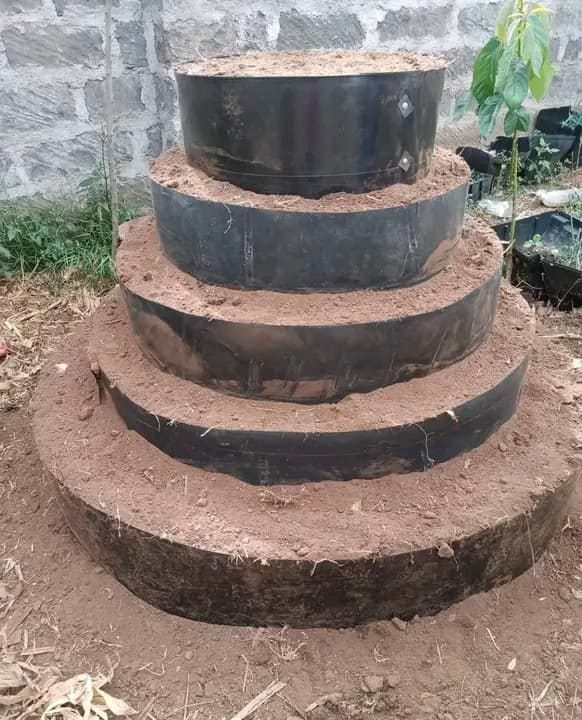
Water a cone from the top ring and let it cascade down, or fit a button dripper per ring for even share. However the top ring dries fastest, so plant shallow-rooted leaves there and deeper crops below. Raised and tiered patterns cost more to build but pay back on rocky or waterlogged plots where flat beds fail.
Keyhole and Mandala Kitchen Garden Designs
The keyhole is a circle with a wedge cut out so you can reach the centre from one path. Make the circle 3 m across (1.5 m radius) and the notch 60 cm wide; then no point is more than an arm’s length from the edge. A compost basket sits at the centre, feeding the ring as it breaks down. Therefore watering and feeding happen from one spot.
The mandala repeats several keyhole circles around a shared path, a design for a larger square plot. It looks ornamental but works hard: every bed is edge, so planting density is high. In practice keyhole and mandala patterns suit mixed herbs and salads picked a little at a time, rather than whole-row harvests. They need more edge material than a straight grid.
Vertical and Square-Foot Kitchen Garden Designs
When the ground is paved or tiny, grow up a wall or fence. Vertical pockets or stacked planters turn a bare wall into a planting face; keep pockets 20 cm deep for roots and face them to the sun. The square-foot grid divides a raised bed into 30 cm squares, one crop per square, so a 1.2 m bed holds 16 squares. Consequently a small bed still grows a dozen crops.
Both patterns dry quickly because the root volume is small, so water little and often. A rain hose laid along the top of a vertical face wets each pocket gently without washing seed out. However vertical designs suit shallow crops (lettuce, herbs, strawberries); deep roots like tomatoes need a bigger container at the base. Match the crop to the pocket depth.
Container and Sack Kitchen Garden Designs
For a balcony or patio, cluster containers instead of digging. Use 20 to 40 litre pots or grow sacks, grouped so one watering round covers them all. Place the tallest at the back so they do not shade the short ones, and stand pots on feet so drainage water escapes. Therefore a paved yard still yields salads and herbs.
Containers let you move crops with the sun and the season, a flexibility fixed beds lack. Fit one button dripper per pot on a small manifold so every container gets the same share. In practice sack designs suit sukuma wiki and spinach planted through side slits, with a watering column at the centre. They are the cheapest pattern to start and the easiest to expand.
A Worked Kitchen Garden Designs Example
Take a 5 m by 5 m sunny yard with water at one corner. Choose the bed-grid: four beds of 1 m by 3 m, two each side of a central 60 cm path, with 40 cm paths between. The head path takes a 32 mm mainline from a raised tank; each bed takes one 16 mm lateral. Total planted area is 12 m², enough for a family’s leafy and fruiting vegetables.
Set it out in an afternoon: peg the four corners, string the bed edges at 1 m, and mark paths at 40 cm. Lay the mainline, punch starter connectors at each bed head, and run the laterals. Finally flush before closing the ends. This worked plan is the bed-grid; swap in a cone or keyhole where the yard is smaller or the soil poorer, keeping the same water logic.
The Shop Table for Kitchen Garden Designs
| Layout pattern | Parts it needs | Stocked part |
|---|---|---|
| Tank and stand (any pattern) | Head and stored water | – |
| Bed-grid, one lateral per row | Row-length wetting | Drip tape |
| Mainline along the head path | Flow to every bed | Irrigation pipes |
| Branch a lateral per bed | Leak-free take-offs | Starter connector |
| Tiered cone, one emitter per ring | Even share per ring | Adjustable button drippers |
| Keyhole / mandala zones | One valve per circle | Drip valve |
| Keep grit out of emitters | Filter at the outlet | Screen filter |
| Vertical face, gentle wetting | No seed wash | Rain hose |
| Stop tank filling at full | No overflow | Ball cork |
| Close every line end | Hold pressure | End plugs |
One stocked part per layout row; the tank and stand alone come from off-site.
Frequently Asked Questions About Kitchen Garden Designs
Which kitchen garden designs suit a small yard?
The tiered cone and the vertical face, because they stack planting on a small footprint. A 1 m² cone plants five rings; a wall face plants pockets without using ground at all.
How wide should a bed be?
One metre, narrow enough to work the centre from either path while feet stay on the path. Paths stay at 40 cm between beds and 60 cm at the head for a barrow.
What is the keyhole radius?
1.5 m (a 3 m circle) with a 60 cm notch. Then every point is an arm’s length from the edge or the notch, and the centre compost basket is reachable.
Do kitchen garden designs need a slope plan?
Yes. Under 2 percent fall, level beds work; above it, terrace or use raised rings so water soaks in instead of running off the top bed.
How many crops fit a square-foot grid?
One crop per 30 cm square. A 1.2 m by 1.2 m bed holds 16 squares, so a small bed still grows a dozen different crops at once.
Can I mix patterns in one yard?
Yes. Use the bed-grid for rows, a cone or keyhole for mixed salads, and containers on the paved edge. Keep one water logic: a mainline, a valve per zone, and one emitter family per zone.
Drawing Your Kitchen Garden Designs
Draw the yard to scale on paper, mark sun and slope, then lay one of the seven patterns over it and count the beds. For the full setup, soil and crop plan, our kitchen garden guide walks the whole build; for the water side see our drip irrigation systems in Kenya design guide. Before buying parts, check the nine buying specs on our irrigation equipment suppliers page. The shop’s kitchen garden drip kit bundles the small-yard parts in one order. Background on the methods sits in the Wikipedia articles on raised bed gardening and square foot gardening.