Table of Contents
Borehole Solar system installation begins with the borehole test report, not a panel count. We use the tested water level, sustainable yield and delivery height to select a submersible pump and solar supply that can fill the intended tank without drawing the borehole down beyond its safe operating range. This guide explains the borehole checks that matter when fitting a new system or converting an existing grid or diesel pump.
Our general solar pump installation guide covers the wider site workflow. Here the focus is the narrow space inside a casing, the water level while pumping, safe pump depth, cable and rising-main protection, and the readings needed before handover. If the borehole has not yet been drilled or tested, start with our borehole drilling guide.
1. Borehole Solar system installation: read the test report
A completed borehole is not automatically ready for a solar pump. First, ask for the drilled depth, casing diameter, screen position, static water level, pumping rate, dynamic water level, drawdown, recovery and water-quality results. Next, confirm whether the test represents the season in which the farm will use the most water. Where records are missing or the borehole has changed, we arrange a fresh assessment before committing to a pump size.
The sustainable yield limits the water that can be taken over the planned pumping hours. More panels cannot create more groundwater. If a test shows a lower safe flow than the farm wants, we change the pumping schedule, add storage, reduce demand or use another approved source. Therefore, we settle that gap on paper before repeated dry-run trips can occur after installation.
2. Borehole Solar system installation: set the head and tank duty
Measure the lift from the dynamic water level to the tank inlet. Then allow for pipe friction and any pressure required at the delivery point. This total dynamic head is the head at which the pump must produce the required flow. However, the drilled depth by itself is not the pumping head. Our engineer checks the chosen pump curve at the actual duty point and calculates how much water can reach storage during the useful solar pumping window.
For example, suppose the pumping water level is 50 metres below ground. The tank inlet is 10 metres above ground and estimated pipe losses are 8 metres. Then the planning head is about 68 metres. These values are illustrative; the final calculation uses the measured route and selected pipe. If the farm needs 18 cubic metres each day over six effective pumping hours, the system must deliver about 3 cubic metres per hour at that head. The source yield and seasonal sun must also support that duty.
3. Borehole Solar system installation: check pump fit and depth
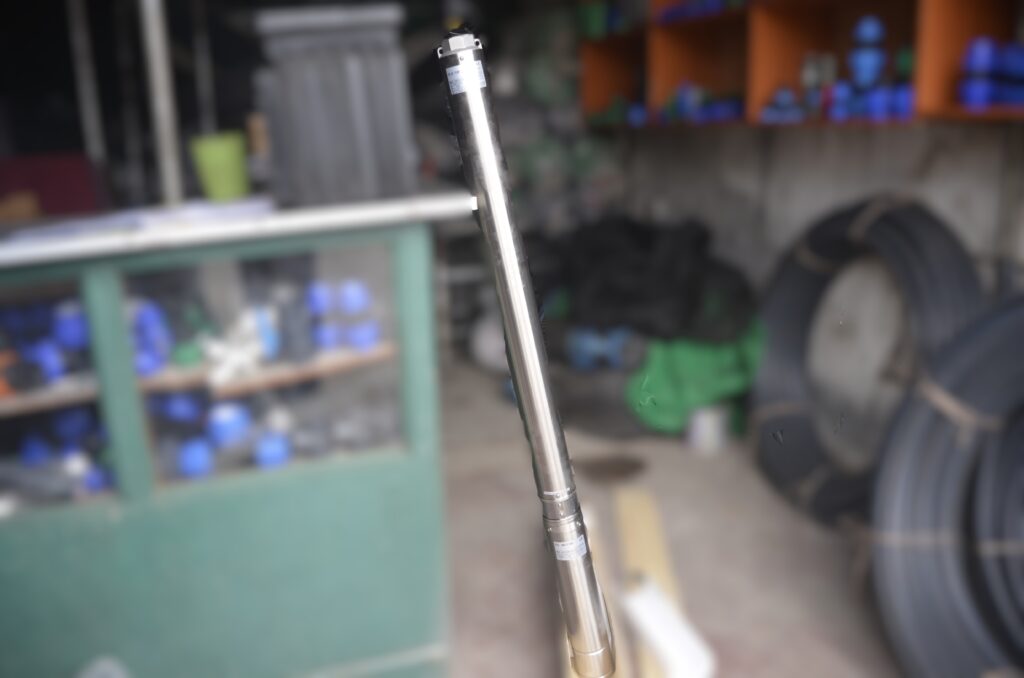
The pump must fit the casing’s usable inside diameter, including any narrowing or bend. It also needs room for the motor cable and rising main. Next, check the pump maker’s minimum clearance and cooling requirements. We confirm the intake position against the dynamic water level, screen and borehole bottom. The pump needs the specified submergence during operation while staying clear of sediment that could damage its stages.
Our solar pump set is selected against that borehole record and the required flow and head. The Global Water Center’s solar water systems guide likewise treats casing diameter, pump submergence and protection from dry running as design constraints. We check the actual model’s specification sheet before setting the installation depth.
4. Borehole Solar system installation: match panels and controls
Panel wattage, operating voltage and controller limits must suit the selected pump. Also, site shading, panel orientation and the hours when water is needed affect output. A protected array frame should leave access for cleaning and maintenance. The controller should include the protections required by the pump design, particularly low-water or dry-run response. In addition, a tank-full signal can stop pumping when storage is full.
For a conversion from diesel or grid power, first record the existing pump model, motor rating, cable condition and controls. Some existing pumps can work with a correctly specified solar drive; others need a matched replacement. Therefore, we check compatibility before adding panels to an existing motor. Our borehole electrical works guide covers cable, panel and earthing checks in more detail. Finally, a qualified installer sets the wiring and protection plan for the chosen equipment.
5. Borehole Solar system installation: protect the headworks
During borehole solar system installation, we lower the pump on the specified rising main, secure and protect the cable, and use a sound borehole cap. The headworks should keep surface runoff, loose soil and animals away from the casing opening. Also, the discharge route needs the pipe diameter and pressure rating used in the head calculation. We add suitable valves and a way to measure flow, then choose an arrangement that lets us isolate the system for service.
Where water feeds drip irrigation, the borehole test and water-quality results also guide filtration. Do not treat a filter as a cure for a pump set too close to sediment. A clean tank and protected pipe route help keep the installed system useful after commissioning. The UNICEF Kenya solar borehole project in Garissa shows how a submersible pump, elevated storage and distribution lines can be combined for a working supply.
6. Borehole Solar system installation: prove the duty on site
Commissioning should show more than water emerging from a pipe. First, measure flow, operating water level where practical, controller readings, voltage, tank fill time and pressure at the agreed delivery point. Next, test the low-water and tank-full responses. Compare the readings with the design duty and the original pump test. If flow is below target, investigate source level, pipe loss, shading, wiring and pump settings before changing equipment.
We hand over the pump and controller model details, cable and pipe routes, protection settings, test readings, maintenance schedule and warranty documents. The operator should know how to read an alarm, clean panels safely and respond when the borehole level falls. Finally, log flow or tank fill time during the first weeks so a change in performance is noticed early.
Can an existing borehole be converted to solar?
Often yes, if the borehole is sound and its tested yield supports the planned demand. Before borehole solar system installation, we inspect the casing, pump, rising main, cable, controls, tank and current operating readings. We then compare retaining the pump with fitting a matched solar submersible set. However, an old pump may be electrically or hydraulically unsuitable even though it still runs on a generator.
The decision also depends on how water is used. For example, daytime pumping into a tank can be simpler to schedule than direct pressure delivery to an irrigation network. Storage gives the farm water outside solar pumping hours, but it must be sized for demand and available yield. Therefore, a conversion quote should state what is reused, what is replaced and which performance readings will be checked at handover.
Eunidrip components for a borehole solar system
We select the pump and supporting components after checking the borehole and delivery duty. Each linked product below has a role in the design; final sizes come from the site measurements and chosen model specifications.
| Product | Selection check |
|---|---|
| Solar pump set | Confirm casing clearance, pump curve, controller and panel compatibility at the tested duty. |
| Irrigation pipes | Choose diameter and pressure rating for the rising main and delivery route. |
| Irrigation water filters | Match filtration to water quality and the downstream irrigation equipment. |
Product fit is confirmed against the measured borehole and the approved system layout.
Frequently asked questions
Does Borehole Solar system installation need a new pump? Not always. We check the existing pump curve, motor and controller compatibility before deciding whether it can be retained.
Can a deeper borehole use the same number of panels? Depth alone cannot answer that. Pumping water level, tank height, pipe loss, required flow and the selected pump set determine the array.
What if the borehole runs low in the dry season? The system needs a pumping schedule within the tested safe yield and working low-water protection. Storage or demand changes may also be needed.
Do I need a tank? A tank lets the borehole pump during useful solar hours and supply water later. Direct pumping may suit some designs, but its required pressure and timing must be checked.
What should I send for a quote? Share the test report, borehole diameter, existing pump details, tank height and location, pipe route, daily water demand and site photos.
Send us your borehole test report and intended water demand. Our team can inspect the existing installation, specify the matched solar pump system and hand over measured commissioning results.