

Table of Contents
Solar pump sizing starts with daily water demand and the height water must be lifted. Then we check source yield, pumping hours and the flow a candidate pump delivers at that head before matching panels and controller. This worksheet prepares the measurements for a Eunidrip system quote.
Our solar pump installation guide explains the site work after a system is chosen. If your source is a borehole, its test report and casing also matter; our borehole guide explains the source records. Here the focus is the sizing calculation that connects water demand, pump duty and solar supply.
Solar pump sizing: the 5 inputs to collect
First, record the five inputs below before choosing a pump or panel count. Use measured values and mark estimates. The design month is when demand is high or usable sun is low.
| Input | What to record | Why it matters |
|---|---|---|
| Daily water volume | Cubic metres needed on the design day | Sets the amount to pump or store |
| Available pumping time | Useful solar hours or an agreed operating window | Converts daily volume to hourly flow |
| Total dynamic head | Water level, delivery height, pipe loss and outlet pressure | Sets the pump’s working lift |
| Source yield | Tested borehole or surface-source flow | Limits a safe pumping rate |
| Critical-month sun and storage | Site solar data, shading and tank capacity | Checks daily delivery outside ideal weather |
Send these inputs with the site location and pipe route for a first sizing review.
Solar pump sizing: find the daily water volume
List each demand separately: crop irrigation, livestock, domestic use and any water needed for washing or processing. Then add them for the busiest design day. For irrigation, use the crop schedule and application depth from the farm plan rather than acreage alone. Also allow for the irrigation method’s losses and effective rainfall where the design requires them. However, a tank’s capacity is storage, not daily demand; a 10,000-litre tank may be filled more than once or used over several days.
Keep units consistent: one cubic metre is 1,000 litres. Two blocks needing 8 cubic metres each per day plus 3 for livestock total 19 cubic metres a day. However, irrigating the blocks on different days can lower the peak duty.
Turn daily volume into hourly flow
For solar pump sizing, divide the design-day volume by the useful pumping hours. This gives a first flow target in cubic metres per hour. For example, 25 cubic metres over five useful hours requires an average of 5 cubic metres per hour. However, this is a planning flow, not a guarantee that the pump will deliver the same rate every hour. Morning, cloud and late-afternoon conditions change the power available to a solar pump.
Next, decide whether the pump fills a tank or feeds irrigation directly. A tank lets water be collected during daylight and used later. By contrast, direct sprinkler or drip supply needs the right pressure at the irrigation inlet while the pump is running. That pressure becomes part of the head calculation. Our solar irrigation guide explains how the pump fits the wider farm layout. Therefore, do not choose a pump from daily litres without defining where the water must arrive.
Solar pump sizing: calculate total dynamic head
Total dynamic head is the effort the pump needs to move water at the target flow. For a borehole feeding an open tank, add the depth of water while pumping, the height of the tank inlet above the wellhead, and friction losses in the pipe and fittings. For a surface source, use the relevant suction and delivery elevations. If water must arrive under pressure, convert that required pressure to head and add it. As a guide, about 10.2 metres of water column equals one bar.
Use the dynamic water level, not the resting level or total drilled depth. Also, friction changes with pipe diameter, route length, fittings and flow. A narrow or long pipe can move the duty point enough to change the pump choice in solar pump sizing. The Global Water Center’s solar water systems guide explains how the pipe layout affects the pump, motor and panel design.
Check the source yield before choosing a pump
A pump must not draw water faster than the source can safely supply it. For a borehole, compare the target flow with the pumping-test yield and the water level at that rate. If the tested yield is below the flow target, revise the pumping window, storage plan or demand. More panels cannot raise the borehole’s sustainable yield. For a dam or river, check the seasonal low-water condition and any abstraction limits. Therefore, solar pump sizing needs source evidence as well as water demand.
Also consider sand, suspended solids and water quality. These affect the pump and any downstream filter choice. Therefore, our sizing sheet records the source constraint next to the desired flow before a model is shortlisted.
Solar pump sizing: choose from the pump curve
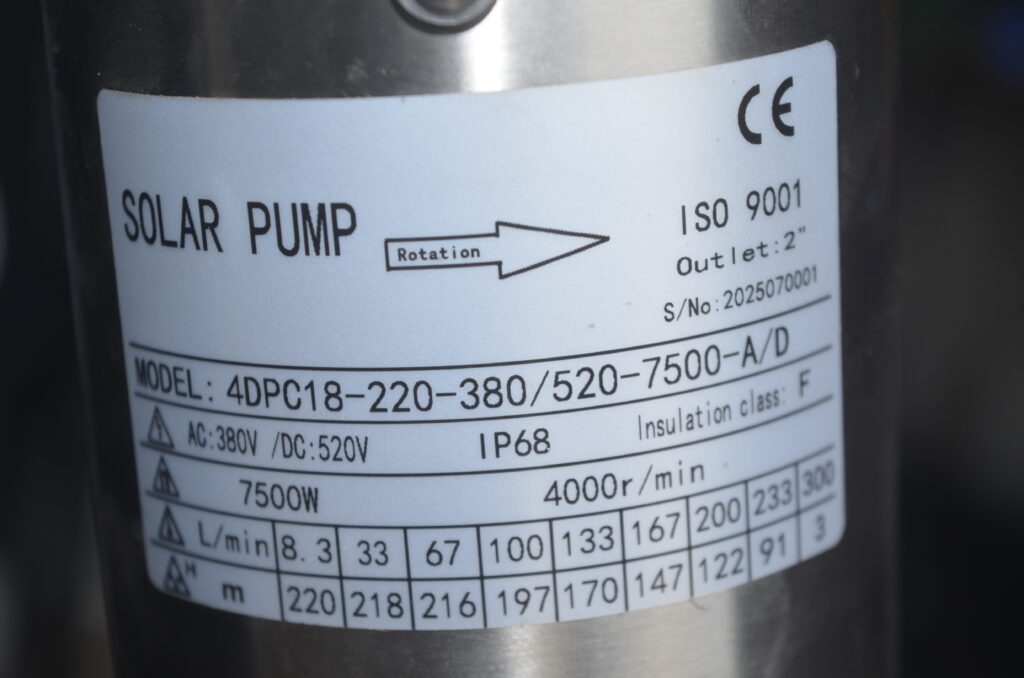
A pump curve shows the flow a particular model can provide at different heads. First, mark the required flow and total dynamic head as one point. Then check whether that point falls within the maker’s operating range. However, a large maximum-flow number at a low head does not prove that the same pump will meet a high-head duty. We check the complete pump, motor and controller combination for the chosen source and operating conditions.
For a borehole, casing diameter and the pump’s required submergence also have to fit. For a surface source, check suction conditions and priming requirements. Similarly, New Mexico State University’s pump-sizing manual works from source measurements and total head to the pump and panels. Finally, we use the specification sheet for the exact Eunidrip model chosen for your site.
Match the panels and controller to the pump
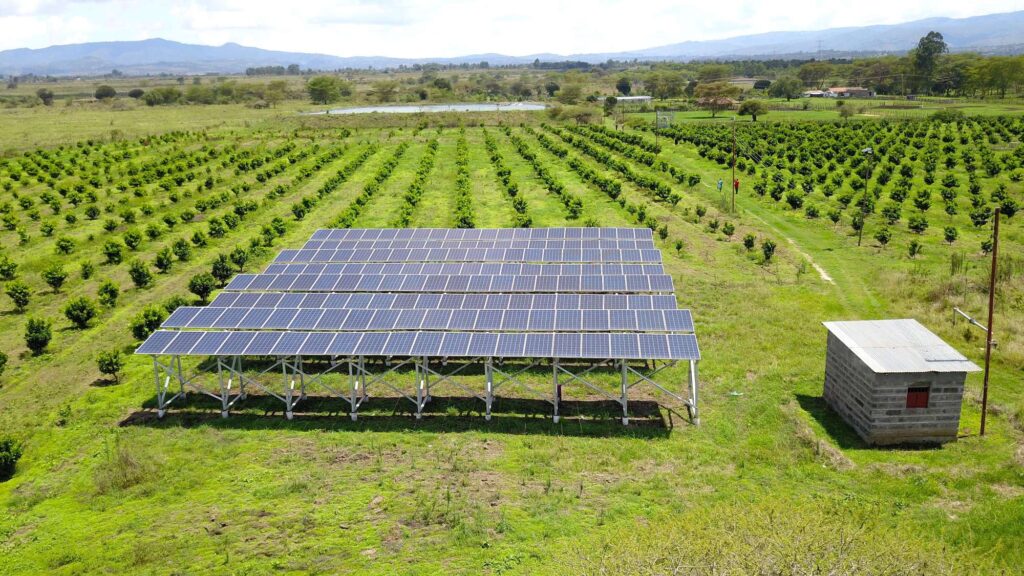
Next, match the panel array to the chosen pump and the controller’s voltage, current and power limits. Use solar data for the site and the month when supply is most difficult. Also, shading, dust, temperature, cable loss and controller performance reduce water delivery compared with a simple panel-wattage calculation. Therefore, a panel count copied from a neighbour’s borehole is not a reliable design.
Our solar pumps are supplied as matched sets with panels, a controller and mounting selected for the water duty. A preliminary energy calculation can flag a set that is too small. However, the final selection needs the maker’s hourly water-output data and local solar conditions. Where dependable supply is critical, also include the intended tank reserve or approved backup supply in the design.
Solar pump sizing formulas
Flow: Q (m³/h) = daily water volume (m³/day) ÷ useful pumping time (h/day).
Total dynamic head: H (m) = pumping water depth + height to outlet + pipe and fitting losses + required outlet pressure head. For an open tank, outlet pressure head is zero.
Water energy: Ew (kWh/day) = 0.002725 × daily water volume (m³/day) × H (m). For water, 0.002725 converts cubic metres lifted through metres of head into kilowatt-hours.
Electrical energy: Ee (kWh/day) = Ew ÷ wire-to-water efficiency (decimal). This efficiency covers the pump, motor and controller.
Preliminary panel rating: P (kWp) = Ee ÷ [critical-month peak-sun-hours (h/day) × array performance factor (decimal)]. Peak-sun-hours mean equivalent hours at full sun; the factor allows for array losses.
These formulas give a first estimate. We confirm the pump curve, hourly water output and panel set against the chosen model and site.
Worked solar pump sizing example
For example, consider a farm that needs 25 cubic metres of water on its design day. It plans to pump for five useful hours into an open tank. The borehole’s tested safe yield is 6 cubic metres per hour. During pumping, the water level is 28 metres below the wellhead; the tank inlet is 12 metres above it. Finally, estimated pipe and fitting loss at the target flow is 7 metres.
| Calculation | Result | Decision |
|---|---|---|
| Flow: 25 ÷ 5 | 5 m³/h | Below tested safe yield of 6 m³/h |
| Head: 28 + 12 + 7 + 0 | 47 m | Check the pump curve at 5 m³/h and 47 m |
| Water energy: 0.002725 × 25 × 47 | About 3.2 kWh/day | Energy transferred to the water |
| Electrical energy: 3.2 ÷ 0.40 | About 8 kWh/day | 40% efficiency is illustrative |
| Panel rating: 8 ÷ (4.5 × 0.75) | About 2.4 kWp | 4.5 hours and 75% are illustrative |
Illustrative figures only. The site test, pipe calculation, chosen pump and critical-month solar data set the final design.
The 40% efficiency, 4.5 peak-sun-hours and 75% array factor are illustrative, not specifications for our listed pump. We use the chosen model’s performance data and the design month for the final set.
Eunidrip products matched to the sizing sheet
Finally, we match these shop products to the approved duty point and operating plan. The table lists what must be checked before ordering; it does not assign a model or price without the site data.
| Product | Selection check |
|---|---|
| Solar pump set | Confirm flow at total head, source fit, controller limits and critical-month water output. |
| HDPE irrigation pipes | Choose pipe diameter and pressure rating before finalising friction loss. |
| Water tanks | Match useful storage to the pumping schedule and water needed outside daylight. |
The actual site measurements and model specification sheet govern the final set.
Frequently asked questions about solar pump sizing
Can I size a solar pump from borehole depth? No. Use the water level while pumping, delivery height, pipe loss, required flow and tested yield. Drilled depth alone does not give the duty point.
How many panels do I need? That depends on the selected pump and controller, the design month, site sunlight and losses. We confirm the array against the matched set’s water-output data.
Does a bigger pump fill the tank faster? Only if the source and pipework support the higher flow at the required head. A bigger nameplate rating does not guarantee more useful water.
Should the system pump into a tank? Storage is useful when water is needed after pumping hours. Direct pumping may work when the required pressure and timing are included in the design.
What should I send Eunidrip for solar pump sizing? Send your location, daily water need, source test or water levels, tank height, pipe route and intended irrigation schedule. Photos of the source and proposed panel site help us check the layout.
Share those measurements with our team. We will check the duty point, source limit and matched solar pump set before preparing a system quote.