
Table of Contents
Solar pump installation in Kenya starts with the water source and the amount of water needed each day. Our team measures the lift, pipe route and available sun before selecting a pump, panels and controller. A complete installation must then move water reliably to a tank or irrigation network and give the owner clear operating instructions.
This is a site-work guide for boreholes, wells, dams and farm reservoirs. Our solar pump sets are sized from the duty, while our broader solar irrigation guide covers system layouts and costs. The seven installation stages below show what should be measured, built and tested on site.
1. Solar pump installation in Kenya: survey the site
Record the source location, borehole or well diameter, water levels, source yield, tank position, route length and height difference. Walk the planned pipe and cable routes. Mark crossings, roads, flood-prone ground and a place for a secure panel frame. For a borehole, use its pumping-test results rather than the drilled depth alone; the water level while pumping affects the lift.
Also record the crop demand and the hours available for pumping. For example, a system serving a tank can pump during daylight and release water later. By contrast, a scheme that must feed sprinklers directly needs a different pressure and operating schedule. Therefore, the site survey sets the duty for every later component.
2. Solar pump installation in Kenya: calculate water duty
Set a daily volume in cubic metres and the flow needed during the planned pumping window. Then calculate total head: water lift, height to the delivery point, friction in the pipe and fittings, and any pressure needed at the outlet. A pump must deliver the required flow at that total head, not just carry an attractive horsepower label.
For illustration, 24 cubic metres per day pumped over six effective hours requires about 4 cubic metres per hour at the operating point. However, the six hours are a planning assumption, not a guarantee of sunshine or output. Therefore, our engineer checks the chosen pump curve, seasonal sun, source yield and pipe losses before the final schedule is approved.
3. Solar pump installation in Kenya: select matched equipment
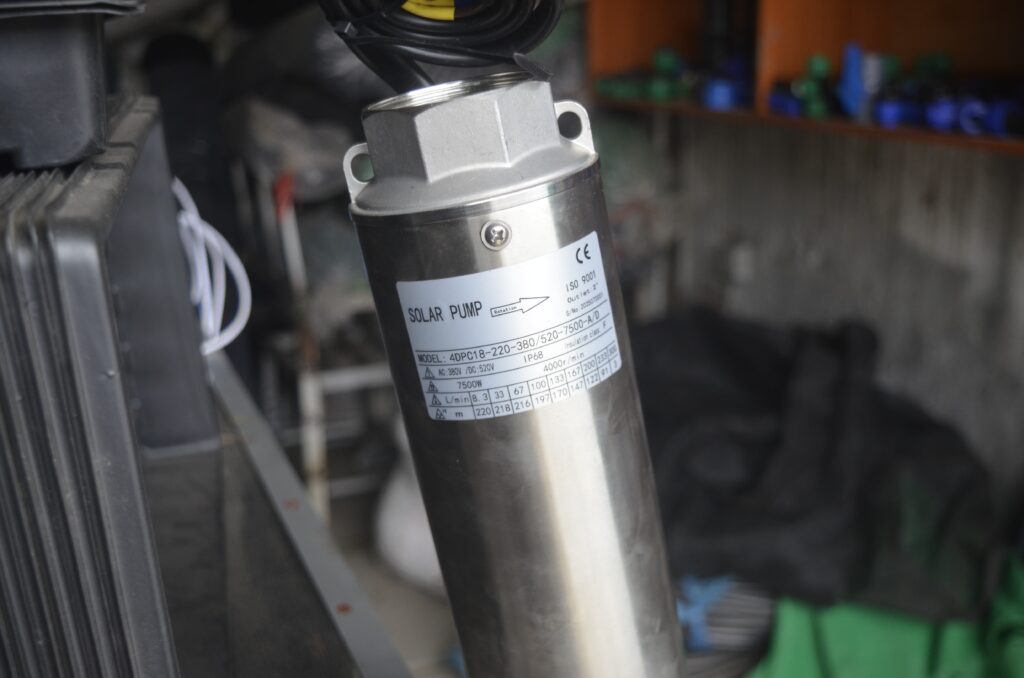
Choose a submersible model for a suitable borehole or deep well, or a surface arrangement where the intake and suction conditions allow it. Match the pump and motor, panel array, controller, cable, protection devices and mounting. Check the controller’s voltage range against the array and pump specifications. Include low-water protection and a tank-full switch where the design calls for them.
Our solar pump product is a matched set rather than a bare pump. First, the selected model’s specification sheet must state its flow and head at the design point. A larger panel array cannot rescue a pump that is hydraulically wrong for the site. Likewise, pipe diameter affects friction and therefore the actual water delivered.
4. Solar pump installation in Kenya: mount the panels
Build the frame on a stable foundation or approved roof structure. Orient and tilt the panels for the surveyed site, keep them clear of shade during the main pumping hours and leave safe access for cleaning. Fasten the modules against wind and protect exposed cables from abrasion and animals. Mark cable routes before trenching or backfilling.
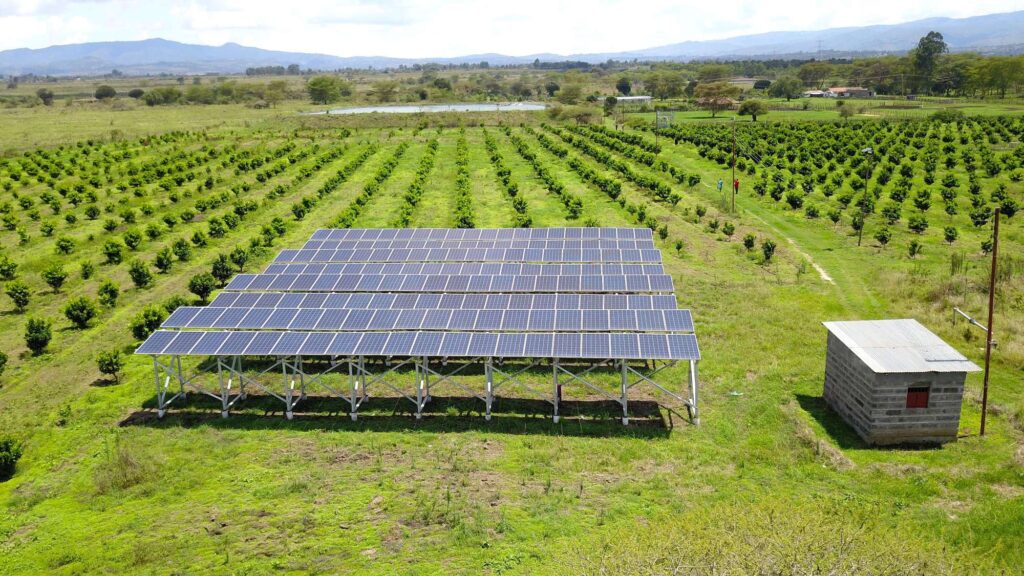
UNICEF’s solar-powered water systems guidance covers siting, design, installation, operation and maintenance. The chosen equipment and site design govern panel tilt, cable sizing and protection; those values cannot be copied from another project.
5. Solar pump installation in Kenya: install pump and pipes
For a borehole, confirm the casing size, tested pumping water level and approved pump setting. Lower the submersible pump with the specified rising main and support; protect and secure the motor cable. Fit the designed non-return, isolation and air-release components. At a surface source, protect the intake from debris and set the unit where flooding and suction problems will not stop it.
Next, lay the delivery line along the surveyed route and use pressure-rated joints. Flush and pressure-test the pipe before it is buried or connected to sensitive irrigation equipment. Our irrigation pipes are selected by diameter and pressure class from the hydraulic calculation. If drip lines follow the tank, filtration and zone pressure also belong in the downstream design.
6. Solar pump installation in Kenya: wire and commission
A qualified electrical installer connects the array, controller, protection and pump to the approved diagram. Before starting, check polarity, secure connections, cable insulation, earthing and the water-level and tank switches. Then run the system and measure flow, pressure, pump current and water level under load. Compare the readings with the duty point and the source’s safe yield.
Next, test a stop caused by a full tank and a safe response to low source water. Check for leaks and air locks, then record how output changes through the day. However, a single midday flow reading is not the daily yield. Finally, the commissioning sheet should show the date, weather, readings, controller settings and any items left for correction.
7. Solar pump installation in Kenya: train and hand over
Show the operator how to start and stop the unit, read alarms, clean panels, inspect the intake or filter, and recognize falling output. Hand over the pump curve, controller settings, wiring diagram, pipe route, warranty details and commissioning readings. Agree who to call if the source level drops or the controller stops the motor.
During operation, log tank fill time and unusual changes in flow. In addition, keep the panels clean without damaging their surface, and inspect exposed fittings and cables. If crop demand or tank location changes, recalculate the duty before adding panels or changing the pump.
Eunidrip components matched to the installation
We select each item after the source test and head calculation. The table identifies the checks to carry into the final bill of materials.
| Product | Selection check |
|---|---|
| Solar pump set | Match pump curve, controller and panel set to daily volume and total head. |
| Irrigation pipes | Size diameter and pressure rating for flow, route and friction loss. |
| Irrigation water filters | Choose filtration from source-water quality and the downstream irrigation system. |
The site design determines product fit and final specifications.
Frequently asked questions
Can a solar pump run from a borehole? Yes, when the borehole yield, diameter, water levels and pump curve support the required duty.
How many panels do I need? The answer depends on the pump, controller, head, daily volume and site solar conditions. Size the matched set from those inputs.
Do I need batteries? A tank can store pumped water for later use. Battery or backup choices depend on when water must be delivered.
How long does installation take? The schedule depends on the source, civil works, cable and pipe routes, permits and test results; request a site-specific programme.
What should the installer hand over? Ask for as-built routes, equipment manuals, protection settings, commissioning measurements and operator training.
Share the water-source test, daily demand, tank elevation, pipe route and preferred operating hours with our team. We can then prepare a solar pump installation in Kenya matched to the site and demonstrate its measured output at handover.