
High Volume Low Pressure Irrigation Systems
High volume low pressure irrigation moves a large water volume at a modest operating head. The goal is simple: deliver the full crop requirement without wasting energy on hydraulic head the field does not need. Eunidrip Irrigation Systems Ltd reaches that balance with wide piping, storage, staged pumping, multi-stage filtration and controlled irrigation blocks.
Every figure below comes from one worked 100-hectare example, so you can follow the arithmetic from survey to commissioning. Because the numbers are illustrative, treat them as a method to copy rather than a design to install. Site surveys, water tests and manufacturer pump curves must confirm the duty point before any pipeline is trenching.
Contents
Table of Contents
Why Low Pressure Irrigation Saves Energy
Head is where the money goes. At the worked duty flow of 556 m³/hour, and at a pump efficiency of 75 percent, shaft power is about 70.7 kW at 35 metres of head. The same duty at 55 metres needs about 111.1 kW. That is a 36 percent theoretical reduction, driven entirely by head, not by flow.
Elevation sets the floor you cannot avoid. For example, a 25 m rise from the pumping station to a field is a static head of 25 m, roughly 2.45 bar using P = ρgH. Friction, filtration losses and emitter operating pressure add to that figure. Therefore every metre of unnecessary head, and every restrictor that creates it, is paid for in kWh for the life of the farm. However, actual electrical savings depend on pump and motor efficiencies and on run hours.
Survey and Feasibility Before Any Design
First, survey the farm boundary, the irrigable area, contour levels, elevation differences, slopes and drainage routes. We use GPS/GNSS and a total station where the terrain demands it. Next, fix the water source, abstraction permissions, pumping-station position, reservoir location, pipeline corridors, power supply and access roads.
Then evaluate soil texture, infiltration, crop pattern, water quality and the irrigation blocks, and confirm the reliable yield of the source. Specifically, a design that assumes more yield than the borehole can sustain will fail in its second dry season. Finally, the survey produces a topographical plan, longitudinal pipe profiles, a preliminary hydraulic schematic and a bill of quantities. Start with land preparation for drip irrigation when the site still needs shaping.
Crop Water Demand and Design Flow
Crop demand comes from evapotranspiration: ETc = ETo × Kc, where ETo is reference evapotranspiration and Kc the crop coefficient, as set out in FAO Irrigation and Drainage Paper 56. Because the peak day governs the pipe sizes, design flow uses peak ETc rather than an annual average.
| Design parameter | Illustrative value |
|---|---|
| Irrigated area | 100 ha |
| Peak crop water requirement | 6 mm/day |
| Field application efficiency | 90% |
| Gross daily water demand | 6,667 m³/day |
| Daily pumping window | 12 hours |
| Nominal design flow | 556 m³/hour |
The arithmetic runs 100 × 6 × 10 ÷ 0.90 = 6,667 m³/day, then 6,667 ÷ 12 = 556 m³/hour. Also account for effective rainfall, the irrigation schedule, application uniformity and how many blocks run at once before freezing the duty point.
Reservoir Sizing in Low Pressure Irrigation Blocks
Three days of usable storage at this demand is 6,667 × 3, so about 20,000 m³. Add allowances for unusable depth, evaporation, sediment, operating reserve and losses. Capacity must come from the actual geometry and a stage–storage relationship, not from surface area multiplied by depth. In practice, that shortcut mis-states volume on every side-sloped dam.
Specify embankment geometry, slope stability, freeboard, an emergency spillway, sediment control, intake screening and safe access. Where a lined reservoir is called for, design subgrade preparation, HDPE geomembrane thickness, weld inspection, the anchor trench and the drainage detail for site conditions. Our build work is covered on the irrigation reservoir construction page.
Mainline Sizing: Use the Internal Bore
Continuity gives Q = A × v. At Q = 556 m³/hour, which is 0.1544 m³/second, and an illustrative design velocity of 1.5 m/s, the required internal diameter is D = √(4 × 0.1544 ÷ (π × 1.5)) = 0.362 m. Select a commercially available pipe by its actual internal diameter and pressure rating.
In practice, this is where installs go wrong. An outside-diameter designation, such as OD 400 mm HDPE, is not the usable bore. Confirm Darcy–Weisbach friction, fitting losses, elevation, surge and the worst-case end-of-line pressure for each irrigation operating scenario. Rather than guessing, model the furthest and highest block, because low pressure irrigation leaves no margin at the end of the line.
Filter Capacity and Multi-Stage Filtration
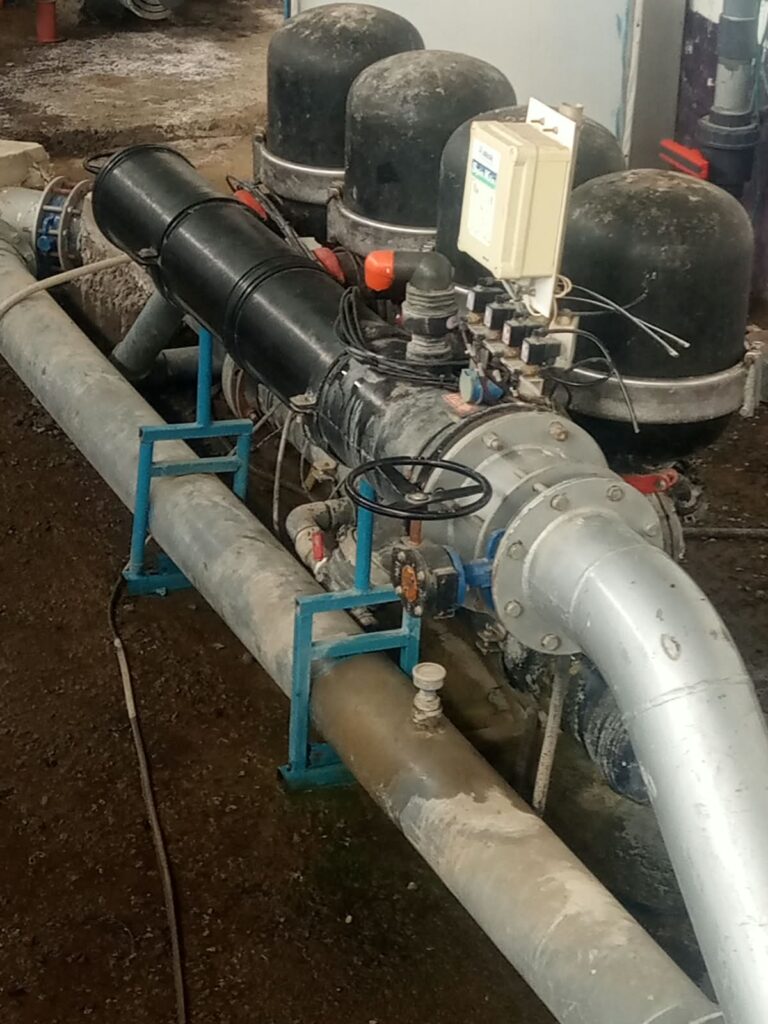
Size filtration above the duty flow. At 556 m³/hour, an illustrative 15 percent planning allowance gives Qf = 556 × 1.15 = about 640 m³/hour. If each disc filter is rated at 80 m³/hour at the required grade, eight units give 640 m³/hour. Similarly, a ninth preserves flow during an isolated backwash, provided the manifold and controls are designed for it.
For media filters, assume a design hydraulic loading of 40 m/hour, so 640 ÷ 40 = 16 m² of active filter area. A vessel with a 1.2 m internal diameter holds 1.131 m² of media area, so fifteen duty vessels provide 16.96 m². Evaluate the spare and backwashing vessel separately. Filter sizing follows the maximum particle size the emitter allows, the water quality, the flow between cleanings and the allowable pressure drop, as Virginia Tech extension explains.
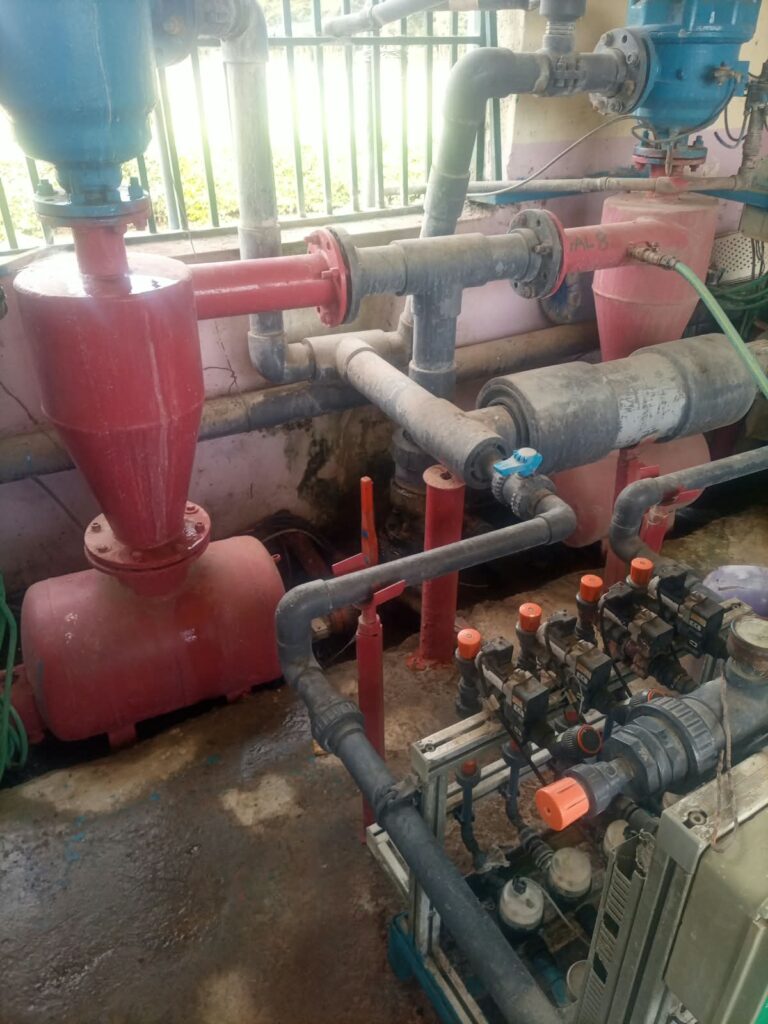
Layer the stages. A coarse intake screen removes leaves before the pump. A hydrocyclone takes out grit and dense sand, though it never replaces fine filtration. Media filters reduce organic and algae-related solids. Automatic disc or screen filters then polish to the emitter grade; many drip systems work around 130 microns, and a 200 mesh screen is common in drip irrigation. Differential pressure triggers cleaning. Note one HVLP-specific catch: automatic backwash can demand more pressure than normal low-pressure operation supplies.
Finally, water chemistry testing guides treatment of iron, manganese, precipitation and biofouling. Mechanical filtration does not remove dissolved salinity, and it does not make water potable.
Pump Staging: Flow Adds, Pressure Does Not
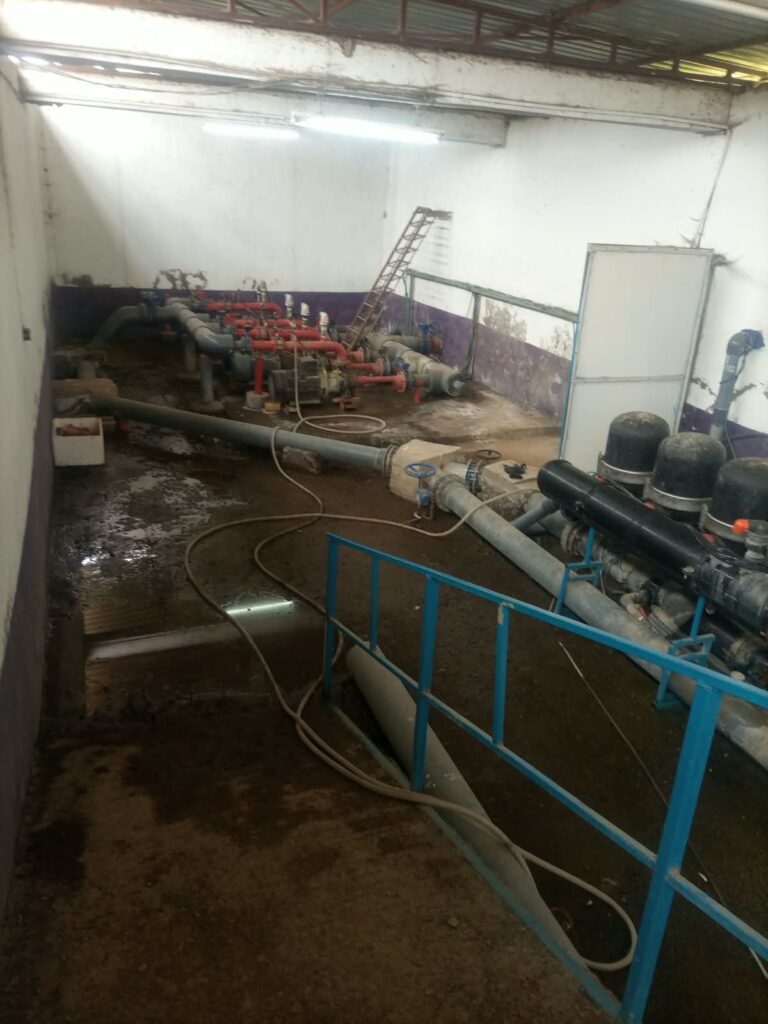
Multiple motorised pumps share common suction and discharge manifolds, so flows add at a common head while the head itself stays roughly flat. In the worked case, four duty pumps at 100 m³/hour and 30 m give 400 m³/hour, each needing about 10.9 kW at the shaft and a 15 kW motor. Therefore staging, not raw pressure, is how a low pressure irrigation network matches the volume a block actually needs.
We set out the full sizing method, the series-versus-parallel comparison and the eight commissioning steps for pumps in parallel on that page. Choose the individual units against pump selection for irrigation.
Fertigation Dosing at the Design Flow
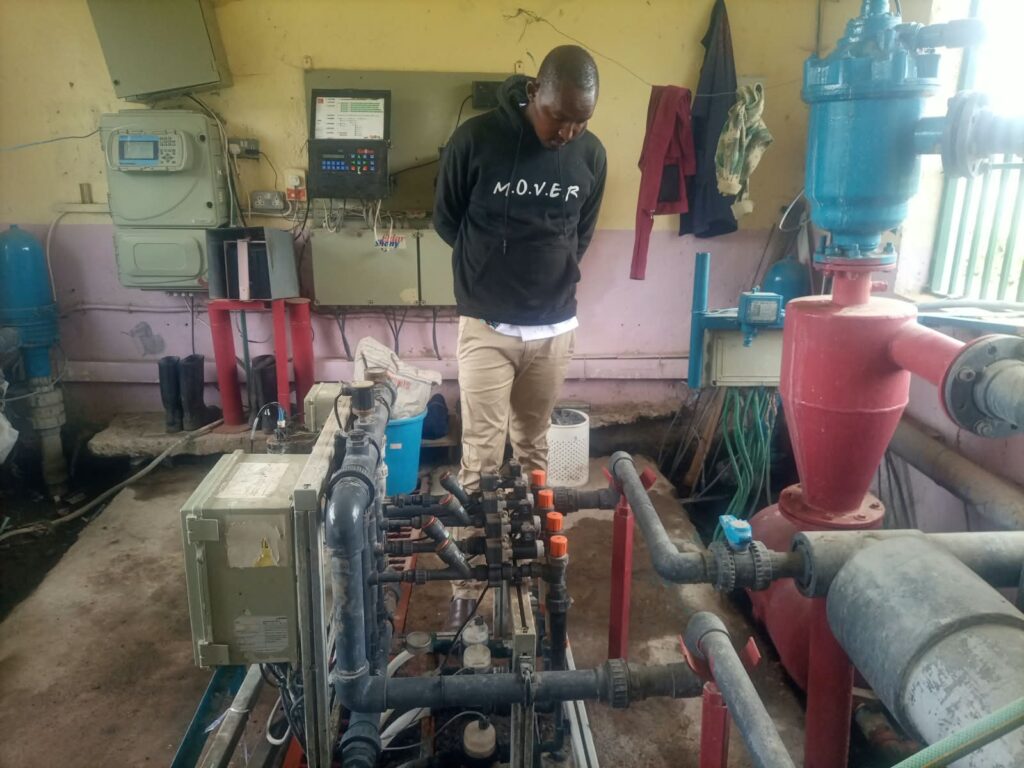
A fertigation unit typically combines a mixing tank, agitator, metering injection pumps, EC/pH instruments, a flow-paced dosing controller, backflow prevention and chemical-compatible valves. Place injection after primary filtration, with suitable mixing and downstream protection. Because dosing must stop when flow stops, interlock the injector to discharge flow and pressure.
At 556 m³/hour and a target of 100 mg/L of fertiliser product, product injection is 55.6 kg/hour. At a stock concentration of 100 kg/m³, that requires 0.556 m³/hour, or 556 litres/hour. This is product dosing, not elemental nutrient dosing. Accordingly, agronomic recipes must account for nutrient grade, water analysis and precipitation compatibility.
Automation and Head Control
Pump staging and variable-frequency control should hold adequate pressure while avoiding excessive head. Monitor flow, pressure, filter differential pressure, reservoir level, energy use and block operation through a PLC/SCADA system or a farm controller. Likewise precision irrigation systems, control valves turn a fixed pump station into a set of independently managed blocks. Moreover, low pressure irrigation rewards that control, since every saved metre of head is saved energy. Without that control, operators raise pressure to fix a distribution problem and pay for it in energy. Consequently, head creeps upward and stays there.
Materials and Commissioning Checklist
- Civil: reservoir excavation, HDPE liner and geotextile, anchor trenches, intake structure, concrete plinths, pump house and valve chambers.
- Mechanical: centrifugal pumps, motors, suction strainers, HDPE/uPVC/steel headers, branch fittings, flange kits, isolation and check valves, air valves, pressure relief and supports.
- Treatment: hydrocyclone where required, media vessels, disc or screen filters, an automatic backwash manifold and waste drainage.
- Fertigation: stock tanks, mixers, dosing pumps, injection assemblies, EC/pH probes and backflow protection.
- Electrical: motor control centre, VFDs or starters, cables, breakers, earthing, low-water interlocks, sensors and the automation controller.
- Commissioning: pressure testing, manifold balancing, flow measurement, pump-curve verification, water quality checks and operator training.
Treat the system as one network: source, reservoir or intake, pump bank, filters, fertigation, mainline, control valves and blocks. Added pumps cannot compensate for undersized suction piping or clogged filters. Thus a low pressure irrigation design must be specified as a whole, which is how we approach irrigation solutions.
Frequently Asked Questions about Low Pressure Irrigation
What is high volume low pressure irrigation?
It is a design approach that delivers a high water volume at a modest operating head. Wide piping, storage and staged pumping replace raw pressure, so the farm meets peak crop demand without overspending on energy.
How much does elevation add to my pressure requirement?
Each 10 m of static rise adds about 0.98 bar. For example, a 25 m rise from the pumping station to a field is roughly 2.45 bar before friction, filtration and emitter pressure are added.
How many filters does a 556 m³/hour system need?
Size for about 640 m³/hour once a 15 percent allowance is applied. At 80 m³/hour per disc filter, eight units meet that duty and a ninth preserves flow during backwash. Confirm against the manufacturer pressure-loss curves and your own water tests.
Can I order pipe by its outside diameter?
No. An OD 400 mm HDPE designation is not the usable bore, and wall thickness changes the flow area. Always select by internal diameter and pressure rating, then check friction losses.
Is reservoir volume just area multiplied by depth?
Not for a side-sloped dam. Use the actual geometry with a stage–storage relationship, then add allowances for unusable depth, evaporation, sediment and operating reserve.
Does low pressure irrigation suit every farm?
It suits farms that can store water and irrigate in blocks. Rather than paying for head, you pay for controlled distribution. Where a borehole has very low yield, storage simply extends the pumping window.
Where to Have High Volume Low Pressure Irrigation Installed in Kenya
Eunidrip Irrigation Systems Ltd surveys, designs, supplies, installs and commissions agricultural water infrastructure. That includes high volume low pressure networks, storage reservoirs, pump stations, filtration plants, drip and sprinkler systems, fertigation and automation. In addition, we commission low pressure irrigation against measured flow and pressure, not against a nameplate. Each supply we lay out is matched to the measured source yield and the surveyed topography, so the design holds in a dry season. Our drip irrigation kits are sized the same way.
Call +254 728 163329 or +254 724 775516, email eunidrip@gmail.com, or use our contact page to arrange a site survey. We issue as-built drawings, maintenance schedules, performance data and safe operating instructions with every commissioning.
Technical note: all calculations here are illustrative. Final installations require site-specific surveys, engineering checks, pump and filter manufacturer verification, and the applicable approvals.